Real life · Black Friday maths
Are Black Friday Deals Really Saving You Money? We Each Saved 30%
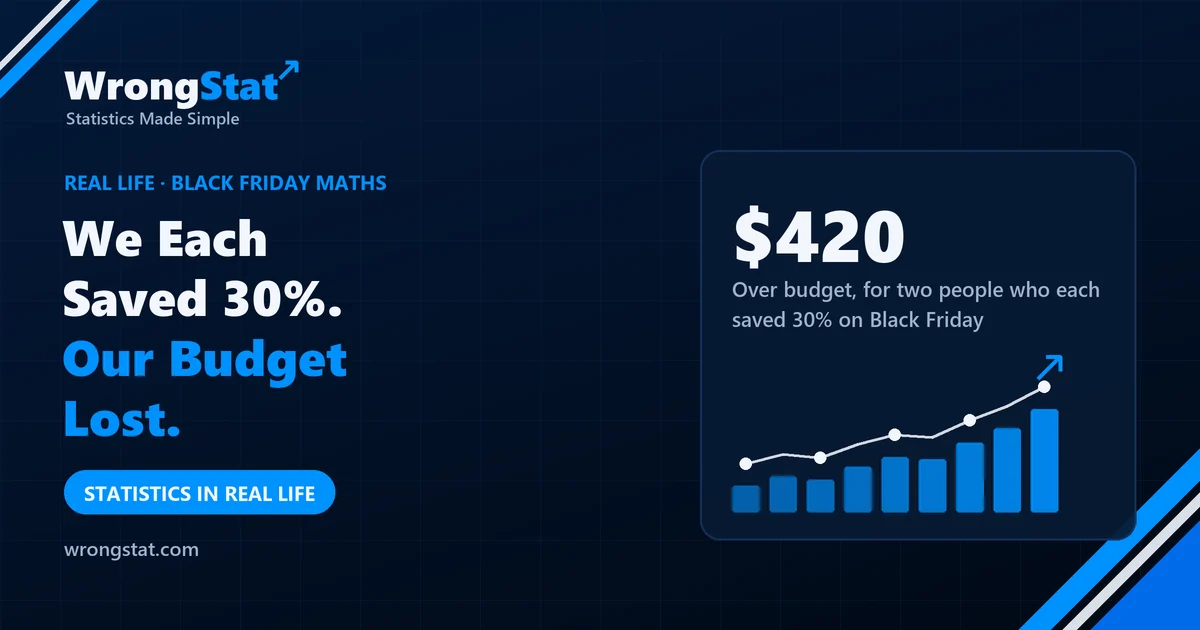
The short version: a discount tells you how much less you paid than the shop's price. It doesn't tell you how much less you spent than you would have anyway. Linda and Gary each saved 30%, and together spent $420 more than planned. Both numbers are true. Real saving only counts on things you were going to buy anyway.
Aunt Linda came back from Black Friday with six bags and a receipt that said "You saved $180". She put the receipt on the fridge, like a school certificate.
Uncle Gary looked at the bank app instead. "We've spent more this weekend than in the whole of October," he said. Linda pointed out that the bags were 30% off. Gary pointed out that the bank doesn't accept percentages.
Then Linda found the box in the garage. Gary had bought a 75-inch TV. It was 30% off. "I saved three hundred dollars," he said, with the same face Linda had made at the fridge.
Everybody's numbers are correct
This is the annoying part. Nobody in this house is lying.
- Linda: six things with a total price of $600, 30% off. She paid $420. The receipt is right: $180 less than the price tags.
- Gary: a $1,000 TV, 30% off. He paid $700. Also right: $300 less than the price tag.
- The bank app: $1,120 gone in one weekend. Right as well.
"Saved" is a comparison, and every comparison needs something to compare with. The receipt compares what you paid with the price tag. The bank compares it with nothing. Neither compares it with the only thing that matters: what you would have spent if there had been no sale.
The comparison nobody made
Before the weekend, Linda needed a winter coat, about $200. Gary needed a new TV because the old one had started showing everything slightly green, and had planned to buy a 50-inch one for $500. So the plan was $700.
| The plan, no sale | What happened | Difference | |
|---|---|---|---|
| Linda's coat | $200 | $140 | $60 saved |
| Linda's other five things | $0 | $280 | $280 spent |
| Gary's TV | $500 (50-inch) | $700 (75-inch) | $200 spent |
| Total | $700 | $1,120 | $420 over plan |
The only real saving was the coat: $60. Everything else was spending that happened because there was a discount. Together they "saved" $480 and spent $420 more than they meant to. Both numbers are true at the same time, and that's not a contradiction. They just answer different questions.
The plan vs Black Friday
Three ways a discount spends your money
- The wrong baseline. The price tag is the shop's number, not yours. If you would never have paid $100 for it, then 30% off $100 isn't a saving of $30. It's a purchase of $70.
- Percentages on a bigger total. 30% off a bigger basket is more dollars "saved" and more dollars spent. The percentage stays the same. The sum grows.
- The upgrade. Gary didn't save on the TV he needed. He got a discount on a more expensive one. A cheaper price on a bigger thing can still cost more than the full price on the right thing.
And the "was" price itself can be the trick: a high price shown next to the real one, to make the real one feel small. That's anchoring, and we did the maths on stacked discounts in Is 50% Off Actually Saving You Money?
How to check your own Black Friday: the two-list test
Before the sale, write down what you need and what you'd pay for it with no discount. That's your baseline. After the sale, sort the receipt into two lists: things that were on your list, and things that weren't.
Your real saving is the difference on the first list only. Everything on the second list is spending, whatever the receipt says. If the second list is longer than the first, the sale worked. For the shop.
Where it costs you money
Investors do the same thing with stocks. A stock that is "30% below its high" feels like a stock on sale. But the old high is the shop's price tag: it tells you what someone paid once, not what the company is worth now. We tested buying stocks after a fall in Does Buying the Dip Work?. Being cheaper than before was not the same as being a bargain.
The moral
Before you celebrate a saving, ask: compared with what? Linda and Gary have now both done the maths. They agree that they spent $420 more than planned. They also agree that it was the other one's fault.
To celebrate how well they understand discounts now, they ordered takeaway. It was 30% off.
Prices are illustrations, and the 30% discount is an example, not a claim about any shop or any sale. Educational content, not financial advice.