Is 50% Off Actually Saving You Money?
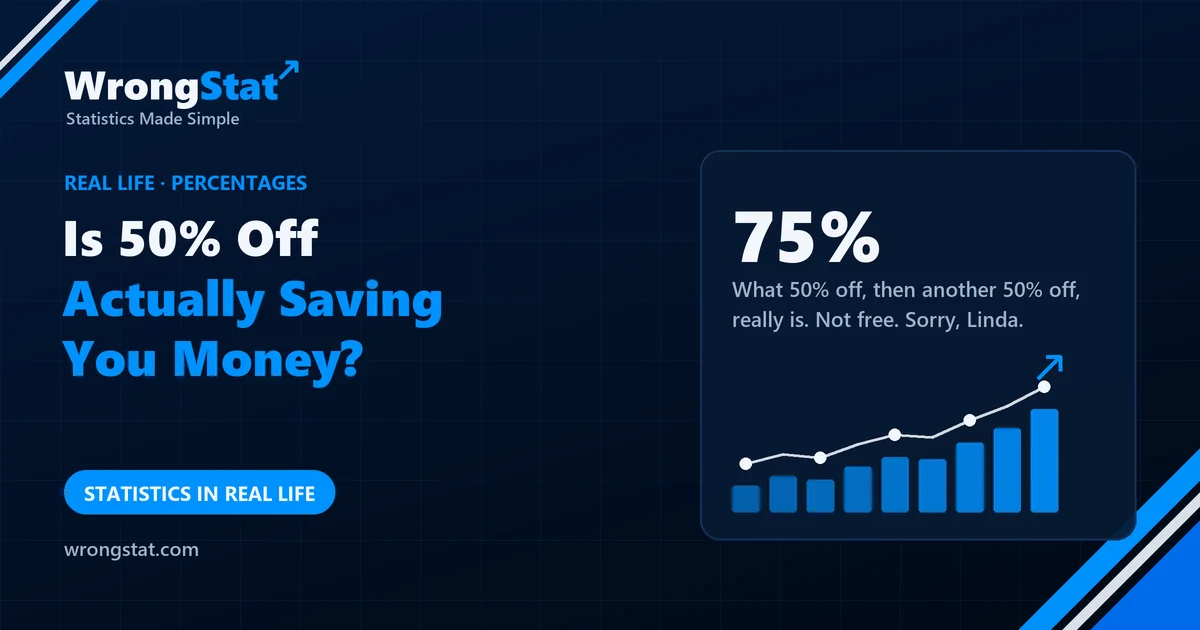
The short version: percentages don't add up the way they sound. 50% off and then another 50% off is 75% off, not free. '20% extra free' is only 16.7% cheaper. And a price that falls 50% has to rise 100% to get back where it was.
Aunt Linda came home from the January sales with a coat that was "50% off, then another 50% off at the till". She announced that it was "practically free".
It was not practically free. It was 25% of the original price, which, as Uncle Gary pointed out, was a price nobody had ever actually paid. Linda pointed out that Gary had once bought a lawnmower because it came with a free hat. The conversation went downhill from there.
Percentages of percentages
The second discount is taken from the already reduced price, not the original one. So:
- $100 coat, 50% off: $50.
- Another 50% off the $50: $25.
- Total discount: 75%. Not 100%. Linda still paid $25.
The same trick works in reverse, and that's the one that costs money. A price that falls 50% and then rises 50% doesn't get back to where it started: $100 becomes $50, and 50% more than $50 is only $75. To recover from a 50% fall you need a 100% rise.
The coat, step by step
Three more shop-floor tricks
| The sign says | What it really means |
|---|---|
| 50% off, then an extra 50% off | 75% off in total |
| 20% extra free | 16.7% cheaper per unit (you pay the same for 1.2 times as much) |
| Buy one, get one free | 50% off, but only if you wanted two |
| Was $100, now $50 | 50% off a price that may have existed for one quiet week in March |
That last one has a name: anchoring. The "was" price is there to make the "now" price feel like a bargain. Whether $50 is a good price for the coat has nothing to do with the number crossed out next to it.
Happy hour, analysed
Kevin's favourite bar does two cocktails for the price of one between 5 and 7. Kevin has calculated that this saves him 50%. In fact, he used to buy one cocktail and now buys two. He spends exactly the same, drinks twice as much, and has started calling it "investing".
A deal only saves money compared with what you would have done anyway. Compared with what the shop wanted you to do, it's working perfectly.
For what happens when two people each "save" 30% on Black Friday, see Are Black Friday Deals Really Saving You Money? We Each Saved 30%
Where it costs you money
Investments work the same way. A stock that falls 50% needs to double just to break even. A fund that is up 10% one year and down 10% the next is not back where it started: it has lost 1%. Losses hurt more than the same-sized gains help, which is why avoiding big losses matters more than chasing big wins.
The moral
Percentages are always "a percentage of something". Before you celebrate, ask: of what? Linda now asks this in every shop. Shop assistants have started recognising her.
Prices are illustrations. Educational content, not financial advice.