Why Does It Always Rain on the Weekend?
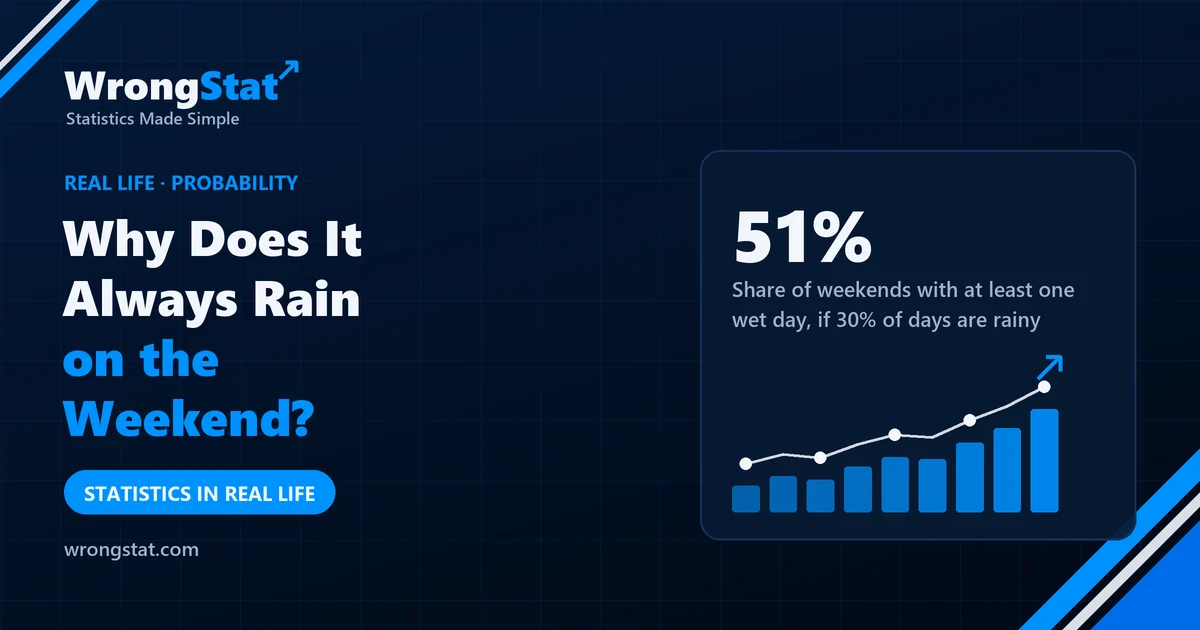
The short version: a weekend is two chances for rain, and one wet day is enough to ruin it. If 30% of days are rainy, 51% of weekends have at least one wet day, so 'it rained at the weekend' is a coin toss before anything spooky happens. Over a 13-weekend summer, three wet weekends in a row happen about 64% of the time. You also notice weekend rain because you planned to be outside, and you don't notice Tuesday's rain from your desk.
Uncle Gary has planned a barbecue every Saturday since May. It has rained on three weekends in a row. Gary has concluded that the weather knows his plans.
His evidence is strong: he has bought charcoal three times and used it once. Aunt Linda notes that it also rained on several Tuesdays, but Gary was at work and does not recognise Tuesday rain as real rain.
A weekend is two chances
Let's say that where Gary lives, about 30% of days have some rain, and each day is a separate roll of the dice. A weekday is one day. A weekend is two, and a single wet day is enough to call it "a rainy weekend".
- Chance that a weekend is dry on both days: 0.7 × 0.7 = 49%.
- Chance that at least one weekend day is wet: 51%.
- Chance that both days are wet: 9%.
So "it rained at the weekend" is a coin toss, even if the weather has no idea what day it is. A 30% daily chance turns into a 51% weekend chance just by counting two days as one event.
Chance of rain, if 30% of days are wet
Three weekends in a row
Gary's three-weekend streak feels like a conspiracy. Over a summer of 13 weekends, with each weekend a 51% chance:
- On average, about 6.6 weekends get some rain.
- The chance of at least three wet weekends in a row somewhere in the summer: about 64%.
Most summers will give Gary exactly the streak he's complaining about. It's the same arithmetic as bad things coming in threes: random things clump.
Why the weekend feels wetter than the week
Even if the numbers were identical, it would still feel worse. On a weekday, rain falls on the office window and the commute. On a weekend, it falls on the plan. You remember the rain that cancelled something, and you forget the rain that only made the car wet. It's the same reason the other queue always feels faster: memory files events by how annoying they were.
Birthdays work the same way. If there's a 30% chance of rain on your birthday, over ten birthdays the chance that at least three of them are rainy is about 62%. That's enough to build a lifelong theory on.
Is there a real weekend rain effect?
Scientists have actually looked. Some studies have searched for a weekly rain cycle, on the idea that weekday traffic and industry pollution might nudge clouds. The results have been mixed and, where an effect has been reported, it's small and limited to certain regions and seasons. Nothing close to "always". The coin toss and the memory do almost all of the work.
How to check your own weather curse
1. Compare days, not events. Count the share of Saturdays that were wet and the share of Tuesdays. If they're similar, the weekend isn't special.
2. Write it down for a season. Every day, wet or dry, not just the days you had plans.
3. Remember that a weekend is two days. A fair comparison for "rainy weekend" is "rainy Monday or Tuesday", not "rainy Monday".
Where it costs you money
"The market always falls on Mondays" and "it always drops after I buy" are weekend-rain theories. Some calendar effects have been studied seriously, and many fade or vanish once people look at more data and count the days they didn't remember. The test is always the same as for the weather: count every day, not the ones that annoyed you.
The moral
Linda kept a calendar for the summer. Saturdays: 31% wet. Tuesdays: 29%. Gary studied the calendar and said this proves the weather is even cleverer than he thought, because it's covering its tracks. He has now planned the barbecue for a Tuesday. It was lovely. He was at work.
The 30% daily chance is an illustrative assumption and the calculations treat days as independent; real weather comes in spells, which makes wet streaks somewhat more likely, not less. Educational content, not financial advice.