Why Do Bad Things Happen in Threes?
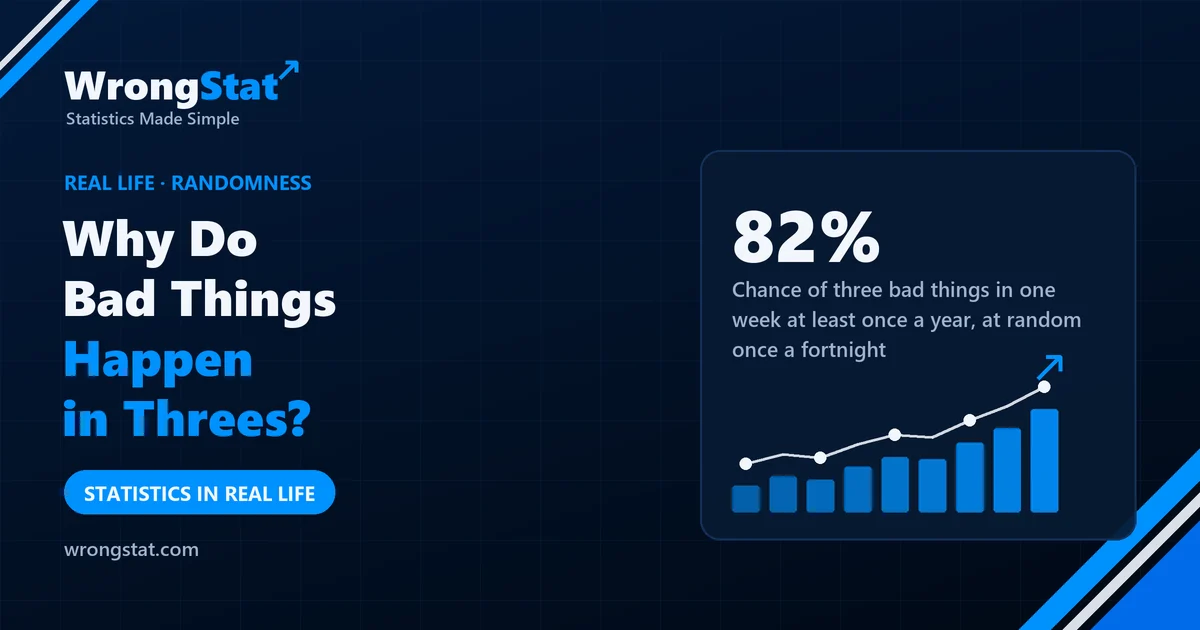
The short version: random doesn't mean evenly spaced, it means clumpy. If bad things happen at random about once every two weeks, there's an 82% chance that at some point in the year three of them land in the same week, and about 40% of them arrive less than a week after the last one. The rule of three also cheats: you stop counting at three, the time window stretches to fit, and the fourth starts a new set.
On Monday Uncle Gary's car wouldn't start. On Wednesday the boiler stopped working. On Friday Aunt Linda's phone fell into a pot of soup, which was, everyone agreed, the most interesting of the three.
"That's three," said Gary, with relief. "Bad things come in threes. We're done."
The following Tuesday the dishwasher flooded the kitchen. Gary looked at it for a long time and announced that this was the first of the next three.
A rule that can't lose
Look closely at how the rule of three works, because it's built to be right.
- You stop counting at three. Nobody says "bad things come in fours", because nobody keeps counting after the third.
- The time window stretches. Three bad things in a week counts. So does three in a month. So, if necessary, does three in a year.
- "Bad thing" stretches too. A broken boiler counts. So does a parking ticket, if you're one short.
- The fourth starts a new set. The rule is never broken. It just begins again.
A rule that can explain any outcome isn't predicting anything. It's narrating. Gary's rule has a perfect record, which is the first sign something is wrong with it.
Random doesn't mean evenly spaced
But there's a second, more interesting reason bad things seem to come in bunches: random events clump. Our intuition expects random things to arrive neatly spread out, one every so often. They don't.
Suppose household bad things happen completely at random, with no connection between them, about once every two weeks on average: 26 a year. We simulated 100,000 such years:
| What happens in a year of purely random bad luck | Result |
|---|---|
| Chance of three bad things within 7 days at least once | 82% |
| Bad things that arrive less than a week after the previous one | 40% |
| Months with nothing bad at all, on average | 1.4 |
If bad luck were evenly spaced, it would arrive every two weeks like a bill, and three in a week would never happen. Real randomness gives you terrible weeks and suspiciously quiet months. Nobody ever says "good things come in quiet months", but the same arithmetic produces both. Seeing meaning in those clumps is called the clustering illusion.
One year, 26 bad things, two ways
Sometimes the three really are connected
To be fair to Gary, not every cluster is chance. A storm can break the fence, block the gutter and dent the car in one night. A cold snap can kill the boiler and the car battery in the same week. When one cause produces several problems, the bad things aren't coming in threes. It's one bad thing with three invoices.
That's worth knowing, because it changes what you do. Random clumps need patience. Connected ones need you to find the cause. Linda's soup, for the record, was random.
How to check your own luck
1. Fix the window and the definition first. "Three things costing over $100 within seven days" is a test. "Three bad things, sometime" is a horoscope.
2. Count the quiet weeks too. If you only record the bad weeks, every year looks cursed.
3. Look for a shared cause. Weather, age, one careless afternoon? Then it's one problem, not a pattern.
Where it costs you money
Markets do both things at once. Big moves really do cluster: nervous periods have many large days and calm periods have few, so bad days there are genuinely connected. But "three down days in a row, so tomorrow must be up" is the opposite mistake, expecting the coin to balance itself. Telling a real cluster from a random clump takes data and a test set up in advance, not a saying.
The moral
Linda started a list. Over the year, 26 bad things, logged with dates. Three in one week happened twice. Two months had nothing at all, and nobody threw a party, because nobody notices the absence of a broken boiler. Gary read the list and said it proves his rule. Linda asked which part. He said all of it.
The simulation assumes bad things happen independently and at a steady average rate of 26 a year, which is the definition of pure chance used here. Real problems are sometimes connected, which makes clusters more likely, not less. Educational content, not financial advice.