Why You Always Pick the Slowest Queue
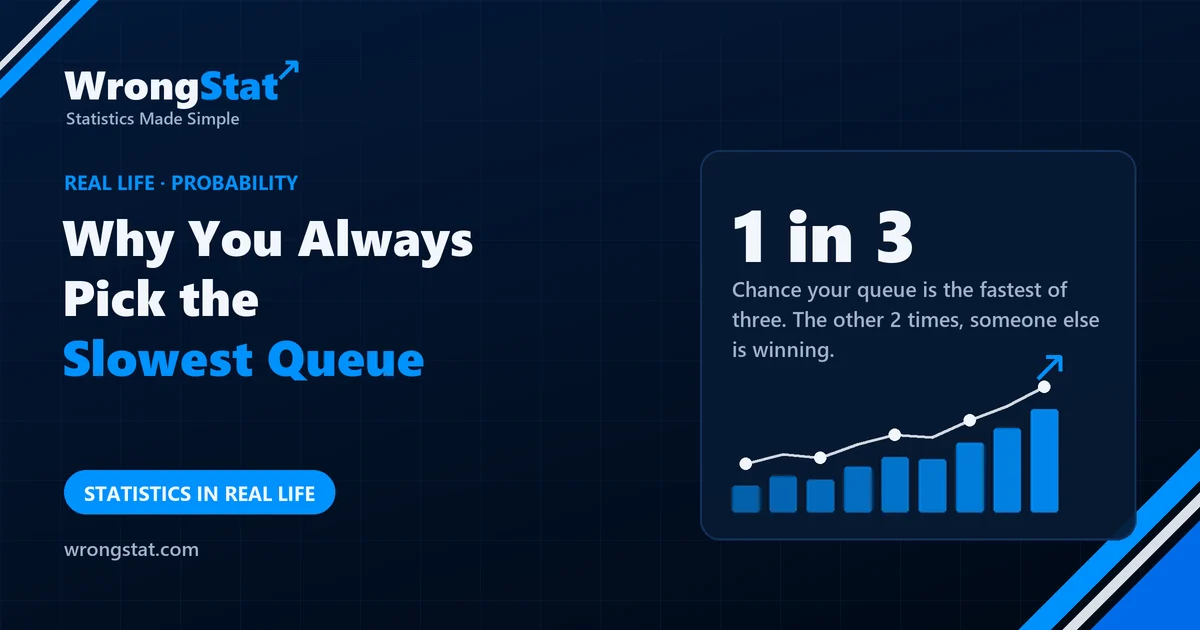
The short version: with three queues, yours is the fastest only one time in three. Two times out of three, at least one other queue is beating you, and you're watching it. You're not unlucky. You're outnumbered.
Uncle Gary is buying beer for the barbecue. There are three tills open. He studies them like a chess grandmaster, counts the items in every basket, and joins the shortest queue.
The woman in front of him has a coupon from 2019, a price that won't scan and a strong opinion about both. The other two queues empty twice. Gary switches queues. The new till runs out of receipt paper.
"I always pick the slowest queue," says Gary. He's not wrong. He's just not special.
The maths of the slow queue
Assume Gary picks well and his queue is as good as any other. With three queues, each one has the same chance of being the fastest. So:
- Gary's queue is the fastest: 1 time in 3.
- Some other queue beats him: 2 times in 3.
- With four tills open, he wins only 1 time in 4. With ten, 1 time in 10.
Most of the time, somebody else is winning. And you can see them, which makes it worse.
Chance your queue is the fastest
Why it feels even worse than the maths
Nobody remembers the times their queue moved quickly. You were too busy packing your bags. You do remember standing still while a stranger with a full trolley sails past. Your brain keeps a very unfair record, and the sample it remembers is mostly the bad days.
Switching doesn't fix it either. The moment Gary changes queue, the new one has the same odds as the old one, plus the cost of starting again at the back.
The better system: one queue
Many banks, post offices and airports use a single shared queue that feeds every desk. Nobody can get stuck behind the one slow customer, because the next free desk takes whoever is next. Queueing maths agrees: pooling everyone into one line gives a shorter average wait and far fewer horror stories. Supermarkets mostly don't do it, partly because a long single queue looks worse, even when it moves faster.
Where it costs you money
Investors do the queue-switching thing too. There is always some other stock, fund or strategy that did better than yours last month. Jumping to it after the fact usually means joining the back of a queue that has already moved. With hundreds of options, something will always be beating you, and that tells you nothing about what comes next.
The moral
You're not cursed. You're one queue out of several. Gary now joins any queue and reads the labels on his beer. Waiting times are unchanged. Blood pressure is down.
Assumes the queues are equally fast on average and you can't tell which one will move first. Educational content, not financial advice.