Myth #2 · AI and the news
Can AI Predict Stock Prices From the News? We Asked It 599 Times.
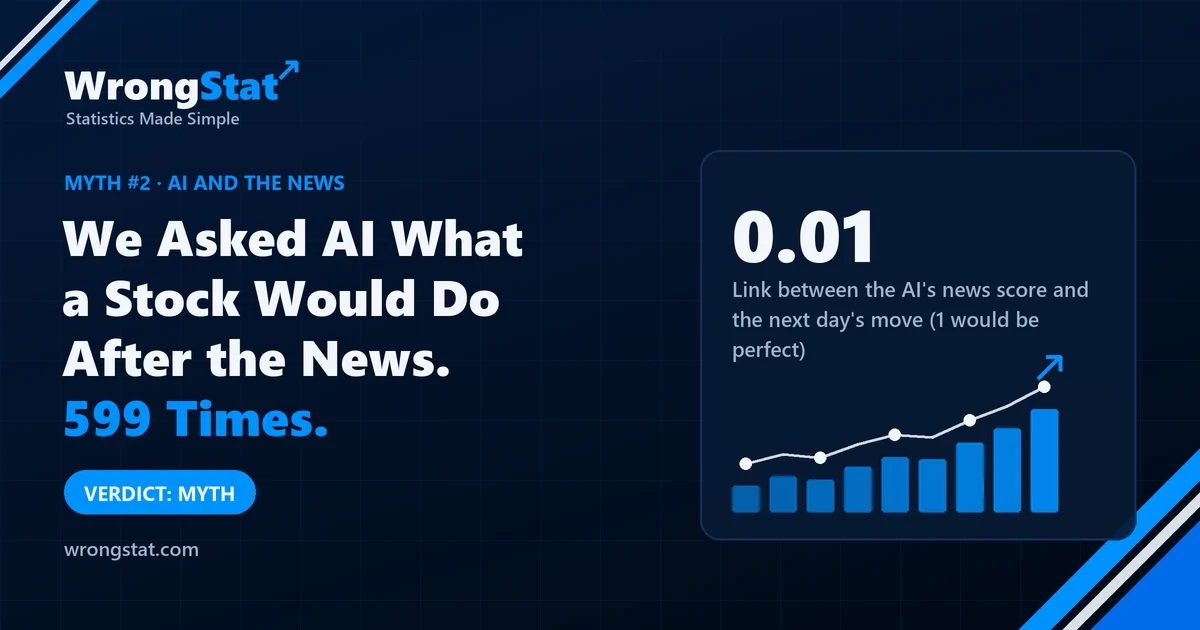
Verdict: myth. An AI model read 599 real company news stories and judged whether each one was good for the stock. Its judgements had essentially zero link with what the price did next. We asked three different ways. Same answer every time.
Cousin Kevin has a new system. Every morning he pastes the latest headlines into an AI chatbot and asks: "Will this stock go up?"
The chatbot always answers. It never says "I don't know". Kevin finds this very reassuring.
So we did what Kevin does, 599 times, and then checked what the stocks actually did.
What we tested
- 599 real news stories about US companies, headline plus summary, picked at random from a month of news (30 August to 29 September 2026) covering 531 companies.
- An AI language model built for yes or no judgements read each story and gave a probability: how likely is this news to push the price up?
- The truth: what the stock actually did over the next 1 and 3 trading days, measured from the first close after the story came out. No peeking at the future.
- We ran it first on 299 stories. Then, separately, on 300 fresh stories it had never seen.
- Then we took the same 599 stories and asked two other questions: "Does this news sound positive for the company?" and "Is this news good for someone who already owns the stock?"
What we found
The first round looked exciting. When the AI said "up", the stock rose the next day 62% of the time. When it said "down", only 49% of the time. The usual rate on those days was 52%. A statistical test said a result this good would happen by pure luck only about 1 time in 37.
We nearly got excited. Then we ran it again on 300 new stories. "Up" calls: 49%. "Down" calls: 47%. The usual rate: 47%. The edge was gone.
Across all 599 stories, the correlation between the AI's score and the next day's price move was 0.01. Over three days, 0.03. A correlation of 1 would be perfect prediction. Zero means no link at all.
| What we asked the AI | Link with next day | Link with next 3 days |
|---|---|---|
| Will the price go up? | 0.01 | 0.03 |
| Does this news sound positive? | 0.02 | 0.01 |
| Is it good for someone who owns the stock? | 0.00 | -0.01 |
Three different questions, one answer. The questions mean very different things. The AI's answers to them did not: they were correlated 0.72 to 0.77 with each other. Whatever we asked, the model told us roughly the same thing: how nice the headline sounded. And how nice a headline sounds tells you nothing about tomorrow's price.
How often the stock rose the next day
Why it doesn't work
Big news moves prices within minutes, often seconds, of being published. By the time a story is sitting in a news feed, the price has usually already moved. The AI can read perfectly well. It just arrives after the party.
Statistics for noobs: why we test twice
The first 299 stories produced a result that passed a standard statistical test. If we had stopped there, this would be a very different article, probably with a "buy my AI trading course" button at the bottom.
Exciting results from one sample often don't survive a second one. That's why every promising result gets a fresh batch of data before we believe it. This one didn't make it.
The moral
AI models are excellent at reading. But reading the news isn't the hard part of investing: by the time you've read it, so has everyone else, and the price already knows. A chatbot that says a stock will go up because of a headline is telling you how the headline sounds, with great confidence.
Kevin has since asked the chatbot whether he should stop asking the chatbot. It said that was a great question.
What this test can't tell you
- One month, one model. We used news from September 2026 and one AI model. Other models or other periods might differ, although a promising result vanishing on fresh data is not a good sign.
- Daily prices only. We measured from the first close after publication, not the minutes after the headline. Professional traders who react in seconds play a different game.
- US companies only.
Analysis of historical data, not real trades. 599 news stories about US companies, sampled from September 2026 news covering 531 companies; price moves measured over 1 and 3 trading days from the first close after publication. Results from a first sample of 299 stories did not replicate on a second sample of 300. Historical results do not guarantee future returns. This is educational content, not financial advice.