More Fire Engines, More Damage: Gary's Plan to Save Money on Fires
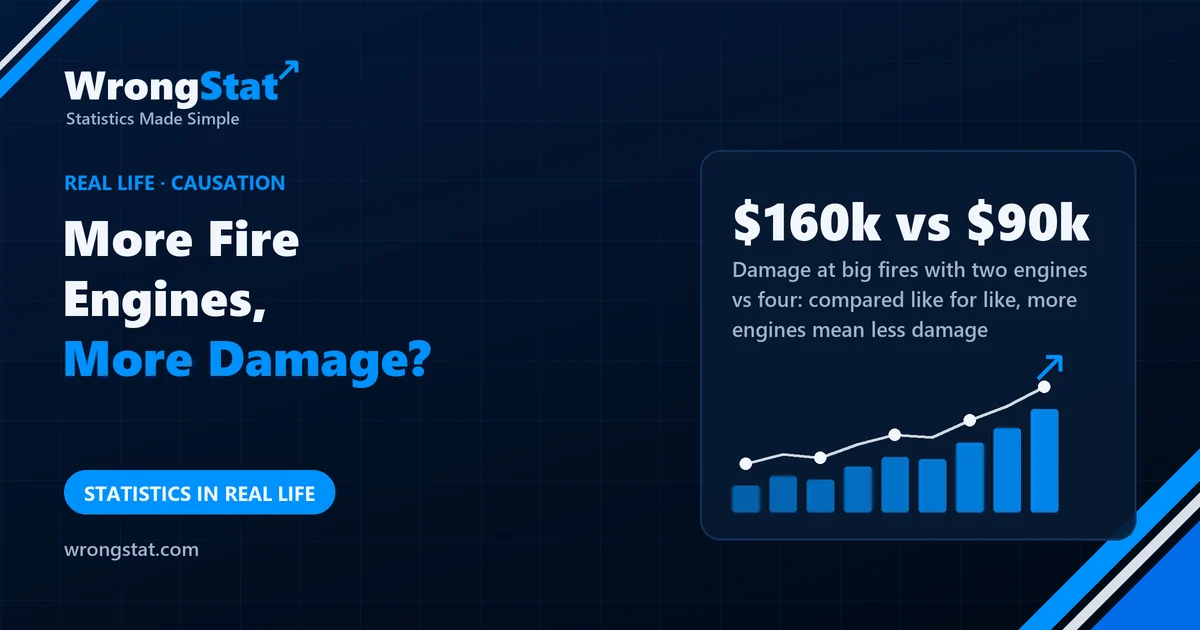
The short version: fires with four engines cause far more damage than fires with one, but the engines aren't the cause. Big fires bring more engines and do more damage, so fire size drives both. Compare like with like (big fires with two engines against big fires with four) and more engines means less damage. When two things move together, check for a third thing behind both, and for cause and effect running the other way.
Uncle Gary has joined the parish council's finance committee and has been reading the fire brigade's annual figures. He noticed a pattern. Fires attended by one engine caused about $2,000 of damage on average. Fires attended by four engines caused about $90,000.
"It's obvious," Gary told the committee. "The more engines they send, the more damage gets done. Send one engine to everything. We save on engines and we save on damage." The committee was impressed. The chairman asked whether it might be even cheaper to send none. Gary said he didn't want to be extreme.
That evening, Old Ted's shed caught fire. The shed contained Ted's cider still, which the fire brigade later described as "an accelerant with a door". Under the new policy, one engine attended.
What the numbers show
Here's the brigade's year, with illustrative numbers:
- Small fires, usually one engine: about $2,000 of damage.
- Medium fires, usually two engines: about $15,000.
- Big fires, usually four engines: about $90,000.
More engines, more damage. The correlation is real and strong. Gary's reading of it is backwards.
The third thing behind both
The brigade doesn't send four engines at random. It sends four engines to big fires. Big fires do more damage. The size of the fire causes both the number of engines and the amount of damage, so the two rise together without either causing the other. Fire size is a confounding variable: a hidden third factor that makes two things look connected.
And part of the arrow runs the other way. The damage, or rather the fire that's doing it, is why the extra engines were called. Gary has the cause and the effect swapped, which is a bit like noticing that people in hospital are ill and closing the hospital.
The comparison that tells you something
To see what engines actually do, compare fires of the same size. Look at big fires only. Some got four engines; some, because engines were busy elsewhere, got two.
- Big fires with four engines: about $90,000 of damage.
- Big fires with only two engines: about $160,000.
Within the same size of fire, more engines means less damage. The overall pattern and the like-for-like pattern point in opposite directions. Only one of them is about engines. It's the same trap as "ice cream sales and drownings both rise in summer", or "umbrellas cause rain".
Average damage per fire (illustrative)
How to read a correlation
1. Look for a third thing. Is there something, like fire size, the weather or age, that could drive both?
2. Try the arrow both ways. Does A cause B, or does B cause A? Engines don't start fires; fires summon engines.
3. Compare like with like. Split the data by the third thing and see whether the pattern survives. Better still, compare against a control group that's similar in every way except the one you're testing.
Where it costs you money
"Companies that spend more on advertising have higher sales" sounds like advertising works. It might. But big companies both sell more and advertise more, and companies with rising sales can afford bigger budgets. Most investment claims of the form "X goes with higher returns" have a fire size hiding somewhere. That's why our tests compare each strategy with the market and with random stocks over the same dates.
The moral
The single engine arrived at Old Ted's shed and was overwhelmed by the still. A second engine was called, then a third, then a fourth. The damage came to about $40,000, most of it to the shed and some of it to the second engine. At the next meeting, Gary pointed out that the fire had needed four engines and caused a lot of damage, which proved his point. The committee has reinstated the old policy. Old Ted has rebuilt the shed, with a door that opens outwards for the fire brigade's convenience.
All fire figures are illustrative. Educational content, not financial advice.