Do You Really Need 10,000 Steps a Day? Where the Number Came From
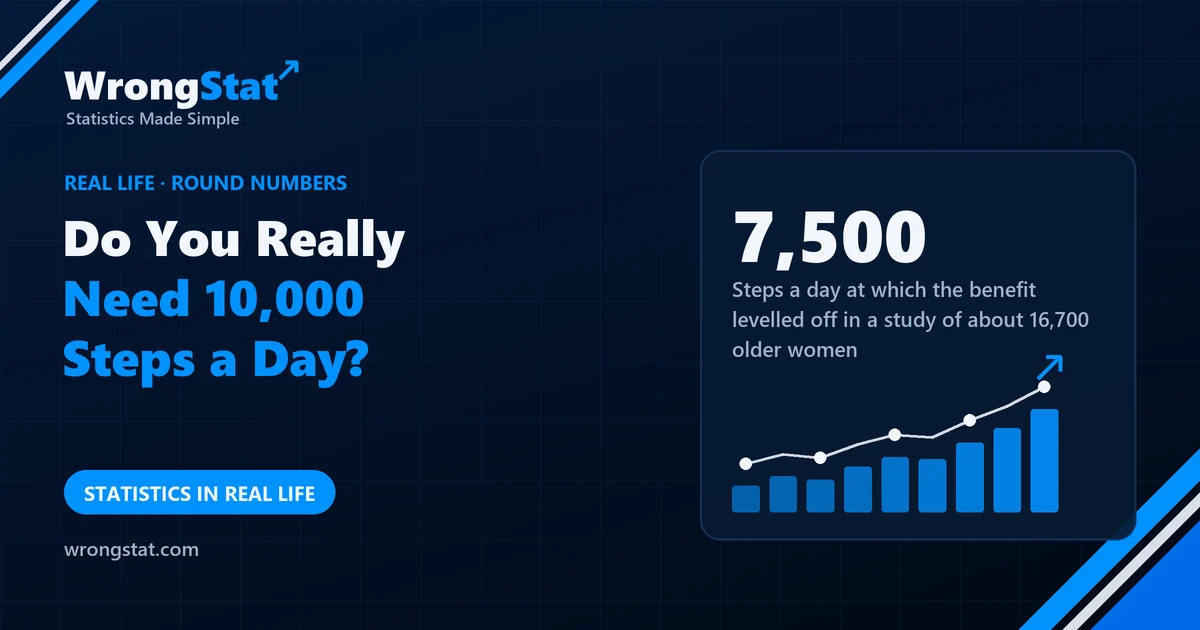
The short version: 10,000 steps began as a marketing name, not a medical finding: a 1960s Japanese pedometer was called the manpo-kei, the '10,000-step meter'. In a 2019 study of about 16,700 women averaging 72, those taking around 4,400 steps a day had lower death rates than those taking 2,700, and the benefit levelled off around 7,500. A 2022 analysis of 15 studies found benefits levelling off at about 6,000 to 8,000 steps for over-60s and 8,000 to 10,000 for younger adults. More walking helps; the magic number is a slogan.
Aunt Linda's smartwatch has one goal: 10,000 steps. When she reaches it, the watch vibrates, shows fireworks and calls her a champion. Last Tuesday she went to bed on 9,960. The watch showed a small sad face.
Linda got out of bed and walked round the kitchen table until the fireworks came. Uncle Gary watched from the doorway and said that if forty steps around a table were worth getting out of bed for, he wanted to know what the forty steps had done for her health. Linda said: "Nothing. But the face has stopped."
Where 10,000 came from
Not from a medical study. In 1960s Japan, a pedometer went on sale under the name manpo-kei, which means "10,000-step meter". Ten thousand is a round, cheerful number. The name stuck, the number spread, and decades later it became the default goal on fitness trackers worldwide.
That doesn't make it wrong. It means nobody chose it by looking at health data. It's an anchor: a number that arrived first and shaped every number after it.
What the research found
In 2019, researchers led by I-Min Lee published a study in JAMA Internal Medicine of about 16,700 women with an average age of 72, who wore step counters for a week and were followed for about four years.
- Women taking about 4,400 steps a day had lower death rates than those taking about 2,700.
- The benefit grew with more steps, then levelled off at about 7,500.
- Walking faster made no extra difference once the number of steps was accounted for.
A 2022 analysis in The Lancet Public Health, pooling 15 studies, found a similar shape: benefits levelling off at around 6,000 to 8,000 steps a day for people over 60, and 8,000 to 10,000 for younger adults. So 10,000 isn't a cliff edge. It's somewhere on a slope that's steep at the start and flat at the top.
Death rate compared with the least active group (= 100)
A study you can't run on yourself
One more caution: these studies observe people; they don't assign them steps. People who walk more may also be healthier to start with, which is a confounding variable in trainers. The researchers adjust for known health differences, but the honest summary is "more walking goes with living longer, especially going from very little to some", not "step 9,961 adds a day to your life".
How to treat a round-number target
1. Ask where it came from. A study, a committee or a marketing department? Round numbers are often the last.
2. Look for the shape, not the line. Benefits usually build gradually and level off. The biggest gain is often at the bottom: from very little to some.
3. Don't let the target replace the goal. Forty steps round a table to please a watch is the number winning and the point losing.
Where it costs you money
Investing has its own round-number anchors: "sell when it's up 20%", "keep 10% in cash", "a 4% withdrawal rate". Some have research behind them; some are rules of thumb that became gospel. Before you organise your money around a round number, ask where it came from and what the evidence looks like on either side of it.
The moral
Linda changed the watch's goal to 7,500. On the first day, the watch reached 7,500 at three in the afternoon and showed fireworks. Linda felt wonderful and went for a walk anyway, because the weather was nice. She did 11,000 steps. The watch, which had already celebrated, said nothing. Linda says it's the best relationship she's had with a gadget.
Study details are summarised from Lee et al. (JAMA Internal Medicine, 2019) and Paluch et al. (The Lancet Public Health, 2022); results are associations from observational studies. This is not medical advice. Educational content, not financial advice.