The Sunk Cost Fallacy: The Sunk Cost Fallacy: Gary's Camper Van Will Pay for Itself
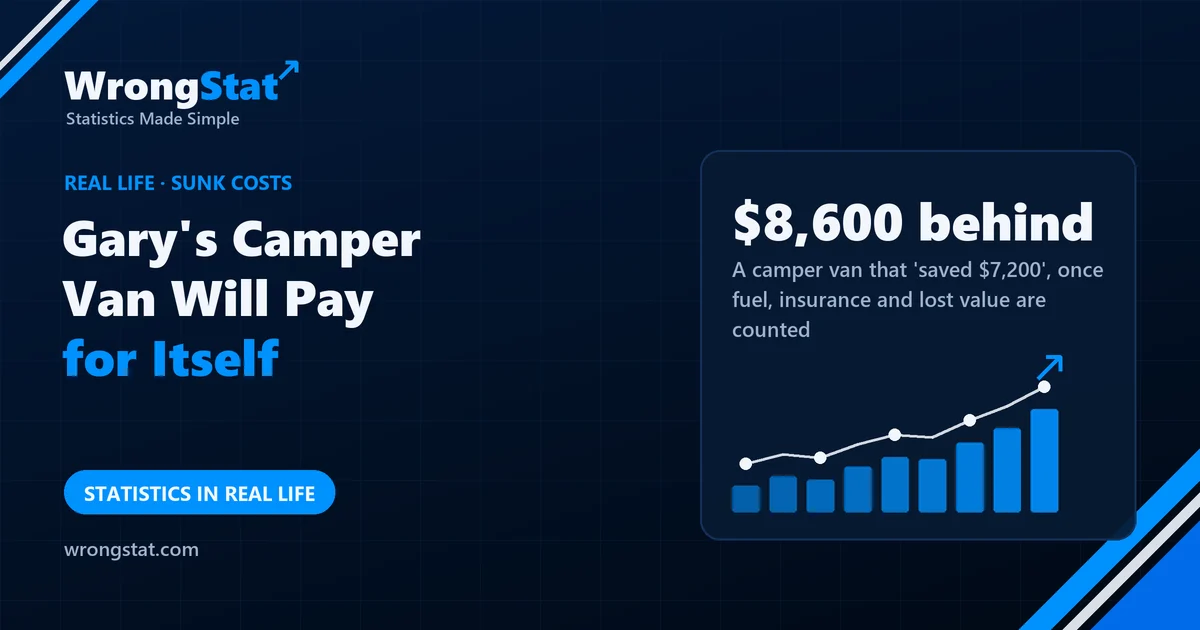
The short version: money already spent is gone whatever you do next, so 'I'll sell when it has paid for itself' is a rule about the past steering the future. Gary's van 'saved' $7,200 on hotels; counted honestly, it's $8,600 behind after three years and loses about $1,300 a year at two trips a year. The only useful question: would you buy it today, at today's price?
Three years ago Uncle Gary bought a camper van for $18,000. He explained the purchase to Aunt Linda with a calculation, which is how most of Gary's worst decisions are introduced.
"A week in a hotel costs us $1,200. The van costs $18,000. Fifteen trips and it has paid for itself. After that, every holiday is free."
Linda asked when he planned to sell it. Gary said: when it has paid for itself. Linda asked when that would be. Gary said: when they use it more. Linda asked why they don't use it more. Gary said he has to work Saturdays to cover the insurance. The insurance is for the van. Linda stopped asking. The circle was closed and, like the van, it was not going anywhere.
Gary's spreadsheet
Three years and six trips later, Gary's tally says the van has saved 6 × $1,200 = $7,200. That's 40% of the price. He has a chart. It goes up.
Linda did the same sum with the things Gary had left out:
| Gary's count | Linda's count | |
|---|---|---|
| Hotels saved | 6 trips × $1,200 = $7,200 | 3 trips × $1,200 = $3,600 |
| Extra fuel | not counted | 6 × $300 = $1,800 |
| Insurance, servicing, storage | not counted | 3 years × $1,800 = $5,400 |
| Value lost | not counted | bought for $18,000, worth $13,000 now: $5,000 |
| Result | 40% paid off | $8,600 behind |
Why only three trips of hotel savings? Because three of the six trips were "giving the van a run": weekends at a campsite 40 minutes from home that nobody would ever have booked a hotel for. A saving on a hotel you were never going to book is not a saving. It's a story about a hotel.
That's the first lesson, and it's a statistical one: a saving only exists compared with what would have happened otherwise. Gary compared the van with holidays they would never have taken.
After three years: the same van, counted twice
Will it ever pay for itself?
Let's be generous and look forward, with two real trips a year. Assume the van loses about 10% of its value each year, so roughly $1,300 next year.
- Each real trip saves $1,200 on a hotel and costs $300 in extra fuel: $900 net.
- Two trips a year: $1,800.
- Insurance, servicing and storage: $1,800 a year. Lost value: about $1,300.
- Total: $1,300 behind, every year.
At two trips a year, the van pays for itself in exactly never. Just to break even on the yearly costs it needs about 3.4 trips a year, so four, and that's before it has paid back a single cent of the $18,000. Gary is currently doing two, and one of them is to the campsite 40 minutes away.
The $18,000 that doesn't matter
Here is the uncomfortable part. Gary's question, "has it paid for itself yet?", is about the past. The $18,000 is gone whatever he does next. Keeping the van won't bring it back, and selling it won't lose it a second time. Economists call money like this a sunk cost, and letting it steer your next decision is the sunk cost fallacy.
The only real question is about the future, and it has two options:
- Sell now: get about $13,000.
- Keep it one more year: about $1,300 worse off, plus whatever the trips are worth to the family as trips.
Notice what isn't on either line: the price Gary paid. A good test is to ask: if I didn't own this, would I buy it today, at today's price? Linda asked Gary whether he'd pay $13,000 for this van today. Gary said, "For that heap? Never." Then he heard himself.
Gary is not completely wrong
In fairness to Gary: the trips are fun, and fun is worth money. If the family loves the van and would gladly pay $1,300 a year for it, keeping it is a perfectly sensible hobby. The mistake isn't owning a van. It's calling it an investment, and refusing to sell until it reaches a number it can't reach.
How to spot a sunk cost
1. Find the past in the sentence. "We've already spent…", "I'm not selling until it's paid back…", "after everything we've put in…". If the reason is about the past, it's probably a sunk cost.
2. Ask the today question. Would you buy it, start it or join it today, at today's price, knowing what you know now?
3. Name the "otherwise". A saving or a gain is always compared with something. Say out loud what would have happened without it.
Where it costs you money
"I'll sell when it gets back to what I paid." The stock market doesn't know what you paid, just as the van doesn't. The price you bought at is your $18,000: gone, and irrelevant to whether the stock is worth holding from today. Waiting to get back to it can also take a long time: a stock that has fallen 50% needs to rise 100% just to return to where it was. The useful question is the today question: would you buy this, at this price, now?
The moral
Gary has not sold the van. He has, however, stopped saying it will pay for itself. He now says it has "sentimental value", which Linda points out is the first honest number in the whole spreadsheet.
Linda made her case against the van over dinner at a restaurant she didn't like, while finishing a dessert she didn't want, because they'd already paid for it.
The prices, running costs and 10% yearly loss of value are illustrative assumptions, not market data. Real costs and resale values vary a lot. The logic (ignore what's already spent, compare the options in front of you) doesn't depend on the numbers. Educational content, not financial advice.