Corporate life · Goodhart's law
How Many Meetings Could Have Been Emails?
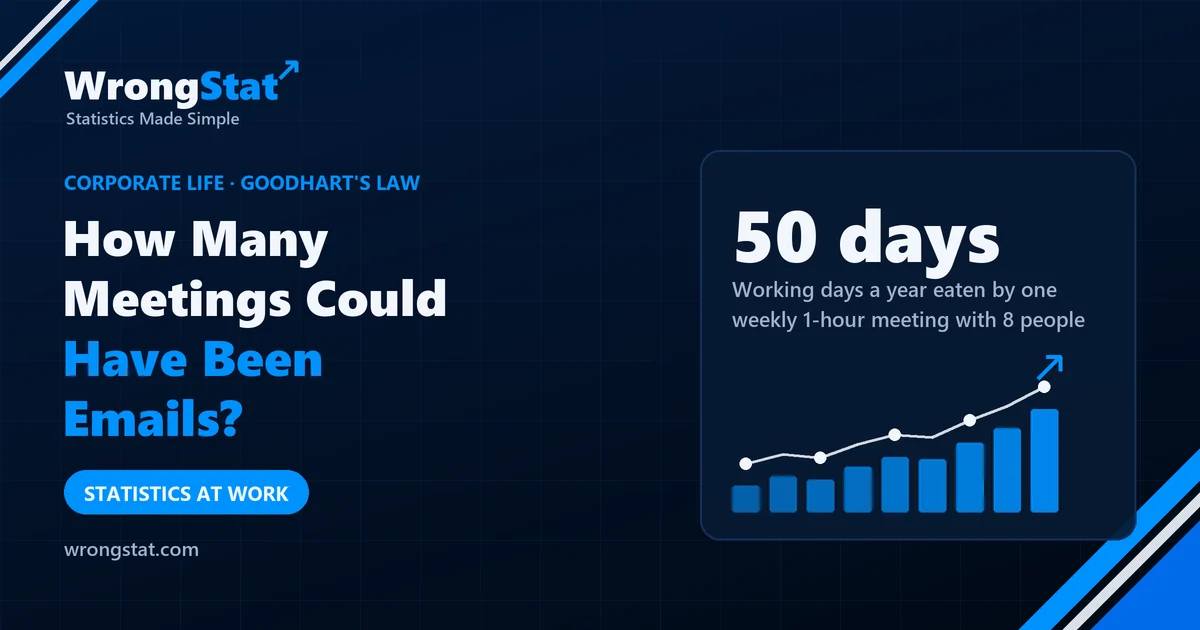
The short version: one weekly one-hour meeting with 8 people uses up about 50 working days a year, one person's entire quarter. But the fix is not to count meetings. The moment a number becomes a target, people start gaming it. That's Goodhart's law.
Cousin Kevin's company decided it had too many meetings. Management set a target: 30% fewer meetings by the end of the quarter.
The target was hit in three weeks. Nobody had fewer meetings. They were simply renamed "syncs", "huddles" and "quick catch-ups", none of which counted. Kevin now attends a 45-minute quick catch-up every morning.
Then the company decided to measure productivity by the number of emails sent. Kevin now replies "Thanks!" to every email he receives, and his productivity has never been higher.
First, the honest maths
Meetings are expensive because their cost is hidden: everyone in the room is paying with their time at once.
- One meeting, 8 people, 1 hour: 8 person-hours. That's one full working day.
- Once a week, for about 50 working weeks: 400 person-hours, or 50 working days a year.
- That's one person's entire quarter, spent on a meeting where three people talk and five check their email.
Some of those meetings are worth it. The question is whether anyone checked.
One working year: 250 days
Then, the trap: Goodhart's law
Economist Charles Goodhart noticed something that is now usually summarised as: when a measure becomes a target, it stops being a good measure.
Counting emails was a reasonable way to see how busy people were, right up until people were rewarded for sending them. Counting meetings was a fine way to spot a problem, until the count became the goal. People are very good at moving a number without moving the thing it was meant to measure.
| Target | What people actually do |
|---|---|
| Fewer meetings | Rename meetings |
| More emails sent | Reply "Thanks!" to everything |
| Shorter call-centre calls | Hang up on difficult customers |
| More points at the pub quiz per correct answer | Uncle Gary writes five answers to every question |
Where it costs you money
Trading strategies get Goodharted too. Optimise a strategy for win rate and you can get 90% winning trades, each making a little, plus one loss that wipes out the year. The win rate looks wonderful. The account does not.
That's why we never judge a strategy by one number. We look at the result after costs, against a random stock and against the market, all at once.
The moral
Measure things to understand them, not to reward them, or you'll get exactly what you measured. Kevin's company has now replaced the email target with a "collaboration score". Kevin has already found three ways to beat it.
The meeting maths assumes about 50 working weeks a year and an 8-hour working day. Educational content, not financial advice.