Is Working From Home More Productive? What Happened When They Tossed a Coin
The short version: you can't answer this by comparing people who work from home with people who don't, because they chose differently for a reason. Two experiments decided by birthday instead. In call centres, staff sent home for nine months performed 13% better and quit half as often. In a 2024 study of 1,612 office workers, two days a week at home made no difference to performance reviews or promotions over two years, and quitting fell by about a third. That's not proof that home is better for every job; it's proof that the comparison in the office kitchen doesn't count.
Report from the third floor. Cousin Kevin's boss has noticed that people who work from home answer emails more slowly. He has noticed this twice, both times on a Friday. He has concluded that working from home doesn't work.
Kevin has noticed that he personally gets more done at home, where nobody stops by his desk to ask whether he got the email about the meeting about the email. He has concluded that working from home does work.
Both of them have examples. Neither of them has a control group. The argument is now in its third year.
Why the obvious comparison doesn't work
The tempting method is to compare people who work from home with people who come in. But nobody was assigned. People chose, and they chose for reasons: long commutes, small children, a quiet flat, a noisy flat, a good relationship with the boss or a terrible one. Any difference in output might come from the place, or from the kind of person who picks that place. That's self-selection bias, and it means the comparison can't tell the two apart however many people you count.
The fix is old and boring: let chance decide who goes where. If a coin, or a birthday, sends people home, then the two groups differ only by the coin. Any difference afterwards is the effect of the place. That's a randomised controlled trial.
Experiment one: the call centre
In 2015, economists published a study from a large Chinese travel agency with 16,000 staff. Call-centre employees who volunteered to work from home were split by birthday: even dates went home for nine months, odd dates stayed in the office. Same job, same software, same pay.
- Performance of the home group rose 13%: about 9 points from working more minutes per shift (fewer breaks and sick days), and 4 points from more calls per minute.
- Quitting in the home group fell by half.
- The catch: at the same performance, the home workers were promoted less often.
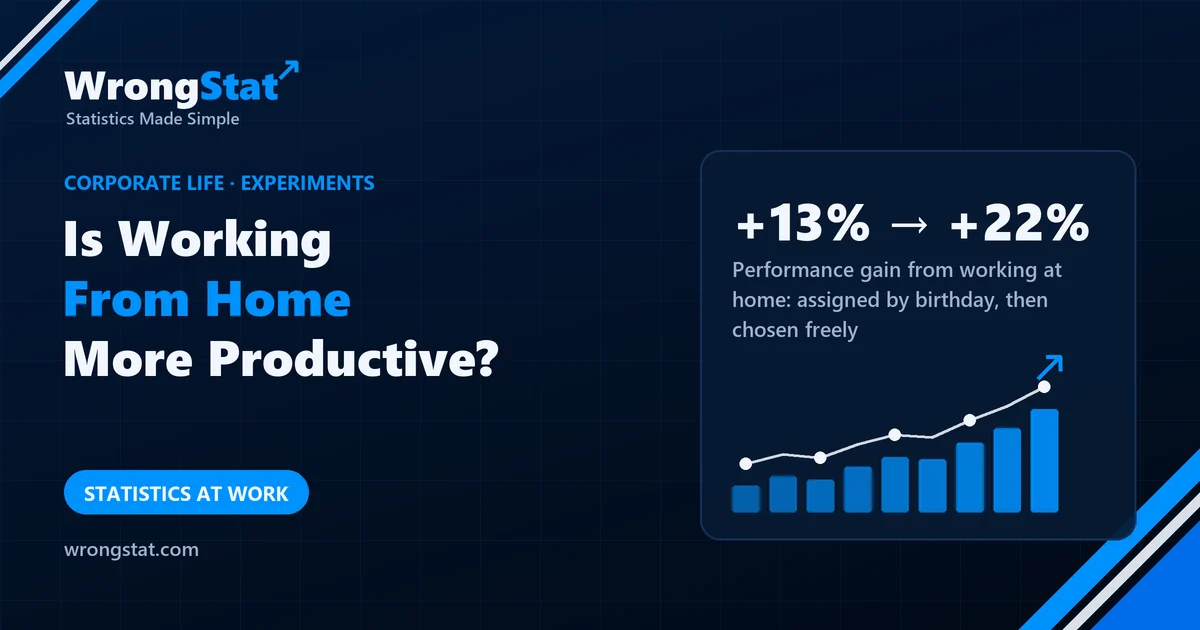
Then the company let everyone choose. More than half of the volunteers switched, many in both directions, and the measured gain from home working nearly doubled to 22%. Not because home got better. Because people who were good at home went home, and people who were bad at it came back. That's self-selection again, this time measured: the same building, the same people, and the choice alone added 9 percentage points.
Performance gain from working at home, call-centre experiment
Experiment two: the office
Call centres are easy to measure: calls per minute. Most office jobs aren't. So in 2024 the same research group published a second experiment in Nature, at the same company, with 1,612 engineers, marketers and finance staff. Again by birthday, half could work from home on Wednesdays and Fridays, and half came in five days a week, for two years of records.
| Two days at home vs five days in the office | Result |
|---|---|
| Performance reviews | no difference |
| Promotions over two years | no difference |
| Quitting | down by about a third |
The detail Kevin printed out: before the experiment, the 395 managers involved mostly expected hybrid work to hurt productivity. After it, they mostly said it helped. Their staff hadn't changed. Their data had.
Statistics for noobs: why the coin matters
When people choose their own group, the groups differ in a hundred ways you can't see. When a coin chooses, the hundred differences end up split roughly evenly between the groups, and only the thing you changed is left. That's the whole trick, and it's why one modest randomised study beats a thousand anecdotes from the kitchen.
The flip side: an experiment answers the question for the people and the jobs it tested. Volunteers at one company in one country are not every job on Earth.
Where it costs you money
Investment comparisons have exactly the same problem. "Investors who use our app earn more" compares people who chose the app with people who didn't, and the app may simply attract people who already had more money and more time. A fair comparison needs the same people, or randomly chosen people, with and without the thing. That's why every test on this site compares a strategy with a random stock bought on the same day.
The moral
Kevin's boss read the summary and said that his team is different. This may be true. It may also be what every manager in the 2024 experiment said before the results came in. The question of whether Kevin's team is different has been added to the agenda of the Thursday meeting, which is held in person, and which Kevin is attending from home.
What these studies can't tell you
- One company. Both experiments took place at the same firm in China. Different work, cultures and homes could give different results.
- Volunteers. In the first study only people who wanted to work from home took part, so it says little about people forced to.
- Fully remote isn't hybrid. The 2024 result is about two days a week at home, not about never coming in.
- Absence of evidence. "No difference in reviews" means the studies didn't find harm, not that harm is impossible in every job.
Kevin, his boss and the third floor are an illustration. The study figures come from the published papers (Quarterly Journal of Economics, 2015; Nature, 2024). Educational content, not career, legal or financial advice.