Does a 4-Day Work Week Increase Productivity? The Trials and Who Signed Up
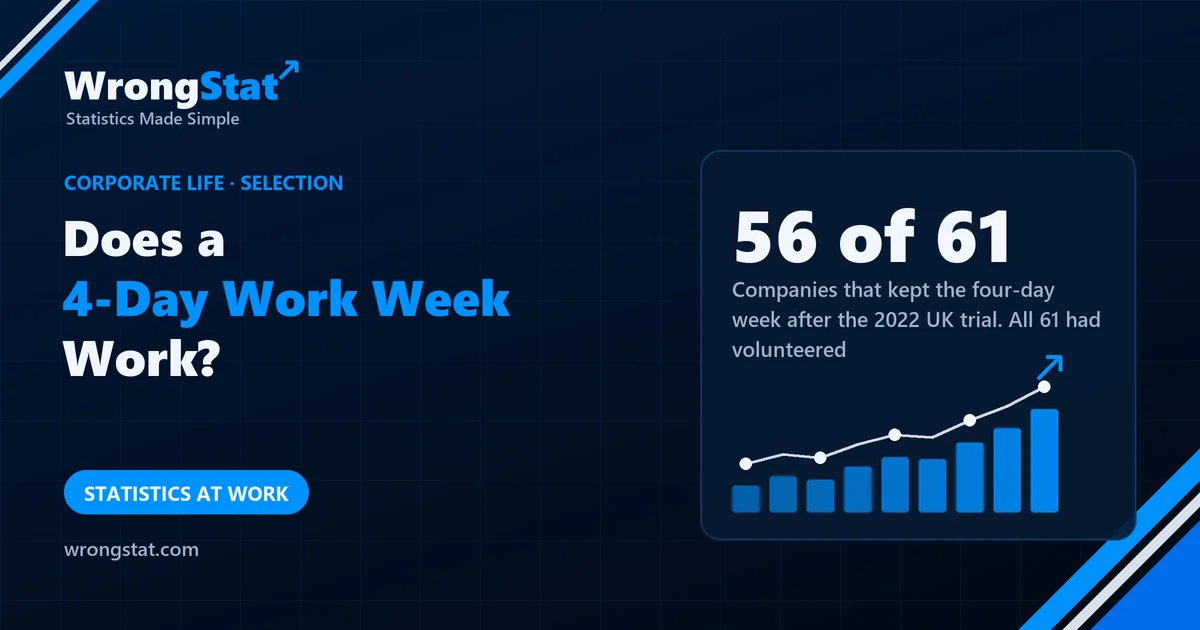
The short version: the four-day-week trials are encouraging but weaker than the headlines. In the 2022 UK pilot, 61 companies with about 2,900 staff cut hours to 80% on full pay, and 56 of them carried on. But the companies chose to take part, which means they were the ones most likely to make it work, and there was no comparison group. A 2025 study of 141 organisations did compare them with 12 companies that didn't change, and found less burnout and better health. Nobody has yet run the experiment that would settle productivity: picking companies at random.
Cousin Kevin has read an article. A trial! Sixty-one companies! Ninety-two per cent kept it! He has prepared a slide titled "Friday Is the New Saturday" and booked a meeting with HR to discuss it.
HR said it will be considered at the next quarterly review, which falls on a Friday. HR could see no irony in this. HR has been trained not to.
What the famous trial did
From June to December 2022, 61 British companies with about 2,900 employees tried a four-day week on full pay: 100% of the salary for 80% of the time, in exchange for keeping output up. At the end, 56 of the 61 (92%) said they would continue, and 18 made it permanent. Staff reported less stress, less burnout and fewer sick days.
All of that is true. Now the three questions Kevin's slide skips.
Question one: who signed up?
Nobody was assigned to the trial. Companies applied. A company volunteers for a four-day week when its bosses already like the idea, its work can be reorganised, and it isn't in the middle of a crisis. Those are exactly the companies most likely to succeed. A trial of volunteers measures how well the idea works for the people keenest on it.
That's self-selection bias, and it doesn't make the result wrong. It makes it narrower. "92% of volunteers kept it" can't be stretched to "92% of all companies would".
Question two: compared with whom?
The 2022 pilot compared each company with itself, before and after. But 2022 wasn't a normal year anywhere: staff were coming back after the pandemic, prices were rising, and everyone was tired. Some of the improvement might have happened anyway. Without a control group, a set of similar companies that didn't change, you can't tell.
A 2025 study in Nature Human Behaviour did add one. It followed 2,896 employees in 141 organisations across six countries that cut hours by about five a week, and compared them with 12 companies that kept the five-day week. Burnout, job satisfaction and mental and physical health improved in the four-day group, and not in the control companies. That's a real step forward. The companies were still volunteers, though, and the authors themselves call for randomised trials.
Question three: what was measured?
Mostly surveys: how stressed do you feel, how satisfied are you. Those matter. But a survey sent by your employer during a trial of your four-day week, asking whether the four-day week is going well, is not a neutral instrument. Anyone who wants to keep their Fridays knows which box to tick. Hard measures of output were patchy, because many of the companies don't produce anything you can count in units.
| What we'd like to know | What the trials can say |
|---|---|
| Do staff feel better? | Yes, fairly consistently, and more than in control companies (2025) |
| Do companies that try it keep it? | Most volunteers did (56 of 61) |
| Does output per week stay the same? | Encouraging but thin: few hard measures |
| Would it work for a randomly chosen company? | Unknown: nobody has tested that yet |
Statistics for noobs: the volunteer problem
When people or companies choose to join an experiment, the result tells you about the kind of people who choose to join. A slimming club where everyone loses weight, a school where everyone gets top marks, a pilot where everyone keeps the policy: always ask who got in, and who stayed out.
"No evidence it fails" and "proven to work everywhere" are different claims. The four-day week currently has the first, for a certain kind of company, and not yet the second.
Where it costs you money
Investment products love volunteer statistics. "Clients who stayed with us for ten years earned 9% a year" says nothing about the clients who left after two bad years, and they're exactly the ones you'd need to count. Look for results of everyone who started, not only of those who stayed.
The moral
Kevin presented his slide. HR said the evidence was promising but came from self-selected volunteers without random assignment. Kevin was impressed; he hadn't known HR could say that. HR then said that, in the spirit of evidence, the department would join a trial, if one were offered, which it would not be, because the department would have to volunteer, and volunteering is decided at the quarterly review. On a Friday.
What these studies can't tell you
- Mostly small, office-type companies. Factories, hospitals and shops were rare or absent.
- Short trials. Six months says little about year five, when the novelty is gone.
- No random assignment. Even the study with control companies compared volunteers with non-volunteers.
- Absence of evidence. That nobody has shown productivity falls isn't proof that it never does.
Kevin and his HR department are an illustration. The trial figures come from the published report of the 2022 UK pilot and the 2025 study in Nature Human Behaviour. Educational content, not career, legal or financial advice.