The Thermostat War: Why Splitting the Difference Pleases Nobody
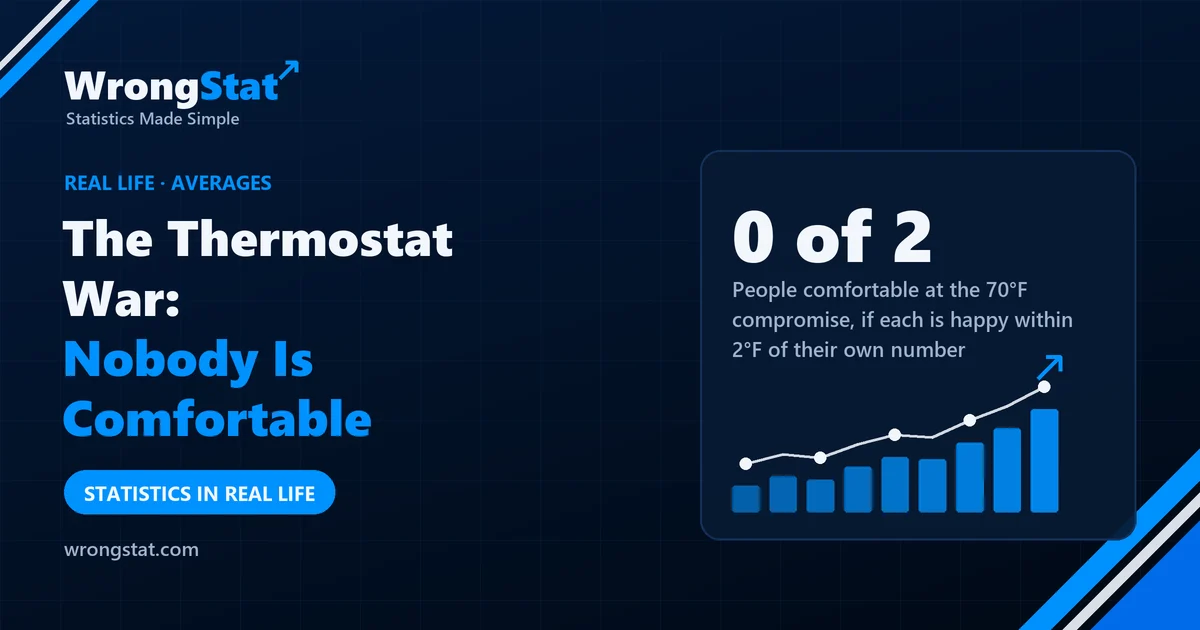
The short version: the average of two preferences is nobody's preference. If big misses hurt much more than small ones, meeting in the middle minimises total unhappiness. If every degree hurts the same, any setting in between is just as good. And if each person has a comfort zone, the midpoint can be the only setting where nobody is comfortable. Taking turns, or giving each person their own setting, often beats the average.
Uncle Gary believes the correct temperature for a house is 66°F. Aunt Linda believes it is 74°F. They have both believed this, with total conviction, for 31 years.
In 1995 they agreed a compromise: 70°F, exactly halfway. It has been in force ever since. Gary sleeps on top of the duvet and opens the bathroom window in January. Linda wears a fleece, a blanket and, on Sundays, a hat. Each of them visits the thermostat at night, separately, in socks. The thermostat has been adjusted more often than the family budget.
Nobody is happy. That isn't the compromise failing. Under one perfectly reasonable rule, it's exactly what this compromise does.
The average person in this house doesn't exist
70°F is the mean of 66 and 74. It's the favourite temperature of the average of Gary and Linda: a person who is comfortable at 70°F and does not live here. Gary is four degrees too warm. Linda is four degrees too cold. The compromise has achieved perfect equality. Nobody gets what they want, to exactly the same extent.
Whether that's fair depends on a question nobody in the family has asked in 31 years: how does unhappiness grow as the temperature moves away from your favourite?
A fair comparison, conducted with full seriousness
We tested three settings against three ways of measuring unhappiness. In the first two rows, lower is better. In the last row, higher is better.
| Unhappiness rule | Gary's 66°F | Compromise, 70°F | Linda's 74°F |
|---|---|---|---|
| 1. Every degree hurts more than the last (distance squared, both added) | 64 | 32 | 64 |
| 2. Every degree hurts the same (distance, both added) | 8 | 8 | 8 |
| 3. Comfortable within 2°F of your number, miserable outside it (people comfortable) | 1 | 0 | 1 |
Under rule 1, the compromise wins easily. Under rule 2, it makes no difference where you put the thermostat between 66 and 74: the total is always 8. Under rule 3, the compromise is the worst possible choice. It is the only setting at which nobody in the house is comfortable.
This isn't a quirk of thermostats. It's a quiet fact about averages: the mean is the best compromise only when big misses hurt much more than small ones. When every degree hurts the same, any point between the two does equally well, which is the property of the median. And when people have a comfort zone, the average can land in nobody's zone at all.
People comfortable at each setting (within 2°F of their own number)
The family holiday at the rest stop
The same arithmetic ruins holidays. Gary wants the mountains. Linda wants the beach. The average destination is a rest stop on the highway halfway between, which is, to be fair, where the family has spent many happy hours waiting for Kevin.
Averages of preferences are not preferences. A dish that's half spicy and half mild is a dish for nobody. A playlist that averages Gary's music and Linda's is an hour of something that offends both. When a choice is really either one thing or the other, splitting the difference often produces the one option nobody would have chosen.
What actually works
1. Take turns instead of averaging. Gary's temperature on even days, Linda's on odd days. Under rule 3, that's one comfortable person every day instead of none.
2. Change the question. One number for the whole house is the problem. A blanket, a fan, a different room: give each person their own setting instead of a shared one.
3. Ask how it hurts before you split it. If small misses are fine and big ones are awful, meet in the middle. If there's a comfort zone, the middle can be the worst seat in the house.
Where it costs you money
Long-run stock market returns have a respectable average, but individual years are scattered far above and below it, and a year close to the average is the exception rather than the rule. A savings plan that only works if every year is an average year is planning for a year that rarely turns up. It's sometimes called the flaw of averages: plans built for average conditions fail in the real ones. That's why the tests on this site look at how results are spread, not only at their average.
The moral
Linda bought an electric blanket. The thermostat is now at 66°F, Gary is comfortable, Linda is warm, and a war of 31 years ended in one evening. Neither of them has changed their mind. Gary says 66°F is objectively correct and the blanket proves it. Linda says the blanket proves she was cold for 31 years. Both statements are, technically, supported by the data.
The preferred temperatures and the three unhappiness rules are illustrations chosen to keep the arithmetic simple. Real comfort depends on clothing, humidity, health and much else. The mathematical point (the mean minimises the sum of squared differences, the median the sum of plain differences) is standard. Educational content, not financial advice.