What Are the Odds of Being Struck by Lightning? And Does It Strike Twice?
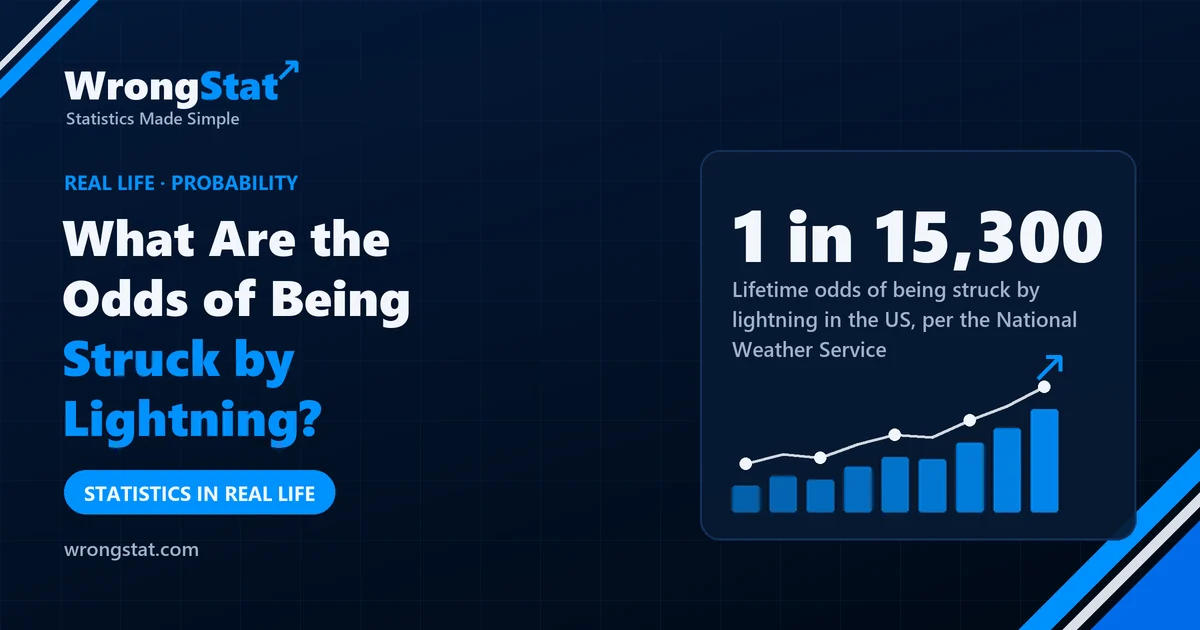
The short version: in the US, about 270 people a year are struck by lightning, which works out at 1 in 1,222,000 per person per year and about 1 in 15,300 over an 80-year life (National Weather Service figures). That's around 240 times likelier in a single year than one Powerball ticket winning the jackpot. But it's an average across 330 million people, most of whom are indoors when storms hit: your odds depend on where you are. And lightning strikes the same place again and again.
Aunt Linda has been trying to talk Uncle Gary out of the lottery with a statistic: "You're more likely to be struck by lightning than to win."
Gary considered this carefully and announced a new strategy. He will now buy his tickets during thunderstorms, to cover both outcomes.
He also keeps his barbecue under the old oak in the garden, which was struck by lightning in 2009. "Lightning never strikes the same place twice," he says. "It's the safest spot in the county." The oak has a different opinion, but nobody asks the oak.
The official odds
The US National Weather Service publishes the numbers, based on 2009 to 2018 averages:
- About 270 people a year are struck in the US: around 27 killed and an estimated 243 injured.
- With about 330 million people, that's 1 in 1,222,000 per person in a given year.
- Over an 80-year life: about 1 in 15,300.
- About 10% of people struck are killed. Most survive, often with lasting injuries.
- For each person struck, about ten others (family, friends, colleagues) are affected, so the chance that it touches your life is about 1 in 1,530.
So Linda is right, and by a lot. Lightning in a single year is about 240 times likelier than one Powerball ticket winning the jackpot (1 in 292,201,338). Gary's whole plan of 312 tickets a year for 50 years gives him about a 1 in 18,700 chance of the jackpot, which is roughly the same as his lifetime chance of being struck. He has announced he will retire on whichever comes first.
Out of 300 million people, how many would it happen to?
Your odds are not the average odds
Here's the catch in "1 in 15,300": it's the number of strikes divided by everybody. Everybody includes people who stay indoors during every storm, and people who spend their working lives outside in thunderstorm country. Nobody actually has the average risk. It's an average of very different people.
There's a famous case of a US park ranger who was struck seven times between 1942 and 1977. If strikes were equally likely for everyone and independent, seven would be beyond absurd. They weren't: he spent his days outdoors in a stormy national park. The lesson isn't that he was cursed. It's that the risk isn't spread evenly, so the average tells you little about any one person.
For you, the useful number isn't 1 in 15,300. It's what you do when a storm comes. The National Weather Service's rule is simple: if you can hear thunder, you're close enough to be struck. Go indoors.
Does lightning strike twice?
All the time. The saying is a myth, and the National Weather Service lists it as one. Tall, pointed, isolated things get hit again and again: the Empire State Building is struck about 23 times a year on average. A spot that's been hit once is, if anything, showing you that it's the kind of spot lightning likes.
Gary's oak is tall, pointed and alone in the middle of the garden. It is the Empire State Building of the cul-de-sac. The barbecue has been moved.
How to read "more likely than being struck by lightning"
1. Check the time period. "1 in 1.2 million" is per year; "1 in 15,300" is per lifetime. Comparing a yearly risk with a lifetime one is like comparing a pint with a barrel.
2. Check who it's about. An average across a whole country hides the people with much higher and much lower risk. Ask where you sit.
3. Check what's being compared. One lottery ticket against one year of lightning is a fair comparison. One ticket against a whole lifetime is not.
Where it costs you money
People fear rare, dramatic risks and ignore common, boring ones. A market crash is lightning: memorable, rare, and on the news. Fees, trading costs and selling in a panic are rain: they happen all the time, quietly, and over a lifetime they usually cost far more. That's why every test on this site counts costs, even when they're less exciting than the strategy.
The moral
Gary has stopped buying tickets during storms, after Linda pointed out that he'd be standing outside a shop in a thunderstorm holding a piece of paper with numbers on it, which is a lot of risk for a 1 in 292 million return. He now buys them online. From under the oak.
Figures are from the US National Weather Service (2009 to 2018 averages, a population of 330 million and an 80-year lifetime) and describe the US as a whole; risk in other countries and for individuals differs. Lightning is dangerous: when thunder roars, go indoors. Educational content, not financial advice.