Secret Santa Odds: Why Someone Always Draws Their Own Name
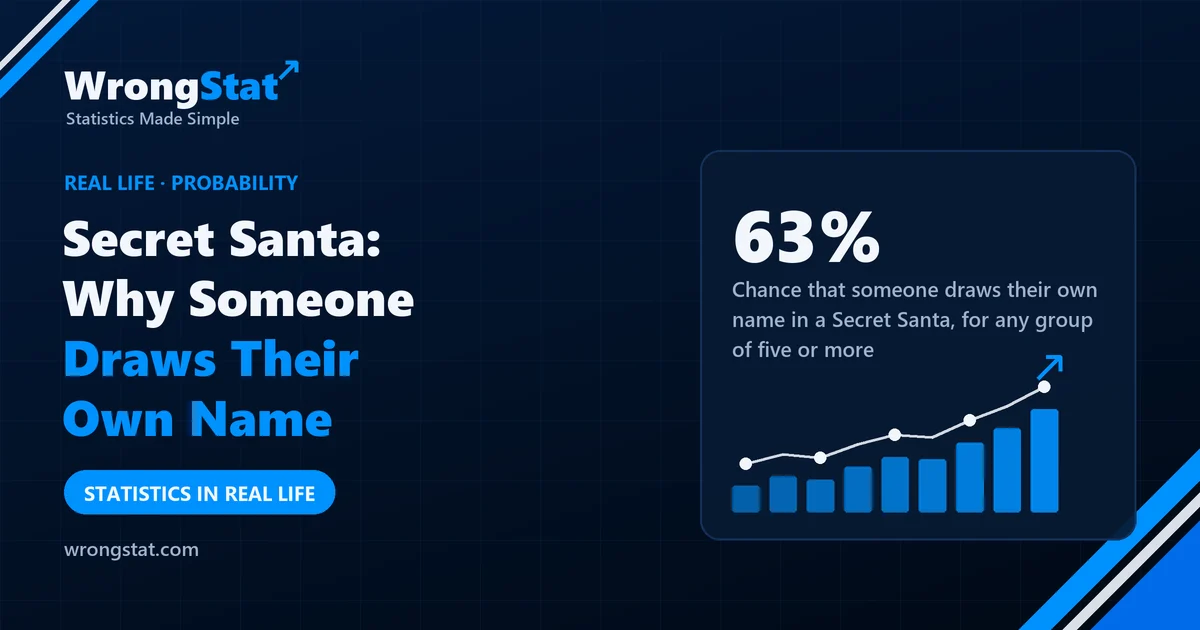
The short version: in a Secret Santa draw from a hat, the chance that at least one person draws their own name is about 63% for any group of five or more, and only slightly different for three or four. Each person's chance is small (1 in 8 in a group of 8), but there are 8 of them, and on average exactly one person draws themselves, whatever the group size. 'Put it back and draw again' fails about 1 time in 11 with 8 people. Seating everyone in a random circle and giving to your neighbour always works.
Aunt Linda runs the family Secret Santa. Eight names go into Uncle Gary's hat, everyone draws one, and every year since records began, somebody has drawn themselves.
Gary believes the hat is cursed. Cousin Kevin believes the family is cursed. Grandpa Frank drew himself two years running and bought himself socks both times, which he says were the best presents he received.
Last year Kevin introduced a fix: if you draw yourself, put your name back and draw again. It worked beautifully until Mia, who drew last, opened the hat and found only her own name. She was given a raffle ticket by way of apology. It didn't win.
The 63% nobody expects
For one person in a group of eight, the chance of drawing themselves is 1 in 8. That feels small. But there are eight people, each taking that small chance.
- Chance that everyone draws someone else: about 36.8%.
- Chance that at least one person draws themselves: about 63.2%.
So Linda's family hasn't been cursed. It has been typical. In two years out of three, someone draws their own name, and three bad years in a row happen about a quarter of the time.
Why the group size barely matters
Here's the odd part. With 3 people the chance someone draws themselves is 67%. With 4 it's 62.5%. With 5, 63.3%. With 6, 10, 100 or a whole office, it's 63.2%, to more decimal places than anybody needs. (It settles at 1 minus 1/e, where e is the famous mathematical constant 2.718, which has apparently been hiding in Christmas all along.)
The reason: a bigger group gives each person a smaller chance of drawing themselves, but it also gives you more people taking the chance. The two effects cancel exactly. On average, the number of people who draw their own name is exactly one, in any group. That's an expected value, and it's the most stubborn number at the party.
Chance that someone draws their own name
Why "put it back" fails
Kevin's rule fixes everyone except the last person. By the time the hat reaches them, there may be only one name left, and it may be theirs. With 8 people, that happens about 9% of the time: roughly 1 year in 11. Redrawing the whole hat whenever anyone gets themselves does work, but takes about 2.7 attempts on average, and the family has to keep forgetting who they drew.
A draw that always works first time
1. Shuffle the names. Write them on cards, shuffle them face down and lay them in a circle.
2. Give to the next card. Each person buys for the name after theirs, going round; the last buys for the first.
3. Keep it secret. Have one person who isn't playing (or a free online draw) tell each person only their own match. Nobody can draw themselves, and it always works first time. The only catch: it makes one big loop, so two people can never draw each other. Nobody at Christmas lunch has ever minded.
Where it costs you money
The same arithmetic catches investors. If one strategy has a 5% chance of looking brilliant by pure luck, that feels safe. Test 20 strategies and the chance that at least one looks brilliant by luck is about 64%. Small chances, repeated, stop being small. That's multiple testing, and it's why our myth tests report every version we tried, not the one that looked best.
The moral
Linda switched to the circle. It worked first time. Gary drew Linda and gave her the same scented candle as last year, and the year before. Linda pointed out that the chance of that is 100%. Gary said that at least it isn't 63%. Grandpa Frank, who can no longer draw himself, has started buying himself socks anyway, outside the system, and calls it his private pension.
The probabilities assume a fair, well-shuffled draw. The family and the candle are fictional. Educational content, not financial advice.