Myth #10 · Overnight returns
Do Stocks Go Up Overnight? We Tested Buying at the Close and Selling at the Open.
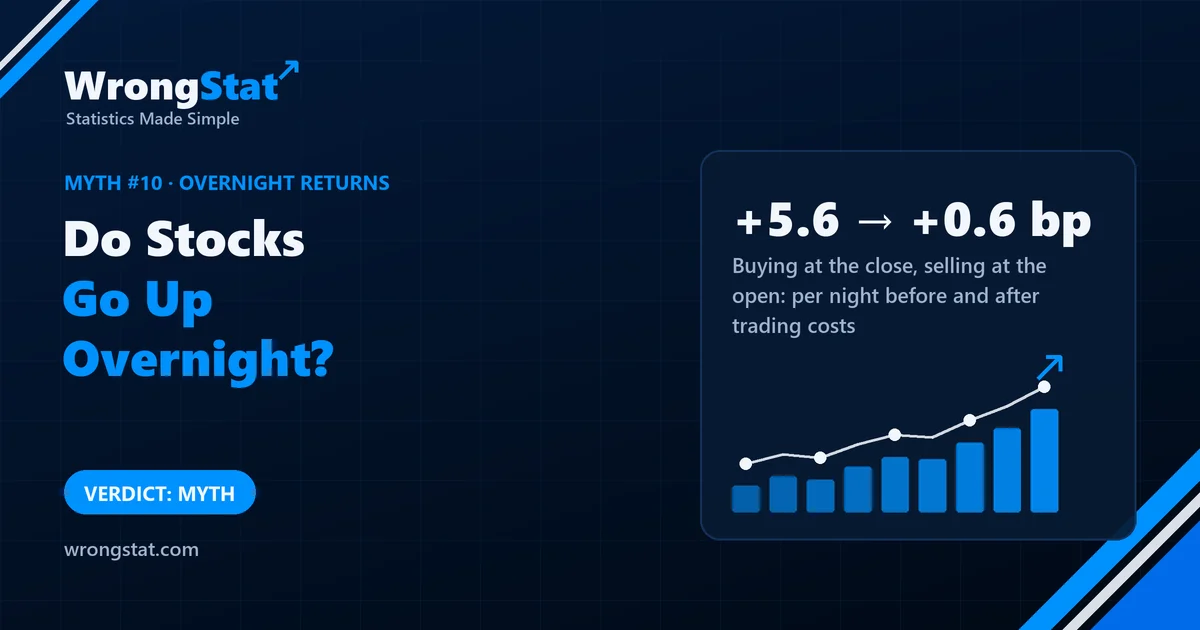
Verdict: a real effect that doesn't make a strategy. Stocks with strong past nights did keep having strong nights, clearly and in both halves of the data. But they tended to give it back during the next day, so for ordinary holding periods it predicted nothing (0 of 18 tests survived the correction for multiple testing). Traded every night, it beat the average stock by 5.6 basis points before costs and 0.6 after, before any slippage. That's not an edge. It's a rounding error with a daily alarm clock.
Cousin Kevin has read that "all the stock market's gains happen overnight". He has a plan: buy at the closing bell, sleep, sell at the opening bell, repeat. "I get the good bit and skip the bad bit," he explained at Sunday lunch. "I'm basically paid to sleep."
Uncle Gary, who has been paid to sleep through several meetings, was impressed. Aunt Linda asked how many times a year Kevin would be paying the broker. Kevin said he hadn't thought of that. So we did.
What we tested
- The split: every day's return for 575 US stocks, 2010 to 2026, cut into two parts: the night (yesterday's close to today's open) and the day (open to close).
- The idea: stocks that have done well at night recently keep doing well at night. We measured recent nights and days over the last 20 and 60 trading days.
- Two questions: does the overnight pattern predict normal returns over the next 5, 20 or 60 days, compared with the average stock? And if you trade only the nights, does it pay after costs?
- Fairness: we checked both halves of the period separately and removed the effect of how volatile a stock is and how much it moves with the market, so that we weren't just rediscovering risk.
Part one: as a stock-picking signal, nothing
We ran 18 main tests: three versions of the overnight pattern, two lookback windows and three holding periods. Two of the 18 crossed the usual significance line, where about one would by chance. After correcting for 18 tries (we explain why in our strategy graveyard), none survived.
The best-ranked 10% of stocks beat the S&P 500 by between +0.01 and +0.18 percentage points, but so did the worst-ranked 10%. When both ends win, that's the market rising, not the signal working.
Part two: the night habit is real
This is where Kevin isn't wrong. Stocks with the strongest nights over the past 60 days did keep having strong nights over the next 20. The link was clear and stable, with a t-statistic of 11.7, far beyond anything luck produces, and it showed up in both halves of the data.
But there's a second half to the habit. The same stocks tended to do worse during the following day, also clearly (t-statistics of about -5 to -7). The night pushes up, the day pulls back. Over a whole day, close to close, the tug of war cancels out. That's why Part one found nothing: if you simply buy and hold, you get both halves.
Part three: so trade only the nights
Kevin's plan avoids the day. Every evening, buy the 10% of stocks with the strongest past 60 nights at the closing price; every morning, sell them at the opening price.
| Per night, compared with the average stock | Result |
|---|---|
| Before costs | +5.6 basis points (same in both halves: +5.5 and +5.8) |
| Trading costs, one round trip | 5 basis points |
| After costs | +0.6 basis points |
| Same idea using the last 20 nights, after costs | -1.2 basis points |
| Selling the weakest 10% instead, after costs | -7 basis points |
A basis point is a hundredth of a per cent. 5.6 basis points a night is a real effect, statistically. It's also 0.056%. And the trade happens every single day: about 252 round trips a year. At 5 basis points each, that's about 12.6% of the money in trading costs every year, before you've earned anything. The night habit pays roughly that much, and then a whisker more.
The whisker is smaller than it looks, because our test bought exactly at the closing price and sold exactly at the opening price. In real life you'd pay a little extra to get in and out at those moments, a cost called slippage that we didn't model. On a margin of 0.6 basis points, it doesn't take much.
Buy strong-overnight stocks at the close, sell at the open: per night
Statistics for noobs: real is not the same as useful
A result can be statistically certain and economically worthless. "Significant" means unlikely to be luck; it says nothing about whether the effect is big enough to pay for itself. Always ask the second question: how much is it, per trade, after costs, compared with simply doing nothing?
And watch the number of trades. A strategy that trades daily needs a daily edge bigger than its daily costs. Most don't have one.
The moral
Kevin was right that something happens at night, and wrong that it happens to him. The pattern exists; the broker collects it. Linda has pointed out that Kevin could also just own the stocks and sleep, which is cheaper, and requires no alarm.
Every test on this site is compared with a random stock and with simply holding the S&P 500, after costs. This one had a real effect and still didn't clear the second bar by any amount worth getting up for.
What this test can't tell you
- Our costs. We assumed 5 basis points per round trip. Cheaper trading would leave more, dearer trading less; slippage at the open and close wasn't included.
- Daily data, US stocks listed today. That brings survivorship bias: companies that disappeared are missing.
- One version of the idea. Other ways of using the overnight pattern, for example as one input among several, weren't tested here.
- Absence of evidence. "It didn't pay in our test" isn't proof that no overnight strategy can ever work.
Simulations on historical data, not real trades. Daily prices of 575 US stocks listed today, 2010 to 2026, with 5 basis points of trading costs per round trip and no slippage. Historical results do not guarantee future returns. This is educational content, not financial advice.