Where Do Missing Socks Go? A Statistical Investigation
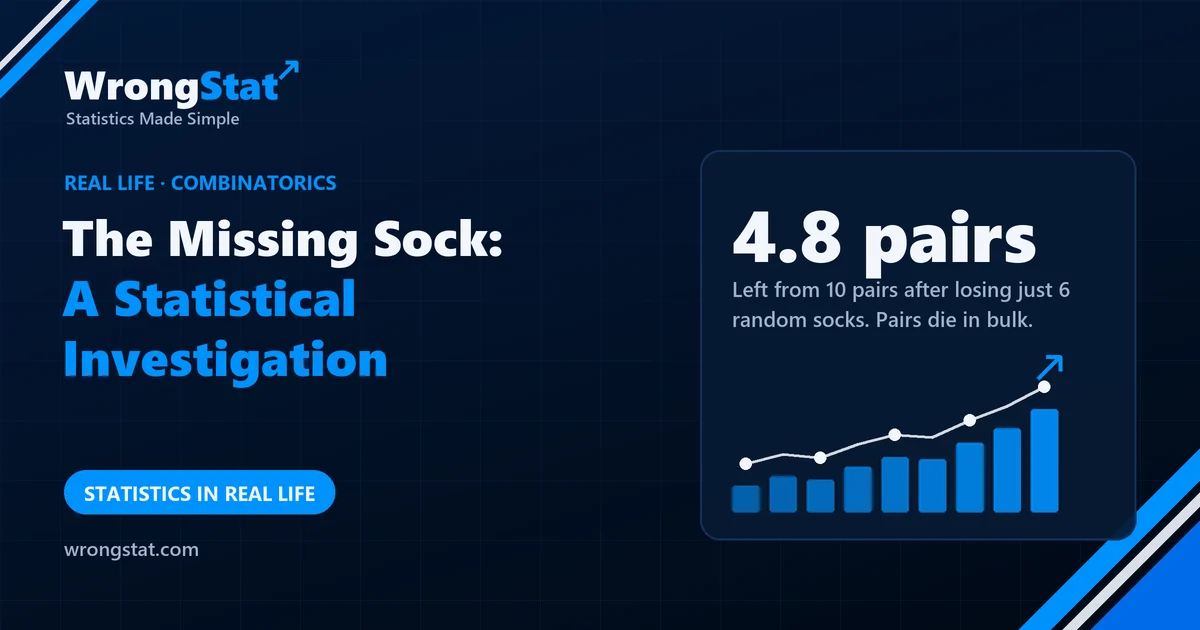
The short version: socks disappear one at a time, but pairs die in bulk. Lose 6 random socks from a drawer of 10 pairs (30% of your socks) and on average you're left with only 4.8 complete pairs. More than half the pairs are gone.
Aunt Linda is convinced the washing machine eats socks. Uncle Gary is convinced Linda throws them away. Kevin is convinced socks are a government experiment.
Nobody has been able to prove anything. But we can at least work out why the drawer looks so much worse than the number of missing socks suggests.
The drawer
Start with 10 pairs: 20 socks, all different pairs. The washing machine takes socks completely at random, one here, one there. How many complete pairs are left?
| Socks lost | Share of socks gone | Complete pairs left (on average) |
|---|---|---|
| 1 | 5% | 9.0 |
| 2 | 10% | 8.05 |
| 4 | 20% | 6.3 |
| 6 | 30% | 4.8 |
| 8 | 40% | 3.5 |
Lose two socks and the chance that they're from the same pair is only 1 in 19. Almost always, two missing socks means two ruined pairs. By the time 30% of the socks have vanished, more than half of the pairs are useless.
Complete pairs left from a drawer of 10 pairs
Why it works like that
A pair survives only if both socks survive. Each extra loss is a new chance to break a pair that was still whole. The losses are spread out at random, so they hit as many pairs as possible. That's expected value doing its quiet work: no single wash is a disaster, but the average outcome is grim.
Bonus: getting dressed in the dark
Kevin only owns black socks and white socks, all mixed up in one drawer. How many does he need to grab in the dark to be sure of a matching pair? Just three. With only two colours, three socks can't all be different. Mathematicians call this the pigeonhole principle. Kevin calls it the only maths he uses before coffee.
Where it costs you money
A trading plan that needs five things to go right is a drawer full of pairs. If each thing has an 80% chance of working, all five together work only 0.8 × 0.8 × 0.8 × 0.8 × 0.8 = 33% of the time. Every extra condition is another sock that can go missing.
The moral
Small, random losses don't add up gently. They break whole sets. Aunt Linda now buys only one kind of sock, in bulk. The washing machine is furious.
Assumes socks go missing completely at random and every pair is different. The averages are exact for that model. Educational content, not financial advice.