The Pub Poll Says 54%. The Margin of Error Says 14.
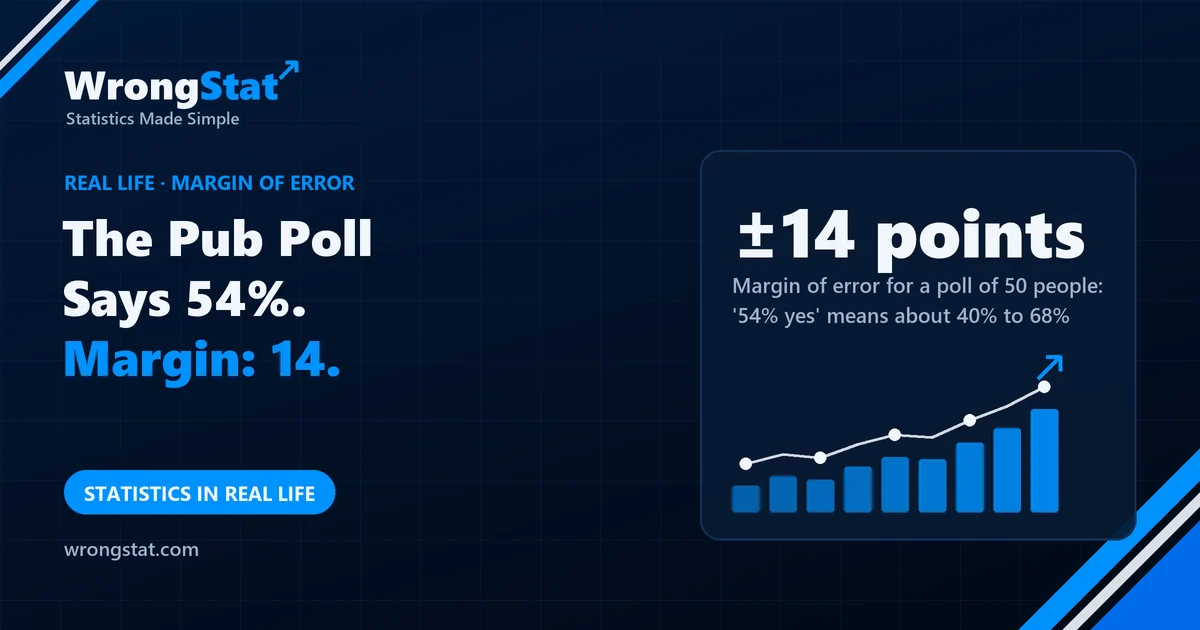
The short version: a poll of 50 people has a margin of error of about ±14 percentage points, so '54% yes' means somewhere around 40% to 68%. To get to ±3 points you need about 1,000 people. And size only fixes random error: if you only ask people in the pub, you get the pub's opinion very precisely. The village vote came out at 41%.
Aunt Linda chairs the fete committee, which is considering moving the fete from Saturday to Sunday. Uncle Gary volunteered to "take the temperature of the village" and spent Friday evening in the Red Lion with a clipboard.
He came back with 50 answers: 27 yes, 23 no. "54% for Sunday," he announced. "A clear majority. The people have spoken." Old Ted, who had been asked three times because Gary kept forgetting he'd already asked him, said that the people had mostly spoken to Gary.
How wrong can 50 people be?
Even if the 50 were a perfectly random sample of the village, a small poll wobbles. Ask a different 50 and you'd get a different answer, just by chance. The margin of error says how big that wobble typically is.
- For a result near 50% from 50 people, the 95% margin of error is about ±14 points.
- So "54% yes" really means "somewhere from about 40% to about 68%".
- That range includes a clear no, a tie and a clear yes. The poll has told us almost nothing.
How big does a poll need to be?
The margin shrinks with the square root of the sample size, so precision gets expensive:
- 50 people: about ±14 points.
- 200 people: about ±7 points.
- 1,000 people: about ±3 points. That's why national polls usually ask around a thousand.
A quick rule: the margin is roughly 1 divided by the square root of the number of people. For 100 people, that's about ±10 points. Four times as many people only halves the margin.
The bigger problem: who you ask
The margin of error only covers random wobble. It assumes the people asked are like everyone else. Gary asked people in the pub on a Friday evening. They're more likely to be free on Sundays, more likely to want a fete with a beer tent, and less likely to be at church or at their grandchildren's football. That's sampling bias, and no amount of extra people fixes it: ask 1,000 people in the pub and you'll know the pub's opinion to within 3 points.
The village held a proper vote at the end of the month. Sunday got 41%. Within Gary's margin of error, as it happens, but on the other side of 50%.
A '54% yes' result: the plausible range for the true share
How to read any poll
1. Find the number of people. Under 100 and the margin is more than ±10 points. Treat close results as ties.
2. Apply the rule of thumb. Margin ≈ 1 / √(number of people). Double it for the difference between two options.
3. Ask who was asked, and how. A pub, a website, a group chat, the people who replied: if they differ from everyone else, the margin of error is the least of your problems.
Where it costs you money
"78% of investors expect the market to rise" from a survey of 60 newsletter readers has a margin of error of about ±11 points and a sample chosen by enthusiasm. Sentiment surveys, customer polls and "most experts agree" claims are only as good as their size and their sample. Find both before you act on the percentage.
The moral
Gary has offered to run the poll for next year's fete as well, with a sample of 1,000. Linda asked where he would find 1,000 people. Gary said the Red Lion, over several weekends. Linda has put Mia in charge of polling, with instructions to stand outside the church, the school gates, the bus stop and, for balance, the Red Lion, for no more than an hour.
The poll, the village and the vote are illustrative. The margin of error shown is the standard 95% figure for a simple random sample. Educational content, not financial advice.