How Many Raffle Tickets Did Gary Sell? The German Tank Problem
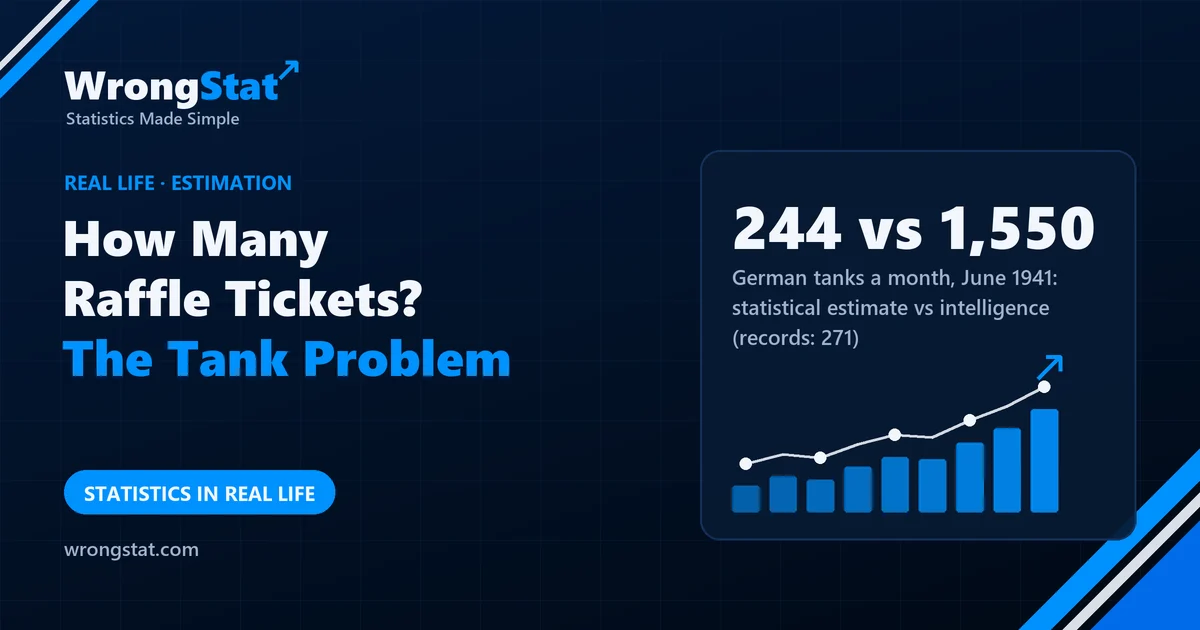
The short version: if things are numbered from 1 upwards and you see a few of the numbers at random, the highest one you've seen tells you a lot about the total. A simple estimate is the highest number times (1 + 1/k), minus 1, where k is how many numbers you saw. Grandpa saw five tickets with a highest of 203 and estimated 243. Allied statisticians did the same with captured tank serial numbers and came far closer than spies: 244 a month against intelligence reports of 1,550, when German records later showed 271.
Uncle Gary ran the raffle at the summer fete. Tickets came from a book numbered 1 upwards, at $2 each. Asked how it went, Gary said he'd sold "about a thousand, give or take".
Grandpa Frank, who reads books about the Second World War the way other people read the newspaper, had noticed five ticket numbers in people's hands during the afternoon: 31, 87, 142, 165 and 203. He wrote them on a napkin, did a sum and said: "Two hundred and forty-three." Gary laughed. Then Aunt Linda opened the cash box.
The highest number tells you most
If tickets are numbered 1, 2, 3 and so on, and the five Grandpa saw are a random handful, then the total can't be less than 203: someone holds ticket 203. The question is how far above 203 the total is likely to be.
Here's the idea. Five random tickets split the full range into six gaps on average: the gaps between them, the gap below the lowest and the gap above the highest. The gaps between Grandpa's numbers average about 40. So the gap above 203 is probably about 40 too. A neat formula does this precisely:
- Estimate = highest number × (1 + 1/k) - 1, where k is how many numbers you've seen.
- Grandpa: 203 × (1 + 1/5) - 1 = about 243.
The cash box held $486. At $2 a ticket, that's 243 tickets.
The tanks
This is called the German tank problem. During the Second World War, the Allies wanted to know how many tanks Germany was producing. Spies and intelligence reports gave large numbers. Statisticians took a different route: captured and destroyed German tanks carried serial numbers on their parts, especially gearboxes, and those numbers ran in sequence. From the numbers they found, they estimated production the same way Grandpa estimated tickets.
- For June 1941, the statistical estimate was 244 tanks a month.
- The intelligence estimate was 1,550.
- After the war, German records showed 271.
A few serial numbers and a formula beat a network of spies by a factor of five. The statistics weren't perfect; in other months they were off in the other direction. But they were in the right neighbourhood, and the confident rumours weren't.
German tanks produced in June 1941
How sure can you be?
With only five numbers, the estimate is right on average but can miss: in our simulation of a raffle with 240 tickets, the estimate landed within 10% of the truth about 41% of the time. More numbers make it much tighter. The method also needs the numbers you see to be a fair, random sample. If you only ever see the tickets sold in the first hour, you'll underestimate.
How to estimate a total from a few numbers
1. Check that things are numbered in sequence. Tickets, invoices, serial numbers, order numbers.
2. Make sure what you've seen is a random handful. Not the first ones, not the last ones, not the ones someone chose to show you.
3. Use the highest number. Highest × (1 + 1/k) - 1. Then remember that with few numbers, the answer is a range, not a fact.
Where it costs you money
Confident numbers from people with a reason to inflate them ("we have thousands of customers", "about a thousand tickets") are worth checking against whatever hard evidence you can find. A small, fair sample of real data usually beats a large, confident claim. Before you invest because "everyone is buying", look for the equivalent of the serial numbers.
The moral
Gary explained that "about a thousand" had been an estimate of enthusiasm rather than tickets. Grandpa said that was exactly what Allied intelligence had said in 1941. Gary has since been asked to number the tombola prizes too, and Grandpa has been seen at the tombola stall with a napkin.
The raffle numbers are illustrative. Wartime figures are from the commonly reproduced 1947 comparison of statistical, intelligence and German-record estimates. Educational content, not financial advice.