Why One 18-Inch Pizza Beats Two 12-Inch Pizzas
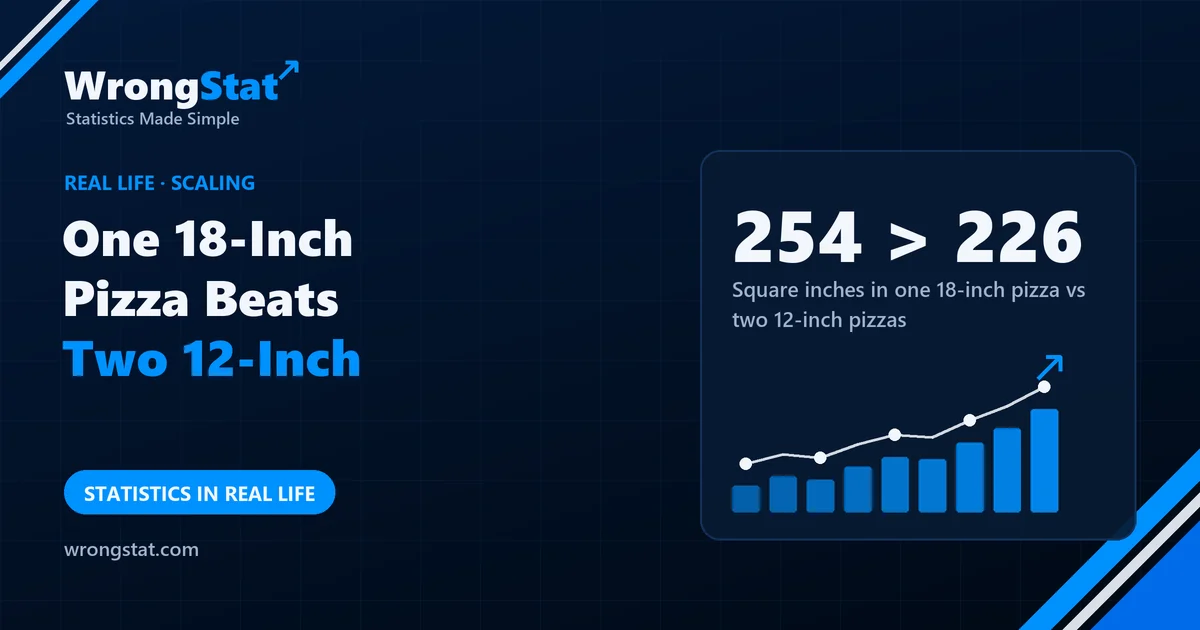
The short version: pizza is an area, and area grows with the square of the width. An 18-inch pizza is 1.5 times as wide as a 12-inch one, so it has 1.5 × 1.5 = 2.25 times as much pizza: about 254 square inches, more than two 12-inch pizzas (226). If the 18-inch costs $20 and the 12-inch $12, you get 2.25 times the pizza for 1.67 times the price. Our brains compare widths; the menu charges for area.
Mia had four friends round on Friday and $25 from Cousin Kevin for pizza. The menu offered a 12-inch pizza for $12 or an 18-inch for $20. One friend said two 12-inch pizzas was obviously more: "Two is more than one." Another said 12 plus 12 is 24, which is more than 18. Kevin, passing through, agreed with both of them and left.
Mia, who is studying statistics, asked for a pen.
Pizza is an area
The size on the menu is the diameter: the width across. But what you eat is the area, and the area of a circle grows with the square of its radius.
- A 12-inch pizza (radius 6): about 113 square inches.
- Two 12-inch pizzas: about 226 square inches.
- One 18-inch pizza (radius 9): about 254 square inches.
One big pizza beats two medium ones, by about 28 square inches: roughly a whole extra slice. "12 plus 12 is 24" adds widths, which nobody eats.
How much pizza, in square inches
50% wider, 125% more
The 18-inch pizza is 50% wider than the 12-inch. But it has 1.5 × 1.5 = 2.25 times the pizza: 125% more, not 50% more. That's the thing our eyes get wrong. We compare widths, because that's what the menu prints, and the extra pizza hides in the second dimension.
And the price? $20 against $12 is 1.67 times as much money for 2.25 times as much pizza. Per square inch, the big one costs about 8 cents and the small one about 11. The friend who said "two is more than one" was right about the number of boxes.
Where else squares hide
The same trick is everywhere something grows in two directions. A TV that's 50% bigger on the diagonal has 2.25 times the screen. A garden twice as long and twice as wide needs four times the turf. A photo enlarged to double the width uses four times the paper. Our instinct is to scale linearly; the world often scales by the square.
Percentages play a similar trick over time. A 50% rise followed by another 50% rise isn't 100% up: it's 1.5 × 1.5 = 2.25, or 125% up, for the same reason the pizza grew. Each percentage change applies to an amount that's already grown.
How to order pizza like a statistician
1. Square the sizes. Compare 12 × 12 = 144 with 18 × 18 = 324. The ratio, 2.25, is the ratio of pizza.
2. Divide price by area. The cheapest pizza per square inch is usually the biggest, though not always: check the deals.
3. Watch for "two for one" on small sizes. Two small pizzas often have less pizza than one large, even when they feel like a bargain.
Where it costs you money
Growth compounds the way area does. A return of 7% a year doesn't add up to 70% over ten years; it multiplies to about 97%. Fees work the same way in reverse: 1% a year doesn't cost 10% over a decade but a little less, taken from a pot that would have grown. Whenever something applies to itself, think pizza, not ruler.
The moral
Mia ordered one 18-inch pizza and spent the change on garlic bread. Everyone had enough, and nobody believed her about the square inches until she cut the pizza with a ruler. Kevin came back, saw one box instead of two, and asked whether they'd been short-changed. Mia said they'd been long-changed by 28 square inches. Kevin said that wasn't a phrase. It is now.
Prices are illustrative; pizza sizes are diameters and real pizzas aren't perfect circles. Educational content, not financial advice.