Are You More Likely to Die on Your Birthday? Grandpa Frank Spends His in Bubble Wrap
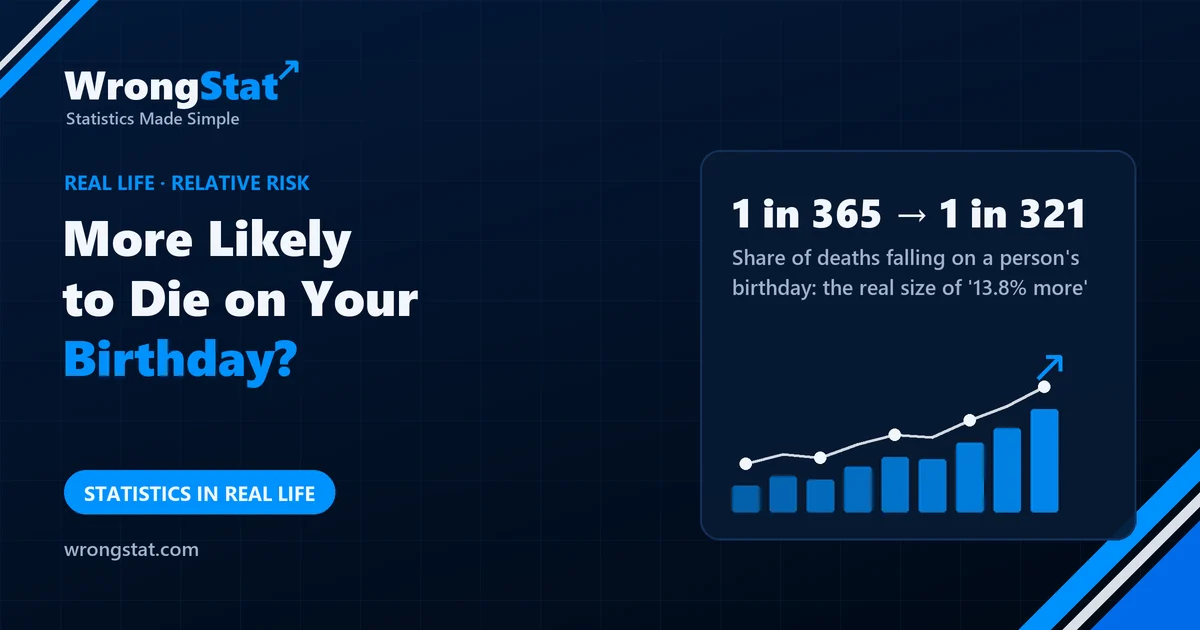
The short version: a study of about 2.4 million deaths in Switzerland between 1969 and 2008 found 13.8% more deaths on birthdays than on an average day, with falls, strokes, heart attacks and suicides among the causes. In absolute terms, the share of deaths falling on a birthday rises from about 1 in 365 to about 1 in 321: roughly 23 extra deaths a year across the whole country. A real effect, worth a careful toast and a sensible staircase, and no reason for bubble wrap.
Grandpa Frank is turning 82. Mia showed him a headline she thought he'd find interesting: "You're more likely to die on your birthday." Grandpa found it very interesting.
He has announced that he will spend the day in bed, wrapped in bubble wrap, with the phone unplugged, the heating set to a safe 68°F and the cake delivered through the letterbox in slices. He has asked for no candles, on safety grounds, and no surprises, on cardiac grounds. Aunt Linda asked how he planned to go to the bathroom. Grandpa said he'd cross that bridge when he came to it, carefully, holding the rail.
What the study found
In 2012, Swiss researchers published a study in the Annals of Epidemiology of about 2.4 million deaths in Switzerland between 1969 and 2008. They compared deaths on people's birthdays with deaths on other days of the year.
- Deaths on birthdays were about 13.8% higher than on an average day.
- The excess was larger among people over 60.
- It showed up in falls (about 44% more), strokes, heart attacks and suicides.
The authors suggested a mix of explanations: the stress and excitement of the day, alcohol, travel, the emotional weight of another year passing. In their data, the excess was clear.
13.8% of a very small number
That 13.8% is a relative risk: it's about birthdays compared with other days. The base rate is the chance that any given death falls on any particular day, which is about 1 in 365.
- Without a birthday effect: about 0.27% of deaths would fall on a person's birthday.
- With 13.8% more: about 0.31%, or about 1 in 321.
- Across Switzerland's 2.4 million deaths over 40 years, that's roughly 900 extra birthday deaths: about 23 a year in a country of millions.
For Grandpa Frank, his risk tomorrow is a little higher than his risk on an ordinary Tuesday. It's nowhere near the risk of spending a day wrapped in plastic trying to reach the bathroom.
Share of deaths that fall on a person's birthday
Could it be the data?
A careful reader always asks whether a pattern could be an error in the records. Dates of birth and death get misrecorded; some records default to round dates when the real date is unknown. A good study checks for that, and the Swiss data were of high quality. But it's a useful habit: when a striking pattern lives in dates, check whether the dates themselves could be producing it before building a theory about human nature.
How to read a scary relative risk
1. Find the base rate. 13.8% more of what? Here, of a 1 in 365 chance.
2. Turn it into people. About 23 extra deaths a year in a whole country. Real, rare, and mostly concentrated in specific causes.
3. Look at the causes. Falls, alcohol and stress point to sensible precautions: a careful toast, a lit staircase, not a bubble-wrapped bed.
Where it costs you money
"Markets are 20% more likely to fall in September" may be a real calendar pattern or a quirk of a short history, and even if it's real, 20% more of a small difference is a small difference. Before rearranging your investments around a striking relative number, ask what it's relative to, how much money it would actually change, and whether it survives in other data.
The moral
Grandpa spent the morning in the bubble wrap and the afternoon at the Red Lion, having been persuaded that the bubble wrap was itself a fall risk. He had one pint, held the rail on the way to the bathroom, and blew out 82 candles in a single breath, which he says proves his lungs are in better shape than the statistics. Mia has noted it in her diary. Grandpa has already asked for bubble wrap for next year, "for the walk home".
Study figures are from Ajdacic-Gross et al. (Annals of Epidemiology, 2012), Swiss deaths 1969 to 2008; absolute figures are our rounded calculations. This is not medical advice. Educational content, not financial advice.