Does Bacon Cause Cancer? What '18% Higher Risk' Really Means
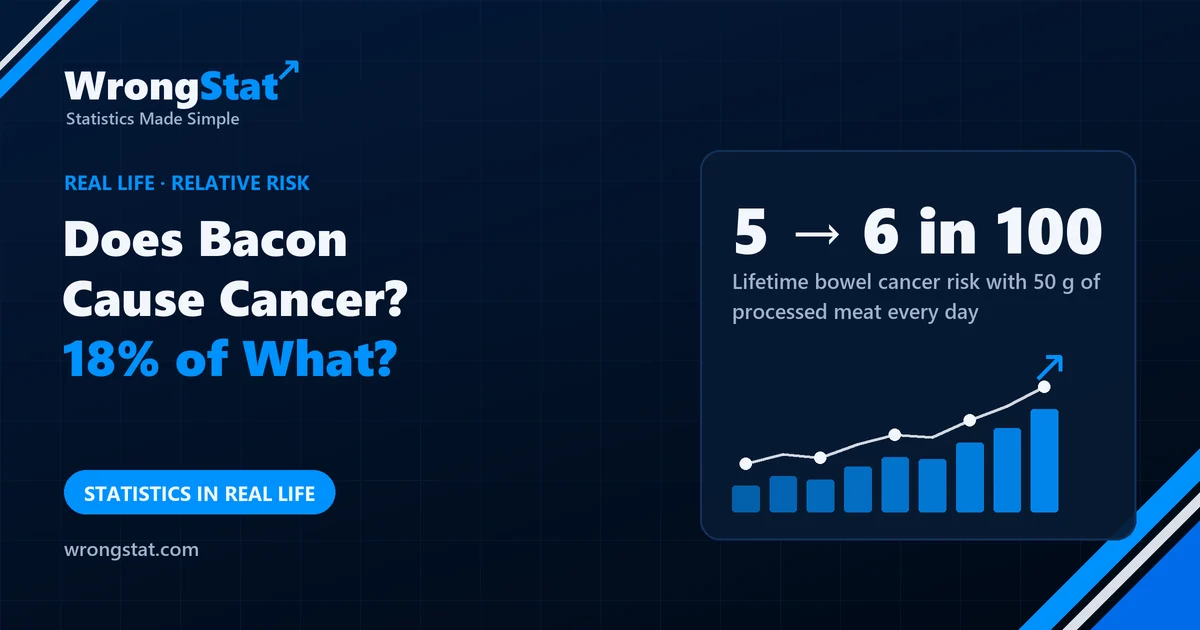
The short version: '18% higher risk' is a relative increase. The lifetime risk of bowel cancer in the US is about 5%, so 18% more is about 5.9%: roughly 6 people in 100 instead of 5, for people who eat 50 g of processed meat every day. That's real, and also much smaller than the headline sounds. Processed meat is in the same 'Group 1' as tobacco because the evidence that it causes cancer is strong, not because the risk is similar: smokers are 15 to 30 times more likely to get lung cancer.
Uncle Gary has a bacon sandwich every morning. One morning the newspaper next to his plate said: "BACON AS DEADLY AS CIGARETTES, SAYS WHO."
Gary put down the sandwich and picked up the newspaper. Then he put down the newspaper and picked up the sandwich, on the grounds that if bacon is as deadly as cigarettes, and he doesn't smoke, he's well within budget. Aunt Linda asked him to read the article first. The article was three paragraphs long and two of them were about a celebrity's barbecue.
What the WHO actually said
In October 2015, the World Health Organization's cancer research agency, IARC, classified processed meat (bacon, ham, sausages, hot dogs) as a cause of bowel cancer. Its experts estimated that each 50 g portion of processed meat eaten every day raises the risk of bowel cancer by 18%. Fifty grams is roughly a hot dog or a few slices of bacon.
That's a real finding. The question is what 18% means for Gary.
18% of what?
The 18% is a relative risk: it's 18% more than the risk you started with. So you need the starting risk.
- In the US, the lifetime risk of developing bowel cancer is about 5%: roughly 1 person in 20.
- 18% more than 5% is about 5.9%.
- So for 100 people eating 50 g of processed meat every day of their lives, about 6 would be expected to develop bowel cancer, instead of about 5.
One extra case per hundred people, over a lifetime, for a daily habit. That's the absolute risk: the change in the actual number of people affected. It's worth knowing. It isn't "as deadly as cigarettes".
Lifetime risk of bowel cancer, out of 100 people
Why bacon is in the same group as tobacco
IARC put processed meat in its "Group 1", alongside tobacco and asbestos. That sounds terrifying until you know what the groups mean. They grade how strong the evidence is that something can cause cancer, not how much cancer it causes. Bacon and cigarettes are in the same group the way a paper cut and a shark bite are both definitely injuries.
For scale: smokers are about 15 to 30 times more likely to get lung cancer than non-smokers. That's a relative risk of 1,400% to 2,900%, against bacon's 18%. Same group, different universe.
How to read a health headline
1. Ask "percent of what?". A relative risk without the starting risk is a number without a size. Find the baseline.
2. Turn it into people. "Out of 100 people like me, how many more would be affected?" That's the number to weigh against the bacon.
3. Check what's being compared. How much, how often, for how long, against whom. "Every day for life" is not "a sandwich at the weekend".
Where it costs you money
Fund marketing loves relative numbers: "fees cut by 20%" (from 1% to 0.8%), "outperformed by 50%" (6% instead of 4%). They can be true and still small, or true and important. Always ask for the absolute numbers: how many dollars, out of how much, over what period.
The moral
Gary did the sums with Linda. One extra case per hundred, for a lifetime of daily bacon. He decided to cut down to weekends, which takes his risk most of the way back towards the baseline, and to stop reading newspapers at breakfast, which he says has done wonders for his blood pressure. The celebrity's barbecue, he notes, was mostly sausages.
Figures are from IARC's 2015 evaluation of processed meat and typical US lifetime risk estimates; individual risk depends on many factors. This is not medical advice. Educational content, not financial advice.