What Does a 30% Chance of Rain Mean? The Weather App Didn't Lie
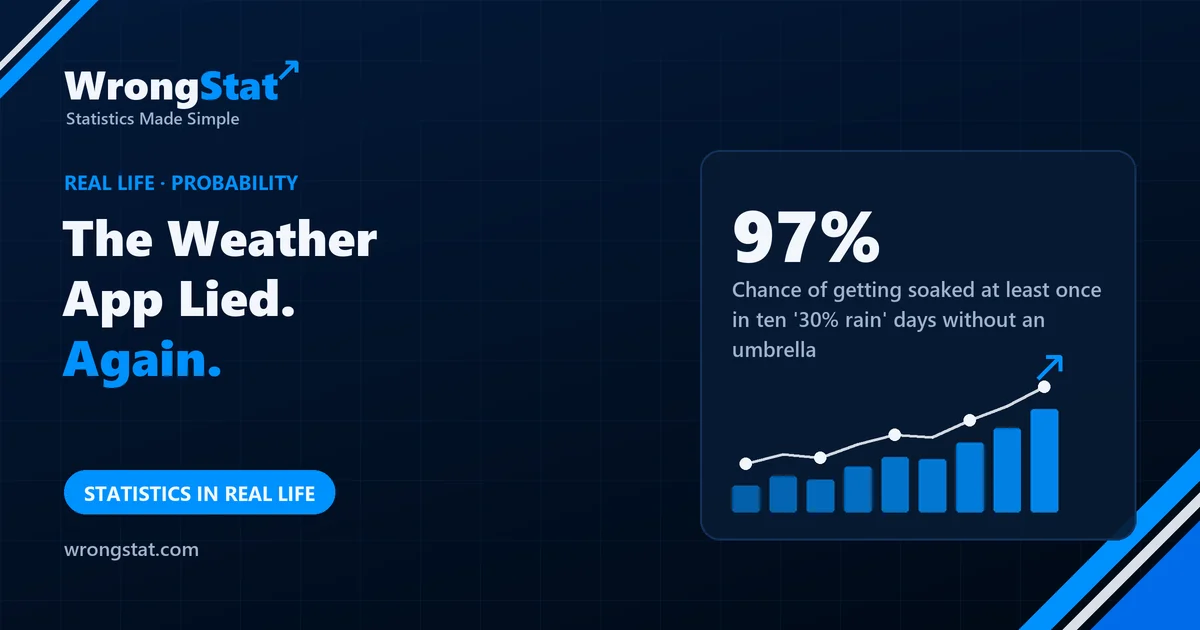
The short version: a 30% chance of rain is a promise about many days, not one. A good forecaster's 30% days end up wet about 3 times in 10. Leave the umbrella at home on ten such days and you'll get soaked at least once 97% of the time. A forecast can only be judged on many days at once, and that's called calibration.
The app said 30% chance of rain. Uncle Gary read it the way he reads everything, which is generously towards himself. "Thirty per cent means seventy per cent of the time the weather has no right to surprise me," he announced, and left the umbrella by the door.
It rained for forty minutes, mostly on Gary. He came home, stood dripping in the hall, and deleted the app. "It lied," he said. "Again."
Aunt Linda pointed out that 30% is not 0%. Gary pointed out that he was wet. Both statements were accurate. Only one of them was about statistics.
What 30% actually promises
A forecast of 30% doesn't promise anything about tomorrow. It's a promise about all the days that get the same forecast. If the forecaster is good, then of all the days marked "30%", it rains on about 3 in 10. Gary got one of the three. That isn't the forecast failing. That is the forecast working exactly as described, on Gary.
(For the record: in US forecasts, the percentage is the chance that a given spot in the forecast area gets at least a little measurable rain during the period. It isn't 30% of the day, and it isn't 30% of the town. Gary's spot was the route from his front door to the bus stop.)
Ten 30% days, one umbrella left at home
Gary's strategy is "30% means I won't need it". Run it for ten 30% days:
- Expected number of wet days: 3.
- Chance that all ten stay dry: 0.7 multiplied by itself ten times, about 2.8%.
- Chance of getting soaked at least once: about 97%.
So Gary's plan isn't a gamble. It's a booking. A 30% chance feels small on any one day, but it's a weekly appointment with rain if you repeat it.
Chance of getting soaked at least once, leaving the umbrella at home on "30%" days
How to tell whether the forecaster is any good
You can't judge a probability forecast from one day. Was "30%" wrong because it rained? Would it have been right if it hadn't? Neither. The only test is to collect many forecasts and check that each percentage comes true as often as it says. That's called calibration:
| Forecast said | Days with that forecast | Days it rained, for a well-calibrated forecaster |
|---|---|---|
| 10% | 40 | about 4 |
| 30% | 30 | about 9 |
| 70% | 20 | about 14 |
| 90% | 10 | about 9 |
If the app's 30% days are wet half the time, it's badly calibrated and Gary has a case. If they're wet about 3 times in 10, the app is fine and Gary has a towel. Forecasters are actually scored this way, over thousands of days, with a formula called the Brier score. Gary scores forecasters over one Tuesday, with a formula called "I'm wet".
So, umbrella or not?
The forecast gives you the probability. Whether to take the umbrella depends on what's at stake. Say carrying an umbrella all day costs you 2 units of annoyance, and getting soaked costs 10. Then leaving it at home is worth it only when the chance of rain is below 2 out of 10, so 20%.
At 30%, the expected cost of leaving it at home is 0.3 × 10 = 3 units, more than the 2 units of carrying it. Take the umbrella. If you hate carrying things more than you hate being wet, your threshold moves. That's not irrational. That's just knowing your own numbers.
Where it costs you money
Trading signals come with percentages too: "70% of the time, this pattern goes up". One losing trade doesn't prove it wrong, and one winning trade doesn't prove it right. The only test is the same as for the weather app: hundreds of signals, checked against how often they were supposed to work, and against what a random choice would have done. That's what every myth on this site does.
The moral
Gary has reinstalled the app. He has also found a new forecaster, his own father, whose knee aches before rain. Grandpa Frank has never been wrong, he says. Nobody has ever checked. We did: Can Achy Joints Predict the Weather? Grandpa's Knee, Tested.
The calibration table is an illustration of what good calibration looks like, not data from a real forecaster. The umbrella costs are an example. Educational content, not financial advice.