Is the Hot Hand Real? Uncle Gary's Six Darts in a Row
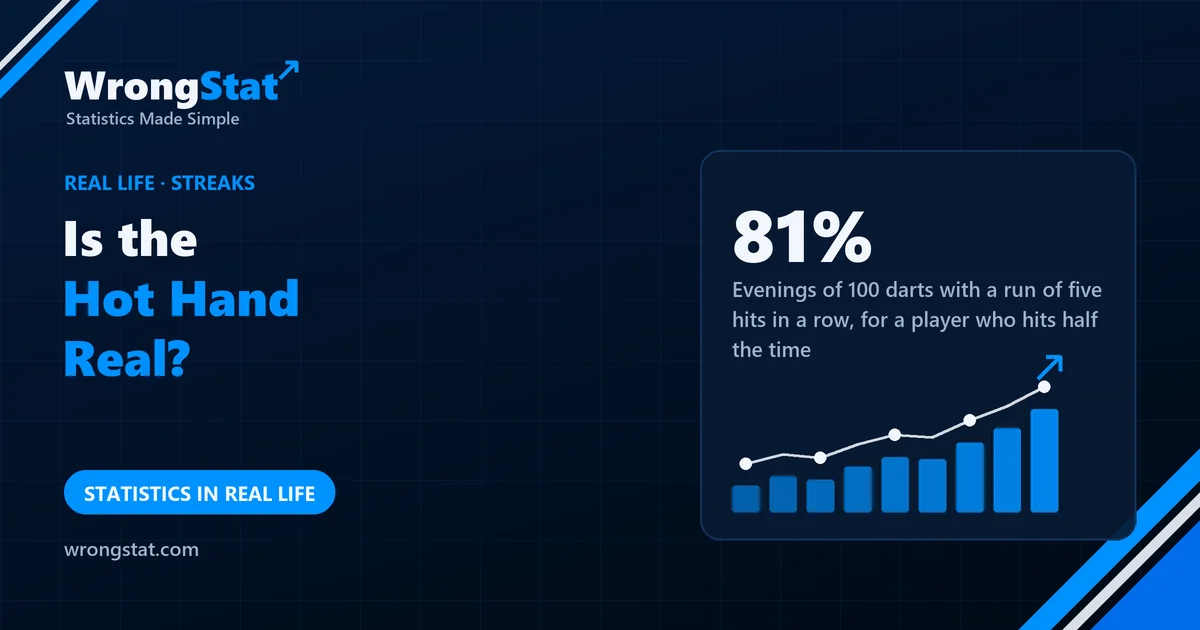
The short version: streaks happen by luck far more than people expect. A darts player who hits half the time throws a run of at least five hits in about 81% of 100-throw evenings, and six or more in about 54%. A famous 1985 study concluded the basketball hot hand was an illusion, but in 2018 economists showed its method was biased towards finding nothing, and reanalysis found a modest hot hand. Both are true: real hot streaks exist, and most streaks you see are luck.
Thursday night at the Red Lion. Uncle Gary, who hits the double he's aiming at about half the time, hit six in a row. He announced that he was "in the zone", demanded to throw every remaining leg of the league match, and celebrated by buying a round of Old Ted's homemade cider, which the Red Lion stocks under a different name for legal reasons.
He missed the next four. Old Ted, who keeps the score in chalk and his opinions in a jar, said Gary's zone had been closed by the council. Mia, who is studying statistics, said it was more complicated than that. Everyone looked at her. She said she'd need a whiteboard.
How streaky is pure luck?
Say Gary hits 50% of the time, and each dart is independent of the last. In an evening of 100 darts:
- His longest run of hits averages about 6.
- He gets a run of at least five in about 81% of evenings.
- At least six in about 54%. At least eight in about 17%.
So six in a row is an ordinary Thursday for a player who's exactly as good as Gary always is. Random sequences are lumpy. People expect them to alternate neatly, so a lump looks like a cause.
Evenings with a run of at least this many hits in a row
The study that called it a myth
In 1985, psychologists Thomas Gilovich, Robert Vallone and Amos Tversky studied basketball shooting, including a shooting experiment with college players, and found that players were no more likely to score after a run of hits than after misses. The "hot hand fallacy" became a textbook example of the mind seeing patterns in noise. For thirty years, statisticians used it to tell sports fans to calm down.
The twist
In 2018, economists Joshua Miller and Adam Sanjurjo published a paper in Econometrica with a surprising point about how streaks had been measured. Take a fair coin, flip it four times, and for each sequence work out the share of heads that come straight after a head. Average that share across all possible sequences. You'd expect 50%. You get 40.5%.
The bias comes from looking only at what follows a streak inside a short sequence: the streak uses up flips that can't then count as followers. So a purely random shooter looks "cold" by that measure, and a shooter who scores 50% after hits is actually doing better than chance. Reanalysing the original data with the correction, they found evidence of a modest hot hand. The textbook example of a fallacy turned out to contain a small real effect, hidden by a subtle bias.
So is it real?
Probably yes, and small. Confidence, focus and rhythm may raise a player's chances a little after a run of success. But luck alone produces most of the streaks you see, and the feeling of being on fire is much bigger than the effect. Gary's six darts are mostly luck, with possibly a pinch of cider.
How to test your own hot hand
1. Record every throw. Not just the streaks. Hundreds of throws, hits and misses.
2. Compare like with like. Your hit rate after three hits in a row, against your hit rate after three misses, with a large sample of both.
3. Compare with a random player. Before believing a streak, ask how often a player of your skill would produce it by luck. For Gary, a run of five turns up four evenings out of five.
Where it costs you money
A trader who wins five trades in a row and doubles the position size is betting on a hot hand. Runs of winning trades appear by luck all the time, so the bigger bet usually lands at a random moment. Even if a real edge exists, it's likely to be small, like the corrected hot hand, and a small edge doesn't justify a big bet. Size your positions by your long-run record, not your last five trades.
The moral
Mia got her whiteboard. Gary agreed to record every throw for a month: 1,200 darts. He hit 49% overall, and 51% straight after three hits in a row. "There you go," said Mia. "A hot hand of about two points. Maybe. With this many throws it could still be luck." Gary had "HOT HAND (MAYBE)" printed on the back of his darts shirt. Old Ted chalked it on the board, then rubbed out the "(MAYBE)", because he needed the space for the cider prices.
Streak figures come from simulations of a 50% player with independent throws. Study details are summarised from the published papers. Gary, Ted and the cider are fictional. Educational content, not financial advice.