Can You Make Up Time by Driving Faster? Gary's Race to the Airport
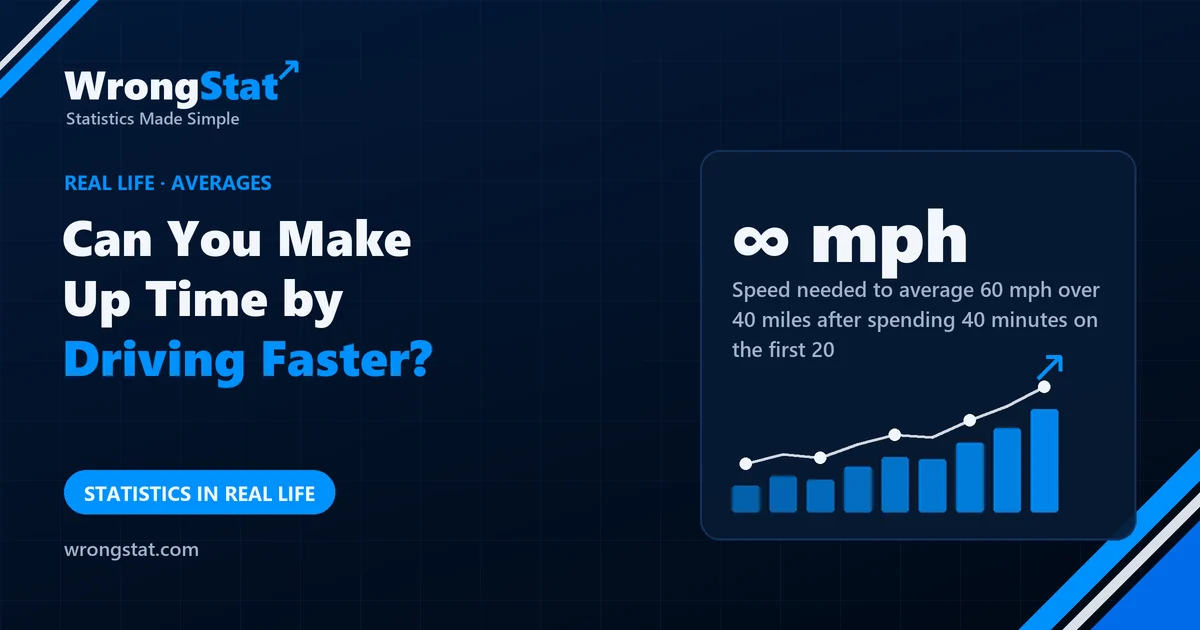
The short version: average speed is total distance divided by total time, so slow stretches eat time that fast ones can't give back. If Gary needs 40 minutes for 40 miles and spends 40 minutes on the first 20 miles, no speed on the second half can save him. On an open 20-mile stretch, 70 mph instead of 60 saves under 3 minutes. Investment returns work the same way: a 50% fall followed by a 50% rise leaves you 25% down, not even.
Uncle Gary had to be at the airport in 40 minutes. It was 40 miles. "Sixty miles an hour," he said, "dead easy." The first 20 miles were roadworks and a tractor, and took 40 minutes.
"No problem," said Gary, at the end of the roadworks. "I'll make it up on the motorway." Aunt Linda, in the passenger seat, asked how fast he planned to go. Gary did the sum in his head, said "about ninety", and put his foot down. Linda did the sum on her phone and asked him to pull over so she could show him something.
The speed that doesn't exist
To average 60 mph over 40 miles, Gary has to cover the whole trip in 40 minutes. Average speed isn't the average of the speeds. It's total distance divided by total time.
- First 20 miles at 30 mph: 40 minutes. That's all the time he had.
- Time left for the last 20 miles: zero.
- Speed needed: 20 miles in zero minutes. Not 90 mph. Not 900. No finite speed at all.
Gary's "about ninety" came from averaging 30 and 90 to get 60, which is exactly the mistake. The slow stretch took twice as long as planned, and time spent can't be un-spent. To make it up, he'd need to arrive before he set off, which is a feature of only the most advanced spacecraft and some airlines' timetables.
How much does speeding actually save?
Even when there's time left to play with, driving faster saves less than it feels. Over an open 20-mile stretch:
- At 60 mph: 20 minutes.
- At 70 mph: 17.1 minutes. Saving: under 3 minutes.
- At 80 mph: 15 minutes. Saving: 5 minutes, for a lot more fuel, risk and possibly a conversation with a police officer.
Each extra mile per hour saves less than the one before, because you're shaving time off a shrinking number. The saving that matters is usually in the slow bits: leaving earlier beats driving faster.
Minutes to cover 20 miles
The same trap in your savings
Investment returns average the way speeds do, not the way people think. Lose 50% and then gain 50%, and you don't break even:
- $1,000 falls 50% to $500.
- $500 rises 50% to $750.
- You're 25% down, although the "average" of the two returns is zero. After a 50% fall you need a 100% rise to get back.
Each percentage change applies to a different starting amount, so they don't simply add up. A bad year is the roadworks: it uses up ground that a good year has to work much harder to recover.
How to think about averages of rates
1. Go back to totals. Total distance over total time. Total money at the end over money at the start. Never average the rates directly.
2. Slow stretches weigh more. You spend more time going slowly, so slow speeds count for more in the average. Losses work the same way.
3. Check what's still possible. Before planning to "make it up", work out whether there's any time, or money, left to make it up with.
Where it costs you money
"Our fund averaged 10% a year" can describe a fund that turned $1,000 into much less than 10% a year compounded would suggest, if the returns swung wildly. Ask for the compound annual return, which is the investing equivalent of total distance over total time. And beware the urge to "make up" a loss with a riskier bet: like Gary's 90 mph, it often isn't enough, and it adds a new way to crash.
The moral
Linda showed Gary the zero. Gary looked at it for a while and said that if no speed was fast enough, there was no point speeding, and drove the rest of the way at a steady 60. They missed the flight by 20 minutes, which, Linda pointed out, was exactly the 20 minutes they'd lost to the tractor. The next flight was in three hours. Gary spent them explaining to the airport bar that the tractor had cost him an infinite speed.
Distances, speeds and the tractor are illustrative. Keep to the speed limit; the maths says it costs you very little. Educational content, not financial advice.