The Average Person Doesn't Exist: 4,063 Pilots and Gary's Family Ski Suits
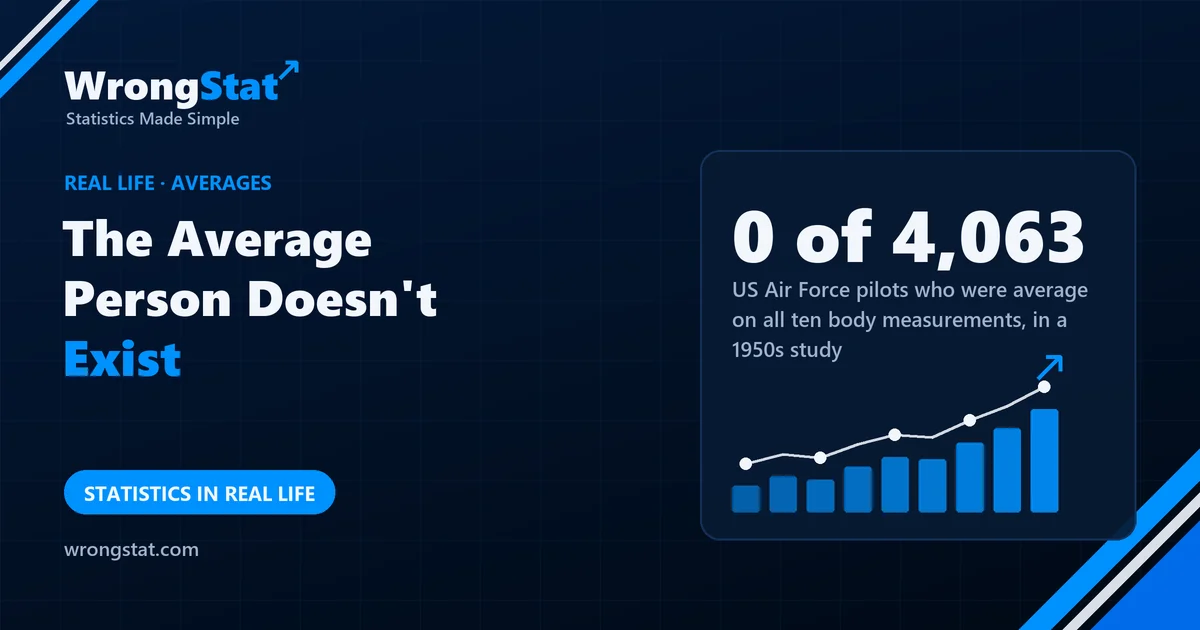
The short version: being average on one measurement is common, being average on many at once is almost impossible. When the US Air Force measured 4,063 pilots on ten body dimensions around 1950, with 'average' meaning the middle 30% on each, not a single pilot was average on all ten; on just three, fewer than 3.5% were. A cockpit built for the average pilot fitted nobody well. The fix was adjustable seats: design for the range, not the average.
Uncle Gary booked a family skiing holiday and, to save money and create what he called "a team identity", ordered five matching ski suits in a single size. To choose the size, he measured everyone's height, waist, arm length and leg length, and took the average of each.
The suits arrived. Gary's had the sleeves of a fifteen-year-old and the waist of a man who has never met a buffet. Grandpa Frank's legs ended at his shins. Mia's suit could have held Mia and a friend. Aunt Linda's fitted perfectly in the shoulders and nowhere else.
Gary maintains that the suits are correct and the family is wrong. He has written to the manufacturer to ask whether they also make the family.
The Air Force had the same problem
Around 1950, US Air Force pilots were crashing planes in ways that weren't explained by engines or weather. One suspect was the cockpit, which had been designed in the 1920s around the average measurements of pilots of the time. Maybe pilots had grown?
A young researcher, Gilbert S. Daniels, measured 4,063 pilots. He then took ten dimensions that mattered for the cockpit, such as height, chest, sleeve and leg length, and asked a simple question: how many pilots were "average" on all ten, with average meaning anywhere in the middle 30% of the range?
The answer, published in 1952: none. Not one of 4,063 pilots. Even on just three of the ten dimensions, fewer than 3.5% were average on all three.
Pilots who were 'average' (middle 30%) on every measurement
Why the average person vanishes
On any one measurement, 30% of people are in the middle by definition. But being in the middle on height doesn't make you likely to be in the middle on arm length, waist and leg length too. Each extra measurement is another filter, and the filters multiply. If they were completely unrelated, 30% on one would become about 2.7% on three and six in a million on ten. Body measurements are related, so the real numbers are a bit higher, but not by enough to save the average man.
That's the flaw of averages: the average of each measurement is a perfectly good number, but the person made of all the averages doesn't exist. A suit, a seat or a plan built for him fits nobody, in many different directions at once.
What the Air Force did instead
It stopped designing for the average pilot and started designing for the range. Adjustable seats, adjustable pedals, adjustable helmet straps: things that the Air Force had been told were too expensive turned out to be cheap compared with planes. Today the adjustable car seat is so ordinary that nobody thinks of it as a statistical discovery. It is one.
How to spot a plan for the average person
1. Count the measurements. The more things have to be "about average" at once, the fewer real people that describes.
2. Ask about the range. What happens to the person at the 10th and 90th percentile? If the answer is "it doesn't fit", it doesn't fit a lot of people.
3. Prefer adjustable to average. A seat that moves beats a seat that's perfectly placed for nobody.
Where it costs you money
Financial advice for "the average investor" assumes an average age, income, savings, debts, family and nerves. Nobody has all of those. A plan that fits the average on paper can be badly wrong for an actual person in several directions at once: too risky for one, too cautious for another. Use averages to understand the market, not to dress yourself in.
The moral
The family went skiing in their own clothes. The five average suits were donated to the ski school, which has been using them to teach the snowplough, because nobody wearing one can move their knees. Gary has since read about the Air Force and ordered adjustable ski suits. They arrived in a single size: average.
Pilot figures are from G. S. Daniels's 1952 report for the US Air Force as widely summarised; the multiplication example assumes unrelated measurements, which real body measurements are not. Gary's suits are fictional. Educational content, not financial advice.