Corporate life · Selecting on the outcome
Should You Copy Successful Companies? What Happened to the 'Great' Ones
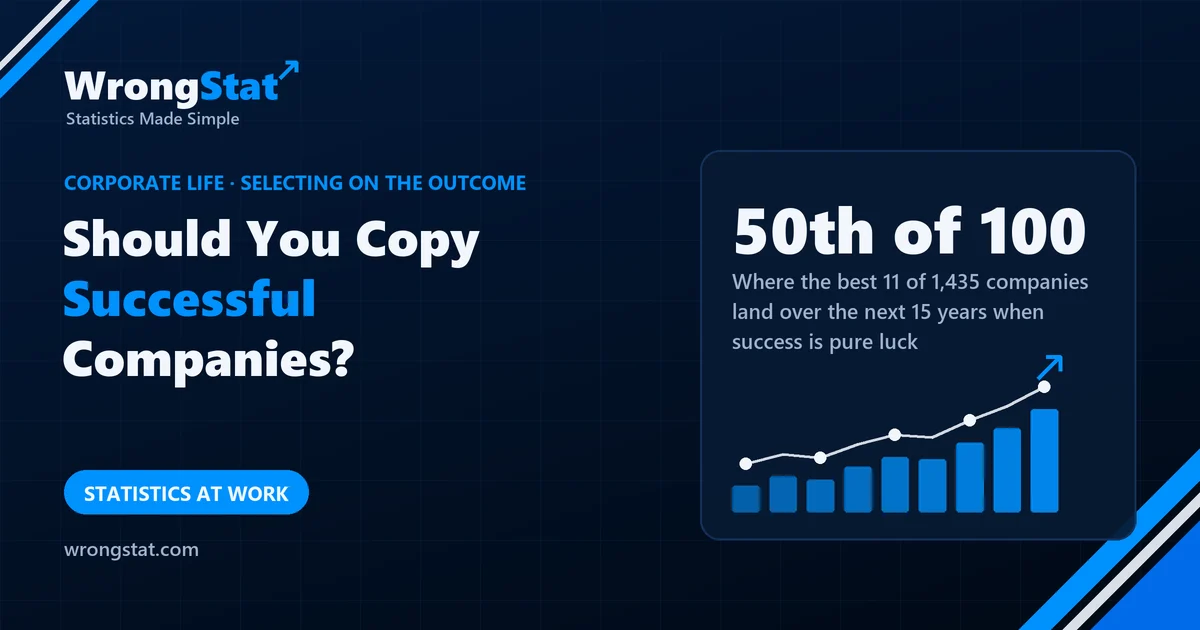
The short version: carefully. Business books often pick the most successful companies and look for what they have in common. That's selecting on the outcome: without the failures that did the same things, you can't tell habits from luck. Of the 11 companies a famous 2001 book picked from 1,435 as 'great', Circuit City went bankrupt in 2008 and Fannie Mae was taken over by the US government the same year. In our model, where 1,435 identical companies differ only by luck, the top 11 over 15 years land exactly in the middle over the next 15.
The CEO has read a business book on a long weekend. It studied the most successful companies and found what made them great: humble leaders, the right people on the bus, a single simple idea. Every manager has been given a copy and a workshop date.
Kevin looked up the companies in the book. Several are doing fine. One no longer exists. Kevin wonders whether to bring this up at the workshop, and decides to bring a chart.
How the great companies were found
The best-known example of the genre, published in 2001, screened 1,435 large US companies and picked 11 whose stock had gone from ordinary to spectacular over 15 years. Then the authors looked for what those 11 had in common, and compared them with similar companies that hadn't made the leap.
That's a serious effort, and the comparison companies help. But the 11 were chosen because of their results. Any trait they shared might have caused the success, or might simply be common among companies in general, or might have been how a lucky run looks from the inside.
What happened next
- Circuit City, an electronics retailer, filed for bankruptcy in 2008 and was liquidated in 2009.
- Fannie Mae, the mortgage giant, was taken over by the US government in September 2008.
- The others had mixed fortunes: some did well, some were ordinary. As a group, the great companies didn't stay great.
This isn't special to one book. A famous 1982 bestseller about "excellent" companies saw a business magazine run a cover story two years later about how many of them had stumbled.
What luck alone would do
We simulated 1,435 identical companies, the same in every way, whose yearly stock returns are pure chance. We picked the best 11 over the first 15 years and watched them for the next 15, 2,000 times over.
| The 11 best of the first 15 years, over the next 15 | Result |
|---|---|
| Average position (0 = best, 100 = worst) | 50 |
| Share in the top half | 51% |
| Chance each makes the top 11 again | 0.8% (random: 0.8%) |
In a world of pure luck, the stars would still have stories, habits and leaders to write about. Then they'd become exactly average. Real companies aren't pure luck, but when past winners slide back towards the middle, this is what a big dose of luck in their success looks like. It's regression to the mean.
Statistics for noobs: study the losers too
Picking cases by their outcome and then looking for causes is called selecting on the outcome. To learn what causes success, you need everyone who had the trait, winners and losers, and everyone who didn't. "All the great companies had humble leaders" means nothing until you know how many failed companies had humble leaders too. It's the same mistake as survivorship bias: the failures who did the same things aren't in the book.
Where it costs you money
"Buy the stocks the best fund managers hold" and "copy the habits of successful investors" are selecting on the outcome. A fair test picks the rule in advance, applies it to everyone, and counts the losers who followed it too.
The moral
Kevin brought the chart. The CEO studied it and agreed that some great companies had stopped being great. He concluded that they must have stopped following the principles, and has ordered a second book, about companies that stayed great. Kevin has checked: it picked its companies for having beaten their industry at least tenfold.
What this can't tell you
- Our model is pure luck. Real companies differ in skill and strategy; the point is how much a pattern of luck can look like a pattern of skill, not that management never matters.
- Some lessons may be right. Selecting on the outcome doesn't prove a lesson wrong; it means the study can't tell whether it's right.
- Later fortunes are a rough check. Companies change, markets change, and later decline can have new causes.
The CEO, the workshop and Kevin's chart are an illustration. The company facts are public record. The simulation is our own: 1,435 identical companies with random yearly returns, 15 plus 15 years, repeated 2,000 times. Educational content, not business or financial advice.