Is Fantasy Football Luck or Skill? Kevin's Three Titles, Tested
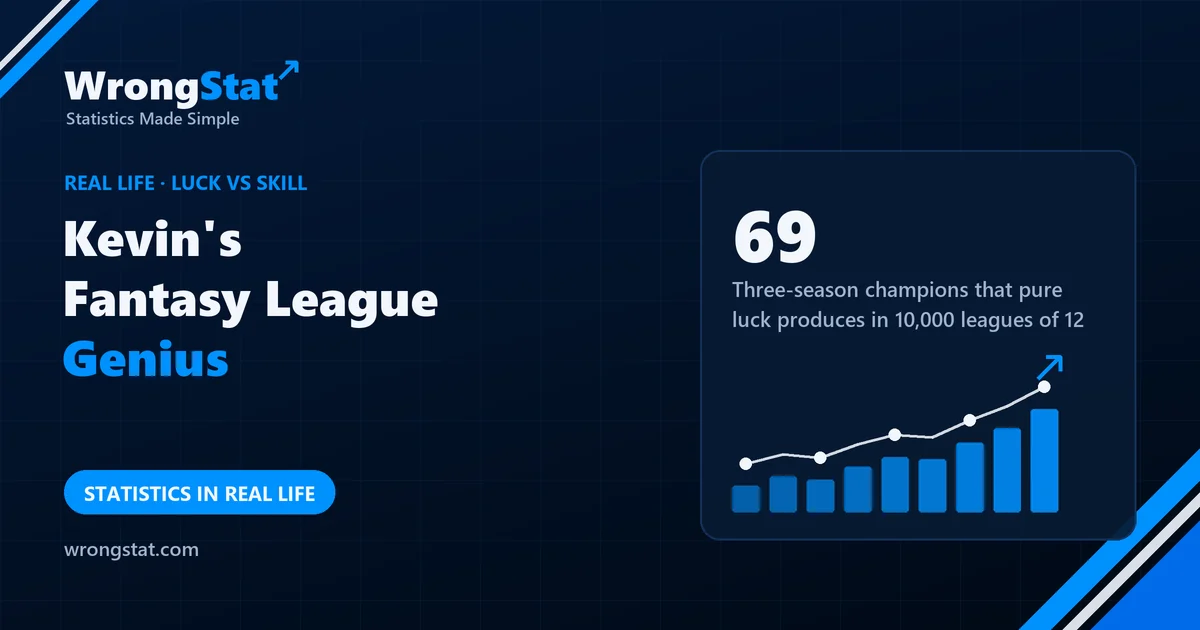
The short version: for one particular person, winning a 12-person league three years running by pure luck is a 1 in 1,728 chance. But somebody in some league will do it: across 10,000 leagues, luck alone makes about 69 three-time champions. Each one has a story about his system. The rare event isn't Kevin. It's Kevin noticing he's rare.
Cousin Kevin has won the office fantasy football league three seasons in a row. He has a trophy, which he bought himself, and a system, which he explains to anyone standing still for long enough. It involves weather, the stars, and a spreadsheet with 14 tabs.
He is now thinking of starting a newsletter. Uncle Gary has offered to subscribe, for a share of the profits.
Aunt Linda is in the same league. She came last three seasons in a row. Nobody has asked her for a newsletter.
How rare is three in a row?
Let's be generous to luck and give every one of the 12 players an equal chance each season, so the system does nothing at all.
- Chance that Kevin specifically wins one season: 1 in 12.
- Three in a row: 1/12 × 1/12 × 1/12 = 1 in 1,728.
That looks like proof. A 1 in 1,728 event doesn't happen by accident. Kevin has calculated this himself and put it on slide one of the newsletter.
Linda's three last places are exactly as unlikely: also 1 in 1,728. By Kevin's logic, she has a system too, an equally astonishing one, for losing. Either both of them are geniuses, or the logic is broken.
The question Kevin didn't ask
The right question is not "how likely is it that Kevin does this?". It's "how likely is it that somebody does this?". Kevin only noticed his record because he's the one who had it.
- In one league, the chance that any of the 12 players wins three in a row is 12 × 1/1,728 = 1 in 144.
- Across 100 leagues, there's about a 50% chance that at least one three-time champion appears.
- Across 10,000 leagues, pure luck produces about 69 of them.
There are far more than 10,000 fantasy leagues. So every year, chance alone crowns dozens of three-time champions, each with a trophy, a system and a newsletter. None of them sees the other 9,931 leagues where nothing happened. Each of them sees himself, and he looks remarkable.
This is the same mistake as testing hundreds of trading strategies and keeping the best one, which we call multiple testing. If you look at enough attempts, something will always look brilliant.
Chance that somebody, somewhere, wins three seasons in a row by pure luck
So is Kevin any good?
Maybe. Skill is real in fantasy football, as in most things. But three seasons can't show it, because luck can produce the same result too often. What would show skill:
1. Many seasons, not three. Finishing in the top half 9 seasons out of 10 is much harder to do by luck than three wins.
2. Points, not trophies. Winning depends on who you played. Total points over a season are less noisy than first place.
3. Predictions made in advance. If the system is real, it should predict next season before it happens, written down. Kevin's system explains last season perfectly. Every system does.
Where it costs you money
The fund manager who beat the market three years in a row, the trader with a famous winning streak, the newsletter with a perfect track record: there are thousands of them, and luck alone guarantees some spectacular records. The ones you hear about are the ones who won. That's why every test on this site compares a strategy with a random choice and corrects for how many things were tried. Without that, you're just reading the newsletter of the luckiest Kevin.
The moral
Kevin launched the newsletter. It has 212 subscribers. This season he finished seventh, which he says is "a reset year for the model". Linda finished third. She has not changed her system, which is to pick players with nice names. She says she's on a winning streak of one.
The odds assume every player has an equal chance each season, so that only luck is at work. Real leagues include some skill, which makes repeat winners somewhat more likely, but doesn't change the point: a short record can't separate skill from luck. Educational content, not financial advice.