Corporate life · Murphy's laws
Parkinson's Law: The Navy That Shrank While Its Office Grew
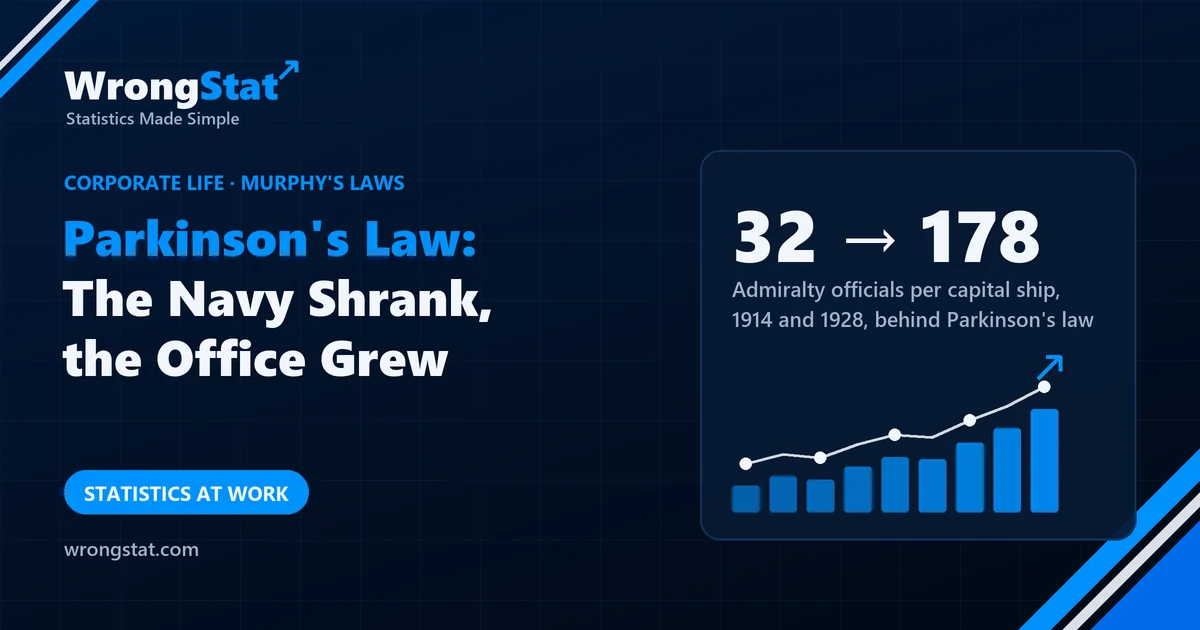
The short version: Parkinson's law is satire with a spreadsheet. In a 1955 essay, a historian used Admiralty figures to show that from 1914 to 1928 the number of capital ships in commission fell from 62 to 20 and sailors fell by 31%, while Admiralty officials rose from 2,000 to 3,569, up 78%. Officials per ship went from about 32 to about 178. His point: staff numbers grow on their own, at roughly 5-6.5% a year, whatever the work. The statistical lesson is to compare growth with the thing the growth is supposed to serve, and to watch both the top and the bottom of every ratio.
Kevin's department has grown from 12 to 19 people in three years. The number of customers has fallen slightly. The department head presents this as a success: "We've invested in capability."
Kevin asks what the capability is for. The department head schedules a meeting to discuss it, with six attendees and a facilitator, which, Kevin notices, is itself a kind of answer.
The essay
In November 1955, a British naval historian, Cyril Northcote Parkinson, published an essay in The Economist that began: "Work expands so as to fill the time available for its completion." The example he used was the Royal Navy, and the figures were real:
| Royal Navy | 1914 | 1928 | Change |
|---|---|---|---|
| Capital ships in commission | 62 | 20 | down 68% |
| Officers and sailors | 146,000 | 100,000 | down 31% |
| Dockyard workers | 57,000 | 62,439 | up 10% |
| Dockyard officials and clerks | 3,249 | 4,558 | up 40% |
| Admiralty officials | 2,000 | 3,569 | up 78% |
The fleet shrank by two-thirds. The people administering it grew by more than three-quarters. Parkinson, tongue in cheek, offered a formula for how officials multiply: they want subordinates, not rivals, and they create work for each other. He estimated that staff grow by about 5 to 6.5% a year regardless of how much work there is.
The ratio that exploded
Divide the officials by the ships and the change becomes dramatic: about 32 Admiralty officials per capital ship in 1914, about 178 in 1928, five and a half times as many. Per thousand sailors, from about 14 to about 36.
A ratio moves when either part moves, and here both moved the wrong way at once: the top went up and the bottom went down. A percent change in a ratio can therefore be far bigger than the change in either of its parts. Whenever a ratio jumps, look at the top and the bottom separately before deciding what happened.
Is it really a law?
It's a satire, and Parkinson meant it as one. Some of the Admiralty's growth had reasons: new technology, aircraft, more complex ships, a navy that was smaller but more expensive to run. But the useful question it asks is a statistical one: does the size of an organisation move with the work it exists to do? If the work falls and the organisation grows, someone should be able to explain why with numbers, not with "capability".
Statistics for noobs: grow with what?
Growth on its own says nothing. Staff up 50% might be wonderful or absurd, depending on whether customers, products or output went up too. Always put growth next to the thing it's supposed to serve: staff per customer, cost per order, managers per team. Then check both halves of the ratio over the same period.
Where it costs you money
Fund fees and company overheads follow Parkinson too: costs that grow every year while assets or sales don't. A cost ratio rising year after year is a warning sign, whatever the annual report calls it.
The moral
After the meeting about capability, the department created a new role, Head of Capability, reporting to the department head, with two analysts to measure capability. Headcount is now 22. The number of customers is unchanged. The department has been nominated for the company's Growth Award, which is judged on headcount.
What this can't tell you
- One essay, one example. The navy figures are real, but the "law" is a witty generalisation, not a study of many organisations.
- Work changes shape. A smaller fleet can need more administration if it's more complex; counting ships doesn't capture that.
- Growth rates vary. Parkinson's 5 to 6.5% a year is his own estimate from these figures, not a measured constant.
Kevin's department and the Head of Capability are an illustration. The navy figures come from C. Northcote Parkinson's essay in The Economist (1955); the per-ship and per-sailor ratios are our own calculation from them. Educational content, not business or financial advice.