Corporate life · Murphy's laws
Murphy's Law at the Office: Why the Bigger Meeting Always Starts Late
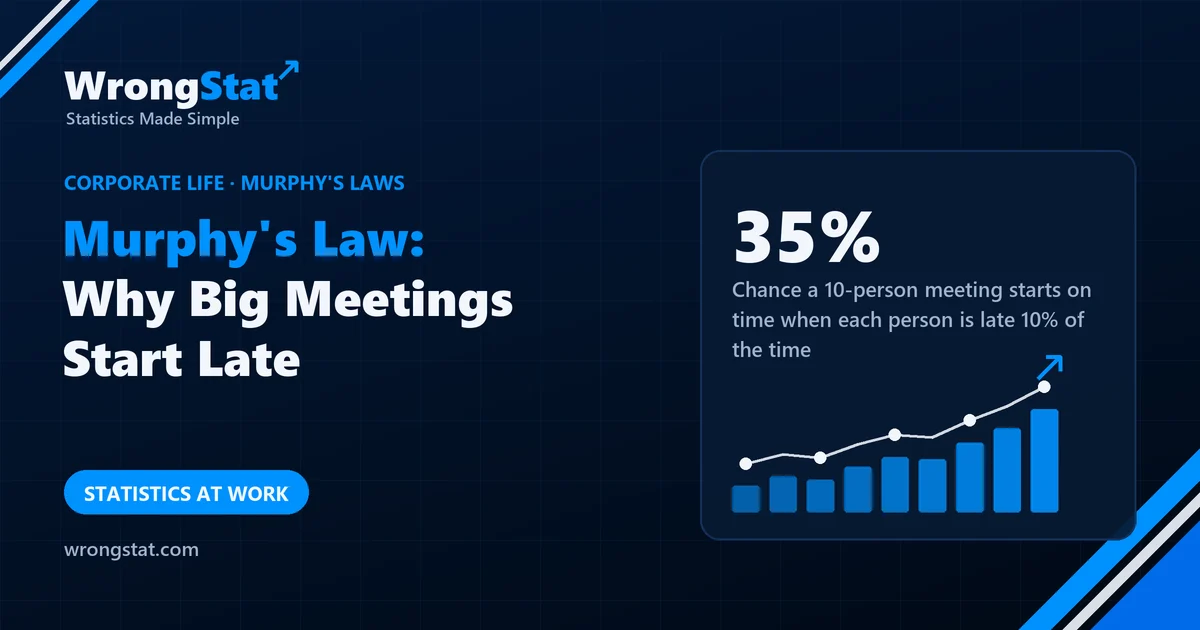
The short version: Murphy's law is mostly arithmetic. A small chance of something going wrong, repeated often enough, becomes a near certainty: the chance that nothing goes wrong in n independent tries is the single chance multiplied by itself n times. If each attendee is late 10% of the time, a meeting of 3 starts on time 73% of the time, a meeting of 10 only 35%, and a meeting of 20 just 12%. A printer that jams on 2% of jobs, used 10 times a day, jams on about 44 days a year. Memory then keeps the jams and forgets the thousands of pages that printed fine.
Monday, 9:00, the weekly all-hands. At 9:00 there are seven people in the room and a phone on speaker saying "can you hear me?". At 9:04 Darren arrives with a coffee. At 9:07 the projector finds the laptop. At 9:09 the boss says "let's give it two more minutes for the others".
Kevin's boss believes the team has a lateness problem. Kevin has looked at the calendar: everyone is on time nine times out of ten. The meeting is late anyway. It has twenty people.
Where the law comes from
The name goes back to 1949 and a US Air Force rocket-sled programme at Edwards Air Force Base, where an engineer called Edward Murphy found that a set of sensors had all been wired the wrong way round. His remark that if there's a way to do it wrong, someone will, became "anything that can go wrong will go wrong", and later the unofficial motto of every IT department.
As a law of nature it's false: most things go right most of the time. As a law of large numbers it's surprisingly accurate.
The arithmetic of "something always goes wrong"
If one thing goes right 90% of the time, two independent things both go right 0.9 × 0.9 = 81% of the time, and ten things 0.9 multiplied by itself ten times: about 35%. The chance that at least one goes wrong is everything else. Statisticians call this the complement rule: it's easier to work out the chance that nothing goes wrong, then subtract it from 1.
We simulated a million meetings in which each attendee, independently, is late 10% of the time, by anything from 1 to 10 minutes. The meeting starts when the last person arrives.
| People in the meeting | Starts on time | Average delay |
|---|---|---|
| 1 | 90% | 0.5 minutes |
| 3 | 73% | 1.5 minutes |
| 5 | 59% | 2.4 minutes |
| 10 | 35% | 4.0 minutes |
| 20 | 12% | 6.1 minutes |
Nobody in the twenty-person meeting is unreliable. The meeting is, because it needs all twenty. An eight-person daily stand-up with these habits starts on time on about 108 of 250 working days.
Chance a meeting starts on time, by number of people
Why it feels like fate
The second half of Murphy's law is memory. The printer that jams on 2% of jobs, used 10 times a day, jams on about 44 days a year, and those are the days you remember, especially the one before the board meeting. The other 2,300 or so print jobs that went fine leave no trace. With enough chances, rare bad luck turns up somewhere every week: that's the law of truly large numbers, and the office gives it a lot of chances.
Statistics for noobs: count the chances, not the luck
Whenever something "always" goes wrong, count how many chances it had. One in a hundred sounds rare until it gets a hundred chances a week. The chance of at least one problem in n independent tries is 1 minus (chance of no problem) to the power n, and it climbs much faster than intuition expects.
Where it costs you money
A portfolio of twenty positions, each with a small chance of a nasty surprise this year, will very likely contain at least one. That's not bad luck or a broken strategy; it's the arithmetic of many small risks. Plan for some surprise, rather than for none.
The moral
Kevin proposed smaller meetings. The boss agreed and split the all-hands into four meetings of five, each starting on time 59% of the time. He now attends all four, and is late to three of them, because they're back to back. The team has asked whether this proves Murphy's law. Kevin says no: it proves the multiplication rule, which is worse, because it's always true.
What this model can't tell you
- People aren't independent. A train strike or a previous meeting running over makes many people late together, which changes the numbers.
- Our 10% is an example. The pattern holds for any small chance; the exact percentages don't.
- Murphy's own story is retold differently. Accounts of the 1949 incident and the exact wording of the remark vary.
The all-hands, Darren's coffee and the projector are an illustration. The meeting figures come from our own simulation of one million meetings per size; the printer figure is our own calculation. Educational content, not financial advice.