Is It a Coincidence or a Sign?
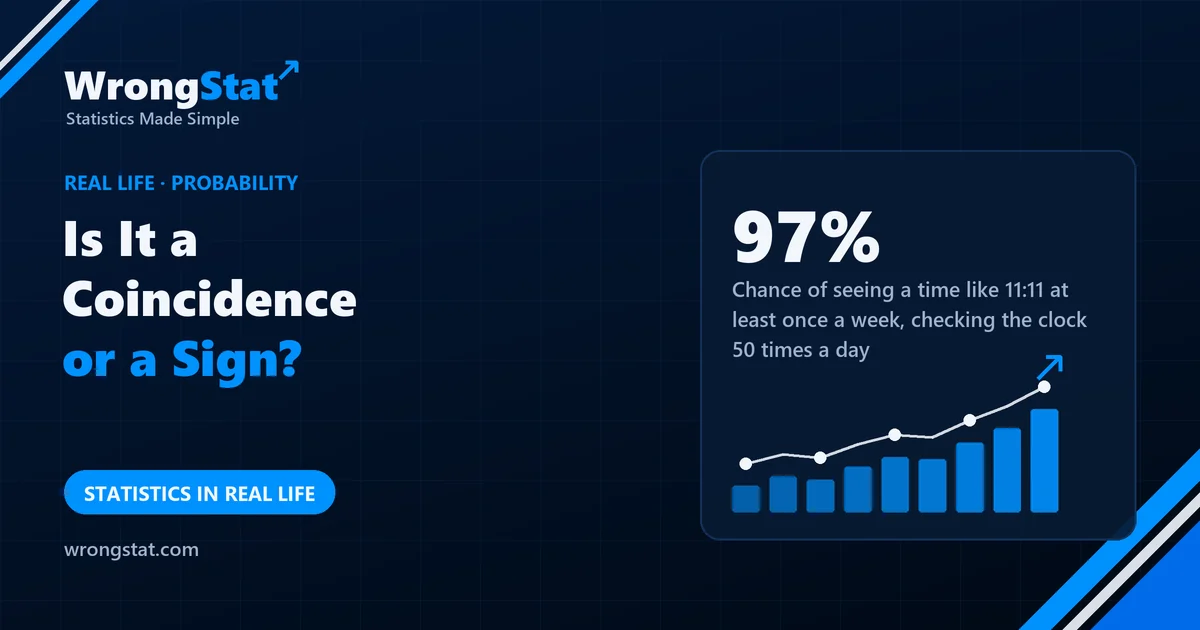
The short version: a coincidence feels rare because you count the hits and not the chances. If about 1 minute in 100 on the clock looks special to you and you check the time 50 times a day, you'll see one at least once a week 97% of the time. With enough chances, something astonishing is guaranteed to happen to someone, every day. A sign would have to beat that base rate, and you can only check that by writing things down in advance.
Aunt Linda sees 11:11. Not once. Several times a week. She looks at her phone and there it is: 11:11, or 2:22, or 12:34. She has read online that this means the universe is trying to tell her something.
Last Tuesday she was thinking about her sister, and at that exact moment the phone rang. It was her sister. Linda took this as confirmation. Uncle Gary took it as a reason to ask whether her sister also knew where he'd left his glasses.
Gary doesn't believe in signs. He believes in his lottery numbers, which is different, he says, because his have a spreadsheet.
How often should you see 11:11?
Let's count, with assumptions you can change. Suppose about 1 minute in every 100 on the clock looks "special" to you: 11:11, 12:34, 2:22, 3:33, 4:44 and their friends. And suppose you check the time about 50 times a day, which with a phone is modest.
| Period | Chance of seeing at least one "special" time |
|---|---|
| One day | 39% |
| One week | 97% |
| One month | practically 100% |
Seeing 11:11 several times a week isn't the universe being persistent. It's 50 glances a day being persistent. Not seeing it would be the strange thing. And nobody has ever felt a shiver at 2:47.
Chance of seeing at least one "special" time, checking the clock 50 times a day
The call from her sister
Linda's sister calls about once a week: 52 calls a year. Say Linda thinks about her sister for about an hour in every 16 waking hours. Then any given call has about a 1 in 16 chance of arriving in that hour, by pure timing.
52 calls ÷ 16 = about 3 calls a year that arrive "just as I was thinking of her". Those three are unforgettable. The other 49 calls are ordinary and forgotten. So are the hours Linda thought about her sister and the phone stayed silent. Memory keeps a very short list, and it only has room for the hits.
The law of truly large numbers
Here's the scale problem. Call something "one in a million" if it has a one in a million chance of happening to a given person on a given day. With over 330 million people in the US, a one-in-a-million event happens to more than 300 of them every single day. Some of them post about it. None of them post about the 330 million people to whom nothing happened.
Statisticians call this the law of truly large numbers: with enough people, days and chances, astonishing coincidences aren't just possible. They're guaranteed. The question is never "how unlikely is this?" but "how many chances were there for something like it?". It's the birthday paradox wearing a mystical hat.
How to tell a coincidence from a sign
1. Decide what counts before it happens. If 11:11, 2:22, 12:34, your birthday and your wedding date all count, you've made hits easy. Pick one, in advance.
2. Write down the misses. Every time you think of someone and they don't call is part of the test. Without the misses, you're only counting the times the coin landed heads.
3. Compare with chance. A sign would have to show up more often than timing alone predicts. Three "telepathic" calls a year is exactly what timing predicts.
Where it costs you money
Markets are full of signs: a chart that "looked exactly like" one before a crash, a pattern that "called" the last rally. Look at enough charts and some will match something, by the same arithmetic as 11:11. That's why we test patterns on thousands of cases chosen in advance and correct for how many things were tried, instead of remembering the one time it looked clever.
The moral
Linda still sees 11:11. She now says "statistics" instead of "sign", in exactly the same tone of voice. Gary, meanwhile, saw his lottery numbers on a car's number plate and bought an extra ticket. He says that's different. It isn't, but he did enjoy it.
The share of "special" minutes, the 50 glances a day and the hour of thinking are assumptions chosen to make the arithmetic clear; change them and the numbers change, but the pattern doesn't. The calculation treats each glance as independent. Educational content, not financial advice.