Do Open-Plan Offices Increase Collaboration? Face-to-Face Talk Fell by 70%
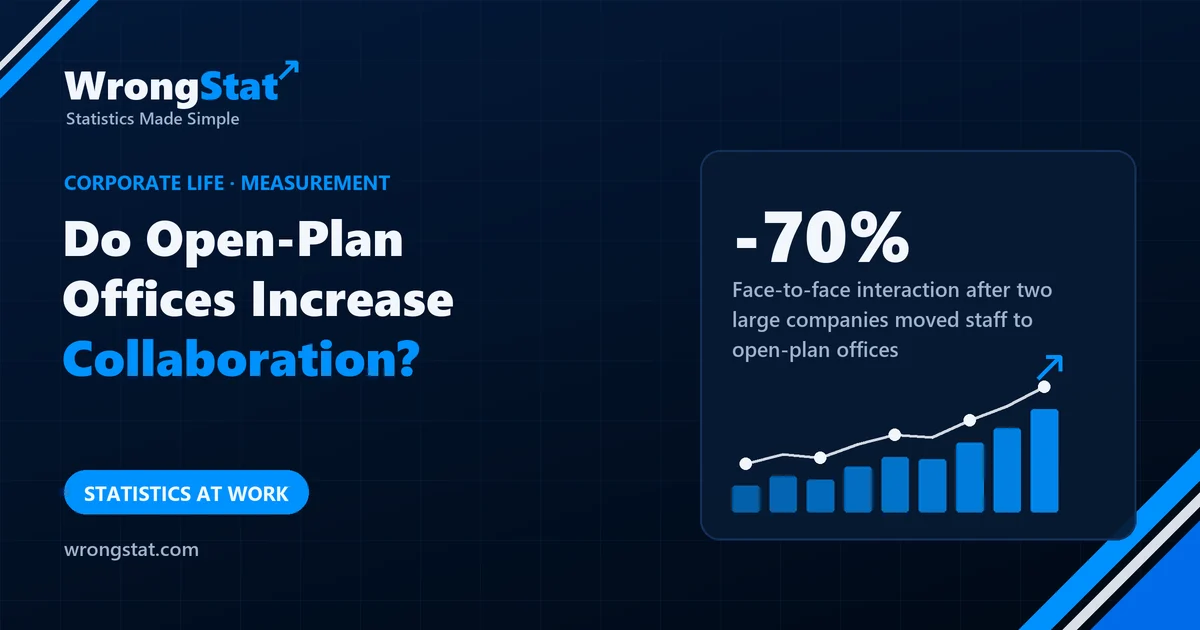
The short version: open plan was sold as a way to make people talk more. When researchers measured it with electronic badges at two large companies, before and after a move to open plan, face-to-face interaction fell by about 70% and email went up. People put on headphones and typed to the colleague three metres away. It's two companies and about 150 people, so it isn't the last word, but it is a measurement rather than a feeling, and the feeling was wrong.
Cousin Kevin's company has moved to an open-plan office to "foster collaboration". The walls are gone. The new floor has a sign that says COLLABORATION ZONE, beanbags nobody sits on and a long table that is technically for everyone and practically for the sales team.
On day one, Kevin noticed that everyone was wearing headphones. On day two, the person sitting directly opposite him sent him a chat message to ask whether he was free for a quick chat. Kevin replied by chat that he was. They then chatted. By chat.
The word that changed meaning
The plan rests on one idea: if people can see each other, they will talk more. It sounds obvious. So obvious that most companies never checked, and simply asked staff afterwards whether they felt the new space was collaborative. Since the space is officially called a collaboration zone, the answer comes back as "yes", and the word "collaboration" quietly starts meaning "the absence of walls".
What happened when someone measured it
In 2018, two researchers studied two large American companies as they moved staff from cubicles to open plan. Instead of a survey, they gave employees electronic badges that recorded when the wearer was in a face-to-face conversation, plus the volume of email and messages, for weeks before and after the move. The same people, the same jobs, the same companies, only the walls changed.
| After the move to open plan | Change |
|---|---|
| Face-to-face interaction | down by about 70%, at both companies |
| up, by roughly 20% to 50% depending on how it was counted | |
| Instant messages | up |
The likely mechanism is the one Kevin saw on day one. When everyone can hear everything, a conversation becomes a performance. People protect their attention with headphones and their privacy with the keyboard. The walls had been doing a job nobody had noticed: making it possible to talk.
Why the badge beats the survey
A survey measures what people think happened, filtered through what they think they're expected to say. A badge measures what happened. Neither is perfect. But when they disagree, the badge has no interest in the answer, and the survey was written by the people who paid for the beanbags.
The design matters too. Comparing open-plan companies with cubicle companies would mix the effect of the office with everything else that differs between them. Following the same people through the same move, a before-and-after comparison, removes most of that, though not all: something else might have changed at the same time, which is why seeing the same drop at two separate companies is reassuring.
Statistics for noobs: measure the behaviour
When you want to know whether something changed what people do, count what they do. Asking them how they feel about it is a different question with a different answer. Both can be useful; only one of them answers "do people talk more?"
And when a result goes against the plan, check the size of the study before celebrating or despairing. Here it's two companies and about 150 people: a strong signal, not a law of nature.
Where it costs you money
Investors are asked how they feel about risk on a questionnaire, then panic and sell in the first crash. What people say they'll do and what they do are measured separately for good reason. If you want to know how you behave in a falling market, look at what you actually did in the last one.
The moral
Kevin forwarded the study to the facilities team. Facilities replied that the open-plan office had been a great success, as shown by the staff survey, in which 81% agreed that the office was "an open environment". Kevin wanted to discuss this in person, but there was nowhere private to do it, so he sent an email.
What this study can't tell you
- Two companies, about 150 people. Small samples; other offices and other jobs may differ.
- Quantity, not quality. The badges recorded that people talked, not what about, or whether the work got better or worse.
- Before and after only. No group of similar staff stayed in cubicles for comparison, so other changes at the same time can't be ruled out completely.
- One kind of open plan. Offices with quiet rooms and small team areas weren't tested.
Kevin, the beanbags and the facilities survey are an illustration; the 81% is made up for the joke. The study figures come from the published paper (Philosophical Transactions of the Royal Society B, 2018). Educational content, not financial advice.