Is It Better to Go First in a Penalty Shootout? What 7,000 Shootouts Say
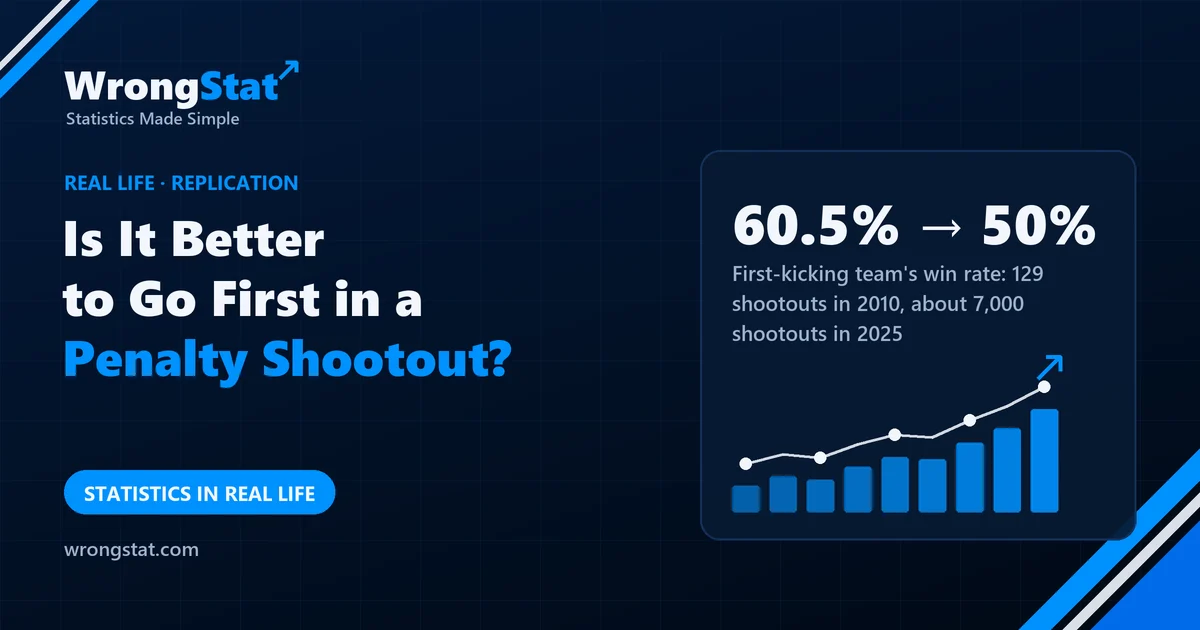
The short version: a well-known 2010 study of 129 penalty shootouts found that the team kicking first won 60.5% of the time, and the idea spread through football. When others collected more data, the edge shrank: 53.4% in 262 shootouts, then nothing detectable in 1,759 shootouts (2024) and in about 7,000 shootouts with 74,000 kicks (2025). The largest study used an equivalence test to rule out any first-kicker advantage bigger than 1.8 percentage points. In World Cup shootouts, roughly 7 penalties in 10 are scored.
The World Cup quarter-final went to penalties, and the Red Lion went quiet in the way a pub goes quiet when everyone in it is an expert. Uncle Gary broke the silence to report that the captain who wins the coin toss should always go first, because the team that goes first wins 60% of shootouts. "It's science," he said. "Pressure. The second team is always catching up."
Cousin Kevin, who captains a five-a-side team that has lost all three of its shootouts, two of them going first, asked where the 60% came from. Gary said it came from science. Kevin looked it up.
Where the 60% came from
Gary was right that it came from science. In 2010, two economists published a study in the American Economic Review of 129 shootouts in major competitions. The coin toss decides who kicks first, which makes it a natural experiment: luck, not skill, picks the order. The team kicking first won 60.5% of them. The explanation, pressure on the team that's always behind, made perfect sense, and the finding travelled: commentators quoted it, coaches chose first, and football's rule-makers even trialled a different kicking order in 2017 to make shootouts fairer, before dropping it.
What happened when the sample grew
Then other researchers did what science is supposed to do and checked. That's replication: run the same test on new data and see if the result survives.
- A replication with 262 shootouts: the first team won 53.4%, not significantly different from a coin toss.
- A 2024 study of 1,759 shootouts: no detectable first-kicker advantage.
- A 2025 study of about 7,000 shootouts and 74,000 kicks: no advantage for the first team or the second, and the same in ice hockey shootouts.
This is a common pattern. Small samples produce big swings by luck. A sample size of 129 shootouts can easily show 60% when the truth is 50%, and a striking result is more likely to get published and quoted than a dull one. As more data arrives, the striking ones shrink towards the truth.
Share of shootouts won by the team kicking first, by study size
"No evidence" is not the same as "proved there's nothing"
Usually, a study that finds nothing only tells you it didn't find anything. The effect could be real but too small for the data to see. The 2025 study went a step further, with an equivalence test: instead of asking "is there an effect?", it asked "how big could an effect be and still hide in this data?". The answer: the first team's chance of winning is between about 48.2% and 51.8%. A real edge of 1% might exist. A 60% edge doesn't.
What the numbers do say about penalties
1. Most penalties go in. In World Cup shootouts, about 7 in 10 are scored, so the shootout is decided mostly by the few misses.
2. Keepers dive. A 2007 study of 286 penalties found goalkeepers almost always dive left or right, even though, given where kicks went, staying in the middle would have saved slightly more. The authors called it action bias: a goal conceded while standing still feels worse. Other researchers later argued keepers behave close to optimally. The debate continues.
3. Going first or second is a coin toss. Choose whichever makes your team calmer. The data no longer cares.
Where it costs you money
A trading rule that won 60% of the time in 129 trades is a 2010 penalty study: a promising start, not a fact. Before trusting it, ask how many trades it was tested on, whether anyone has checked it on new data, and how big the edge looks when they do. Our own tests found the same pattern again and again: ideas that look strong on a small sample tend to shrink towards zero on a large one.
The moral
The team that kicked first won the quarter-final. Gary said it proved the 60%. Kevin said that one shootout can't prove anything, and that it would be shootout number 7,117 in the dataset, where it would make no difference. Gary said that was the most depressing thing anyone had ever said in the Red Lion, which, given the Red Lion, is a high bar. Kevin's five-a-side team now lets the goalkeeper choose. He chooses second, to give himself time to finish his drink.
The pub and the five-a-side team are fictional. Figures are from Apesteguia and Palacios-Huerta (American Economic Review, 2010), the replication by Kocher, Lenz and Sutter, Vollmer et al. (2024), Pipke (Journal of Economic Psychology, 2025), Bar-Eli et al. (Journal of Economic Psychology, 2007) and Opta-based World Cup shootout tallies. Educational content, not financial advice.