Corporate life · Diminishing returns
Does Working Longer Hours Get More Done? What the Factory Data Showed
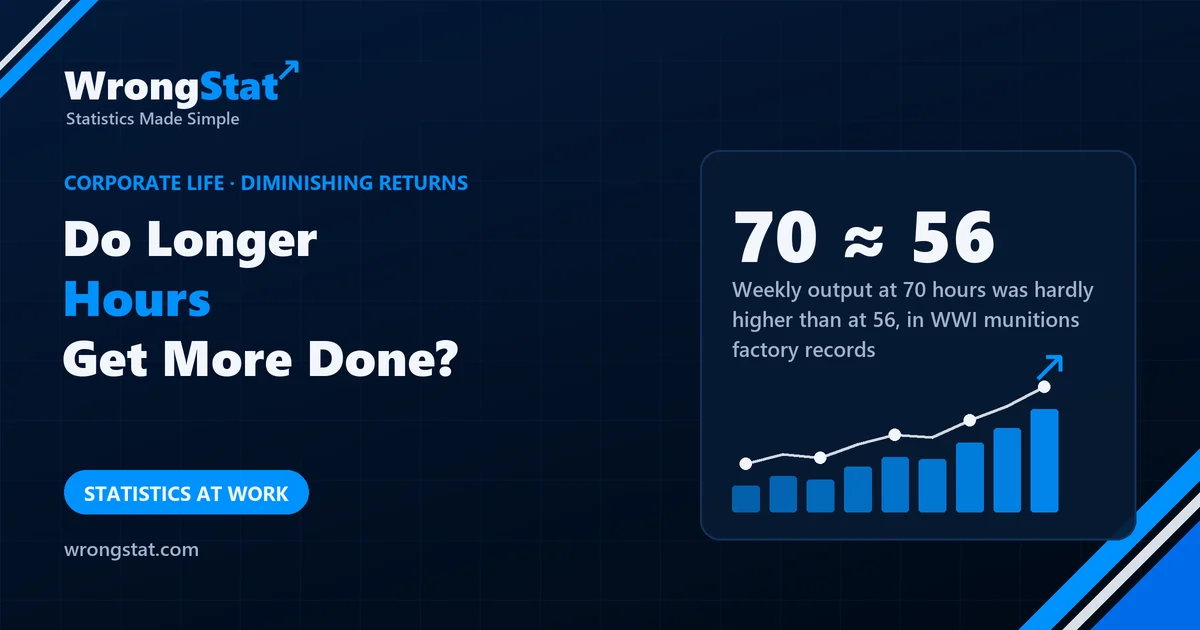
The short version: up to a point. In records from British munitions factories in the First World War, analysed by an economist a century later, weekly output rose roughly in proportion to hours up to about 49 hours a week. Above that, each extra hour added less, and a 70-hour week produced hardly more than a 56-hour week. Workers without a weekly day off also produced less. A plan that assumes 50% more hours means 50% more output draws a straight line through a curve.
The launch is in six weeks and the team is behind. Kevin's boss has done the maths: the team works 40 hours a week; at 60 hours, it will do 50% more, and the launch will be on time. Weekends are "optional but noticed".
Kevin asks whether hour 58 is as productive as hour 8. The boss says that's what commitment means.
The munitions factories
During the First World War, Britain needed shells fast, and many factories ran very long weeks. A government committee recorded hours and output for groups of workers, mostly women, in munitions work over months, because it worried that exhaustion was costing production. In 2014, an economist went back to those records and estimated how weekly output changed with weekly hours.
- Up to about 49 hours a week, output rose roughly in step with hours: more hours, proportionally more shells.
- Above that, each extra hour added less than the one before.
- At 70 hours, weekly output was hardly higher than at 56. The extra 14 hours produced very little.
- No day off made it worse: weeks without the Sunday rest produced less than the same hours with it.
Why the line bends
Tired people work more slowly and make more mistakes, and mistakes need fixing. Past a point, the extra hours are spent at a lower pace, and the tiredness carries over into the normal hours too. The relationship between hours and output isn't a straight line; it rises, then flattens. That shape is called diminishing returns.
A plan that multiplies the 40-hour output by 1.5 assumes the line stays straight. Above about 50 hours, in this data, it didn't.
Statistics for noobs: don't draw a straight line through a curve
Many relationships work well in the middle and break at the ends: fertiliser and crop yield, practice and skill, caffeine and focus. A rule measured in the normal range ("an hour of work gives an hour of output") can be badly wrong outside it. Before extending a trend, ask whether you've ever seen data at that extreme.
Where it costs you money
Doubling the size of a trade doesn't double the profit if the extra size moves the price against you, and doubling the hours spent watching screens doesn't double the good decisions. Returns to more effort, money or risk usually bend. Test the extreme, don't assume it.
The moral
The team worked 60-hour weeks for six weeks. Output rose about 15%. Bugs rose about 40%, and the final two weeks were spent fixing what weeks three and four had produced. The launch was two weeks late. The boss has concluded that the team lacked commitment and has scheduled the next project at 70 hours.
What this can't tell you
- Factory work a century ago. Physically demanding work in wartime; office work may bend at a different point, earlier or later.
- Not an experiment. Hours weren't assigned at random; the analysis compared groups and periods with different hours.
- Short bursts differ. A single long week may cost less than months of them; the data came from sustained schedules.
- Our epilogue is invented. The 15% and 40% in the story are illustration, not data.
Kevin, his boss and the launch are an illustration. The findings come from a study of British munitions workers' hours and output during the First World War (IZA discussion paper 2014; The Economic Journal, 2015). Educational content, not career, health or financial advice.