Corporate life · Cause and effect
Do Happy Employees Work Better? The Call Centre, the Weather and the Windows
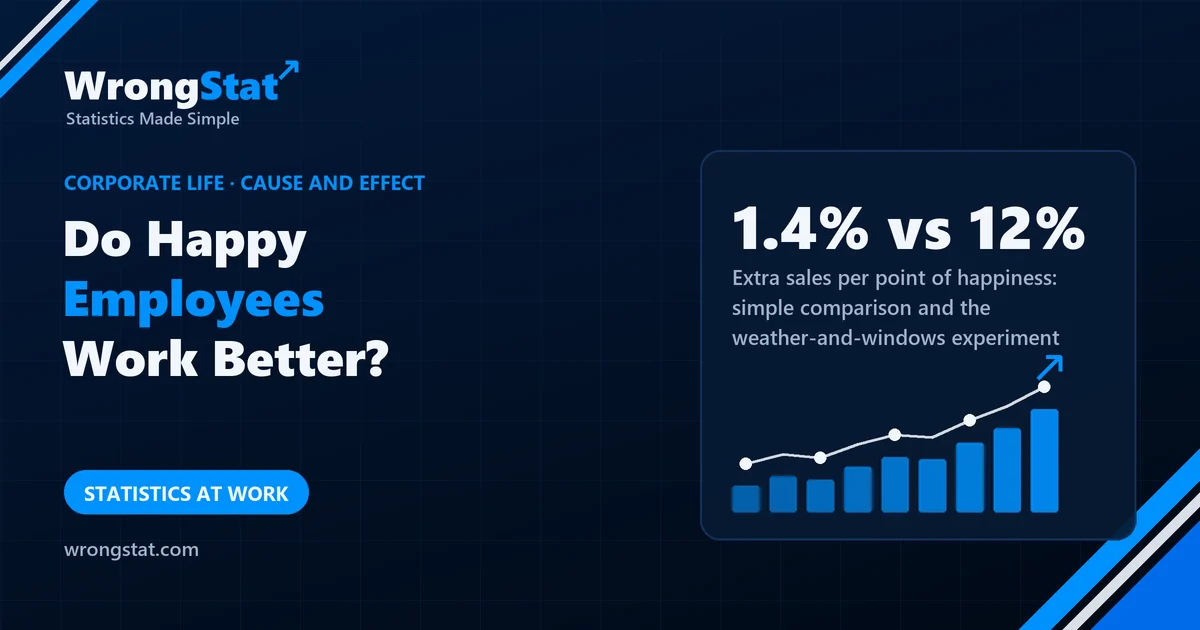
The short version: probably yes, at least in sales. Comparing happy and unhappy weeks can't prove it, because success makes people happy and busy weeks make them miserable. A study at a large UK telecom company used a natural experiment instead: bad weather lowers mood, but only for people who can see it, so call centres with more windows got a mood shock unrelated to sales. A one-point rise in happiness on a 0-10 scale meant about 3 more sales a week on a base of 25, around 12%, though with a wide margin of error. The simple comparison had shown only about 1.4%.
HR has run a survey. Teams that report being happy also report higher sales. HR has concluded that happiness causes sales and has introduced Fun Friday, attendance expected.
Kevin's boss has concluded the opposite: people are happy because they sold a lot, so the way to raise happiness is to raise targets. He has raised targets.
Kevin notes that both of them are now acting on the same chart, in opposite directions, and that the chart doesn't say which arrow is the right one.
Why the simple comparison fails
Happiness and output can push each other in several ways at once. Happy people may work better. Good results bring praise, bonuses and a nice feeling, so output can cause happiness: that's reverse causality. And a week with twice as many calls is tiring, so more work can lower happiness. Some of these arrows make the link look stronger than it is, some make it look weaker, and a survey can't separate them.
The ideal test would be to make random people happier and watch their sales. That's hard to do on purpose, so researchers looked for something that does it by accident.
The weather and the windows
The study followed 1,793 telephone sales staff in 11 call centres of BT, one of Britain's largest private employers, for six months. Every week they got a one-question email: how happy are you, answered with one of five faces. The answers were linked to the company's own sales records.
Then the trick. Gloomy weather lowers people's mood, but only if they can see it. Some of the call centres were glass towers; others were warehouses with almost no windows. So in a grey week, workers in bright, windowed buildings got a dose of gloom that had nothing to do with their sales, while workers in windowless buildings didn't. That's a natural experiment: chance, not choice, moves people's happiness.
- A one-point rise in happiness on a 0-10 scale meant about 3 more sales a week, on a typical 25: roughly 12%.
- The margin of error is wide: anywhere from under 1 to about 6 extra sales (95% confidence).
- Happier weeks didn't mean more hours, fewer breaks or better attendance. The gain came mostly from turning more calls into sales, and a little from more calls per hour.
The twist: the simple number was too small
Usually a naive correlation exaggerates. Here it did the opposite. Comparing happy and unhappy weeks directly gave an effect of only about 1.4% more sales per point of happiness, a tenth of the natural-experiment estimate. One reason the researchers found: in weeks when workers answered twice as many calls, their happiness fell by about half a point. The busiest weeks were the unhappy ones, which hid the effect of happiness on sales.
Reverse causality doesn't only invent effects. It can also hide real ones.
Extra weekly sales per one-point rise in happiness (0-10 scale)
Statistics for noobs: looking for an accident
When you can't run an experiment, look for something that changes the cause by chance and can only affect the result through it: weather plus windows, a lottery, a birthday cut-off. That's the idea behind natural experiments. Its weak point is the "only through it" part, which has to be argued, not just assumed.
Where it costs you money
Lists of companies with the happiest staff often do well as investments, and it's tempting to read that as "happiness makes profits". Profitable companies can also afford perks, and winning makes everyone cheerful. Before investing on a correlation, ask which arrow you're betting on.
The moral
HR read the study and concluded that to raise sales it must raise happiness scores. The weekly survey is now compulsory and the saddest face has been removed for being negative. Average happiness rose sharply. Sales didn't change. The survey now measures how well people understand the survey, which it does very precisely.
What this study can't tell you
- One company, one job. Telephone sales, where mood may matter more than in many jobs.
- Week-to-week mood. It measures the effect of a better week, not of a wellbeing programme, a pay rise or a ping-pong table.
- Self-reported happiness. About 80% of staff took part, and not every week; the people who answered may differ from those who didn't.
- The assumption. The method assumes weather seen through windows affects sales only through mood. The researchers tested this, but it can't be proved outright.
HR, Fun Friday and Kevin's boss are an illustration. The figures come from the study's 2022 version, published in Management Science in 2024. Educational content, not career or financial advice.