Why Average Salary Can Rise When Everyone Earns Less
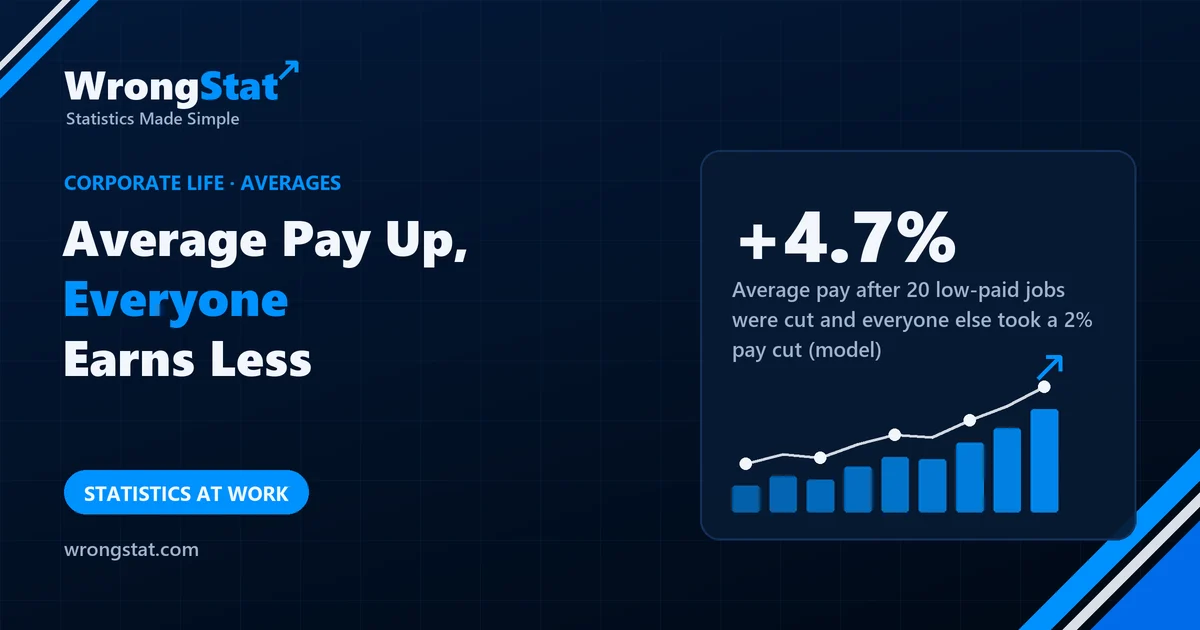
The short version: an average describes a group, and if the group changes, the average can move without anyone's pay changing in that direction. In our example, a company of 100 cuts 20 of its lowest-paid jobs and gives everyone else a 2% pay cut; average pay still rises 4.7%, from $55,000 to $57,575, while the median falls 2%. It works the other way too: give everyone a 5% raise and hire 40 juniors, and the average falls 9.4%. In April 2020, US average hourly pay jumped about 4.7% in a month, mostly because millions of low-paid workers lost their jobs.
The annual report has a page called People. It says that average pay rose 4.7% this year, "reflecting our commitment to our workforce". The CEO mentioned it in his video message.
Kevin's pay went down 2% this year. So did everyone else's. The cut was announced in February, in a different video message, about tough decisions.
Kevin has checked the arithmetic, and the report is correct.
How the average went up
Here is a simplified version of Kevin's company: 100 people, 70 in support roles on $40,000 and 30 specialists on $90,000.
| Last year | This year | |
|---|---|---|
| Support staff | 70 × $40,000 | 50 × $39,200 |
| Specialists | 30 × $90,000 | 30 × $88,200 |
| Total pay | $5,500,000 | $4,606,000 |
| Average pay | $55,000 | $57,575 (up 4.7%) |
| Median pay | $40,000 | $39,200 (down 2%) |
Twenty support jobs were cut and everyone left took a 2% cut. Nobody earns more. But the people who left were the lowest-paid, so the group that's left is, on average, better paid. The average measures the mix of people as much as their pay. That's a composition effect.
The median, the pay of the person in the middle, fell by exactly the 2% everyone lost, because the person in the middle is still a support worker. Here it told the truth and the average didn't.
It works the other way too
Next year the company grows. Everyone gets a 5% raise and it hires 40 juniors at $30,000. Average pay falls from $57,575 to about $49,821, down 9.4%, although every existing employee is better off. A newspaper could report "pay collapses at growing firm" and be correct.
It happened to a whole country
In April 2020, as the pandemic closed shops, restaurants and hotels, US average hourly earnings in the private sector jumped by $1.34 in a single month, to $30.01, about 4.7%, and about 7.9% above a year earlier. Workers had not suddenly been given raises. The official statisticians explained that the job losses were concentrated among lower-paid workers, which pushed the average up. As those people went back to work, the average dropped back.
Statistics for noobs: who is in the average?
Whenever an average changes, ask two questions: did the values change, or did the group change? Average pay, average test scores, average hospital survival and average customer value can all move because of who's in the group, not because of what happened to anyone in it.
The cleanest check is to follow the same people: what happened to the pay of those who were there both years? Here the answer is minus 2%, for every one of them.
Where it costs you money
Index and fund averages have the same problem. An index of "the 500 biggest companies" changes its members; a fund family's "average fund return" improves when it closes its worst funds. Check whether the figure follows the same things over time, or only the ones still standing.
The moral
Kevin raised the point at the town hall. The CEO thanked him for his engagement and explained that the company prefers to look at the big picture. The next annual report will show average pay up again. Kevin's team has been told that support roles are being reviewed, as part of the company's commitment to its workforce.
What this example can't tell you
- The company is a model. Real pay structures have more levels, but the effect works the same way with any mix.
- The median isn't magic. It can also move through composition; it just did the right thing in this example. Following the same people is the robust check.
- The 2020 figures are a snapshot. Official monthly data are revised, and the exact numbers can shift slightly.
The annual report, the CEO and Kevin's pay cut are an illustration. The company figures are our own model. The April 2020 figures come from the US Bureau of Labor Statistics' monthly employment report. Educational content, not financial advice.