The Wisdom of Crowds: Guess the Weight of the Cake, and Galton's Ox
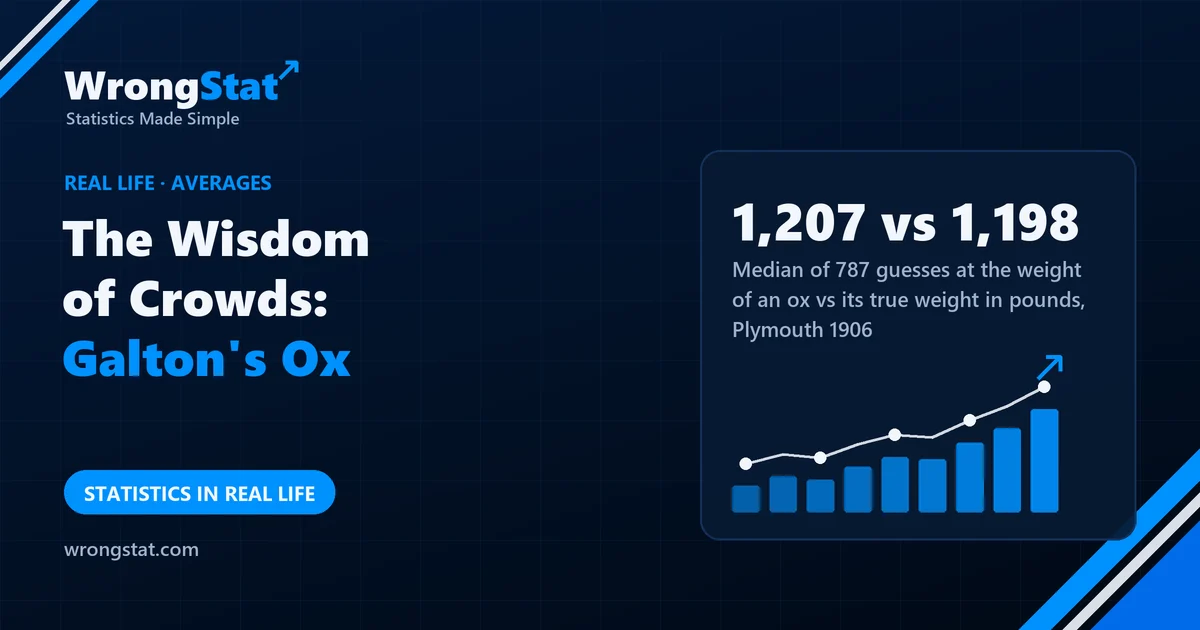
The short version: in 1906, 787 people at a livestock show in Plymouth guessed an ox's weight. Francis Galton found that the middle guess, the median, was 1,207 pounds; the ox's dressed weight was 1,198, less than 1% off. Individual guesses were all over the place, but their errors largely cancelled. The trick needs independent guesses: if everyone hears the loudest person first, the crowd stops being wise and becomes an echo.
Aunt Linda baked a fruitcake for the fete's "guess the weight" stall: 50 cents a guess, closest wins the cake. Over the afternoon, 140 people wrote down a number.
Uncle Gary guessed 25 pounds, on the grounds that Linda's fruitcake "has its own gravity". Grandpa Frank guessed 4. Cousin Kevin guessed 8.6 after weighing it in his hands for a long time and making a face he described as "calibrating". The cake weighed 8.6 pounds. Kevin was insufferable for a week. But the more interesting number was hiding in the other 139 guesses.
The ox
In 1906, the scientist Francis Galton visited a livestock show in Plymouth, England, where visitors paid sixpence to guess the weight of an ox once it had been slaughtered and dressed. Galton collected the 787 legible tickets afterwards and did something nobody had thought to do: he looked at all of them together.
- The middle guess, the median, was 1,207 pounds.
- The ox's dressed weight was 1,198 pounds: the median was less than 1% off.
- The average of all the guesses, worked out later, was about 1,197: even closer.
Galton published the result in Nature in 1907 under the title "Vox Populi", the voice of the people. Most individual guessers were well off. Together, they were nearly perfect.
Galton's ox, Plymouth 1906, in pounds
Linda's cake
At the fete, the 140 guesses ran from Grandpa's 4 pounds to Gary's 25. The median guess was 8.5 pounds, about 1% under the true weight. Gary's 25 pounds, an outlier, would have dragged a simple average upwards; the median simply ignored him, which Linda says is the correct response to most of Gary's estimates.
Why does it work? Each guess is the truth plus an error. Some people guess high, some low, for different reasons: one saw the cake tin, one judged by the fruit, one by the smell. When the errors point in different directions, they cancel, and what's left is close to the truth.
What ruins it
The cancelling only works if the errors are independent: if people guess on their own. At the next stall, a jar of sweets, Gary stood beside the box announcing his guess loudly to everyone who approached. The median guess there was close to Gary's number and nowhere near the jar's. A crowd that copies its loudest member isn't a crowd. It's Gary, many times.
How to use a crowd well
1. Collect guesses independently. Written down, before anyone hears anyone else.
2. Use the median when there are wild guesses. It isn't dragged around by the Garys.
3. Mix people who think differently. Different errors cancel; the same error, repeated, just gets louder.
Where it costs you money
Market prices are, in part, a crowd's guess, and they can be surprisingly good when investors think independently. They go wrong when everyone copies everyone else: bubbles and panics are crowds that stopped being independent. When "everyone" agrees, ask whether they reached that view separately or heard it from the same loud voice.
The moral
Linda gave Kevin the cake and kept the list of guesses, which she now uses as evidence whenever Gary estimates anything. Gary has proposed that next year he should guess last, "after reviewing the data". The committee has ruled that Gary will guess first, alone, in a sealed envelope, and that the envelope will be opened only after the cake is eaten.
Galton's figures are from his 1907 Nature article and later re-analyses. The fete and its cake are illustrative. Educational content, not financial advice.