Should You Guess on a Multiple-Choice Test? The Maths of Negative Marking
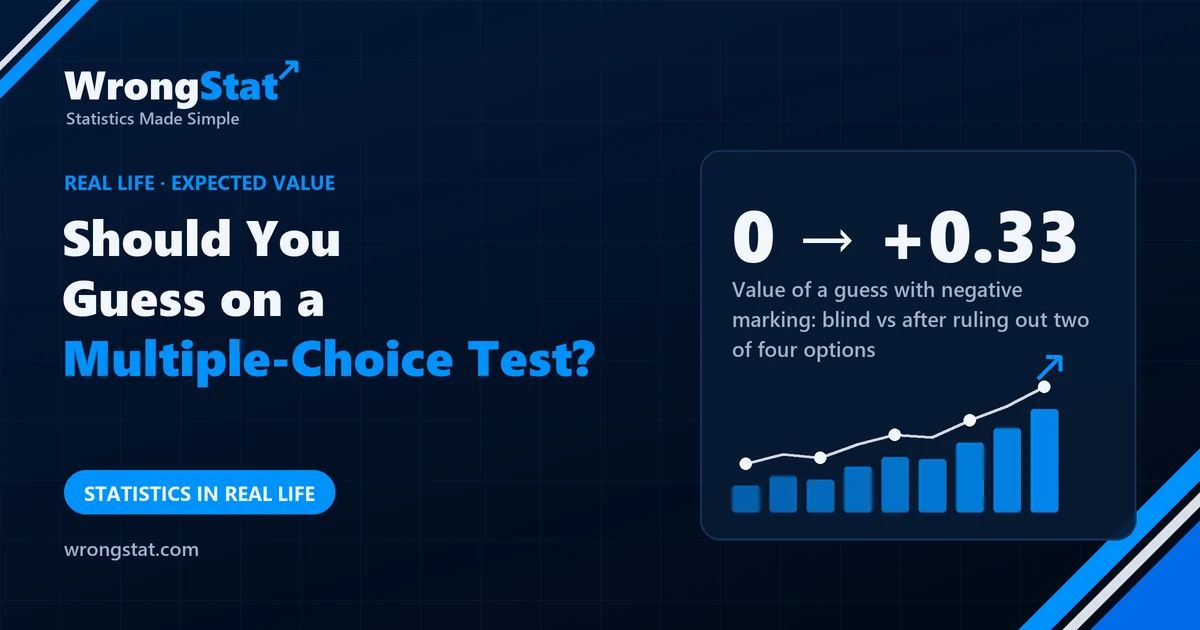
The short version: with four options, +1 for right and -1/3 for wrong, a blind guess has an expected value of exactly zero: you gain nothing on average, you just add risk. But if you can rule out one wrong option, a guess is worth +0.11 points on average; rule out two and it's +0.33. With no penalty, always guess: a blind guess is worth +0.25. The penalty is set to cancel blind guessing, not informed guessing.
Mia has a chemistry mock exam: 40 multiple-choice questions, four options each. The rules, printed in bold on the front: one point for a correct answer, a third of a point deducted for a wrong one, nothing for a blank.
Uncle Gary's advice was to leave blanks: "Never guess. The examiners can tell." Cousin Kevin's was to fill in C for everything: "C is statistically the most common answer." Grandpa Frank said that in his day exams were marked with a ruler, and showed her his knuckles. Mia decided to work it out.
What a blind guess is worth
With four options and no idea, a guess is right 1 time in 4 and wrong 3 times in 4.
- Right: +1 point, a quarter of the time: +0.25.
- Wrong: -1/3 point, three quarters of the time: -0.25.
- Total: 0. On average, a blind guess gains you exactly nothing.
That's not an accident. The penalty is chosen so that the expected value of blind guessing is zero. Guessing blind doesn't lose on average; it just makes your score jump about more. So Gary is half right: blind guessing doesn't help. But only half.
What an educated guess is worth
Most of the time you're not completely blind. You can often rule out one answer that's clearly wrong. That changes everything.
- Ruled out one option: right 1 time in 3. Worth 1/3 - (2/3 × 1/3) = +0.11 points.
- Ruled out two: right 1 time in 2. Worth 1/2 - (1/2 × 1/3) = +0.33 points.
- Over 10 such questions, ruling out two each time adds about 3 points on average.
The penalty is set for a blind guesser. Anyone who knows anything beats it. Leaving a question blank when you can eliminate an option is throwing away points.
Average value of a guess (four options, a third of a point off for a wrong answer)
And with no penalty?
Then always guess. A blind guess on four options is worth +0.25 points, and a blank is worth nothing. Many exams have dropped negative marking for exactly this reason: it mainly punished cautious students. The SAT in the US dropped its guessing penalty in 2016; before that, with five options and a quarter point off for a wrong answer, blind guessing was worth zero, just like Mia's mock.
As for Kevin's "always C": in a well-made test, the right answers are spread evenly across the letters, so C is right a quarter of the time, like any letter. Patterns in your own past tests are mostly the clustering of small samples.
How to decide on any question
1. Read the marking rules. Points for right, penalty for wrong, number of options.
2. Count what you can rule out. Each option you can eliminate makes a guess more valuable.
3. Guess when the expected value is positive. With a one-third penalty and four options, that's whenever you can rule out at least one. With no penalty, always.
Where it costs you money
A bet with an expected value of zero adds risk and nothing else, like a blind guess. Information is what turns a coin toss into a worthwhile bet. In investing, if you can't say what you know that the price doesn't, you're guessing blind, and costs make the expected value negative. If you genuinely can rule out some outcomes, the maths can be on your side, as long as you size the bet for being wrong.
The moral
Mia answered 28 questions she knew, guessed on 9 where she could rule out at least one option and left 3 blank. Five of her nine guesses were right, so she scored 31.7: almost 4 points more than if she'd followed Gary's advice. Kevin took the same exam the year before, answered C for everything and got ten right and thirty wrong, which comes to exactly zero. He maintains that C was unlucky that year.
Marking scheme and scores are illustrative; check the rules of your own exam. Educational content, not financial advice.