Gary's Roulette System That Can't Lose: Why the Martingale Always Does
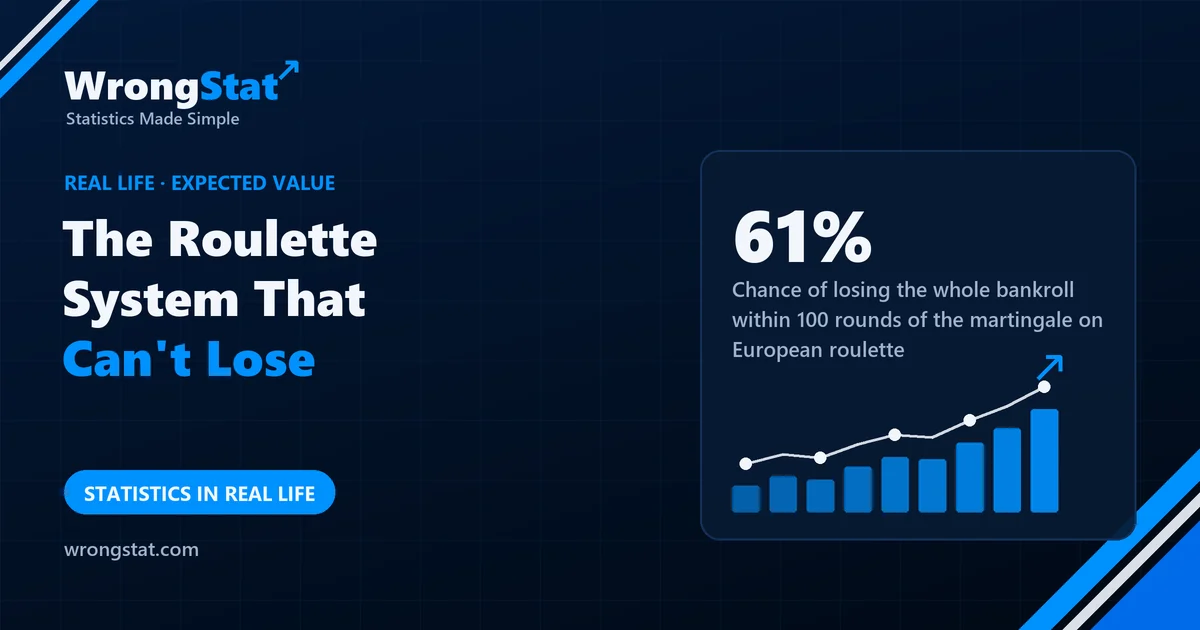
The short version: the martingale (double your bet after every loss) wins a small amount almost every time and then, eventually, loses everything. On European roulette with $1,270, Gary can survive six losses in a row; the seventh, which comes about once in 106 rounds, costs him $1,270. Each round is worth about $2 less than nothing on average, and over 100 rounds there's a 61% chance of being wiped out. No betting system changes the expected value of the bets underneath it.
For Old Ted's eightieth birthday, the allotment society hired a minibus to the casino. Old Ted brought a hip flask of his cider, which security confiscated and then, according to Ted, drank. Uncle Gary brought a system.
"It can't lose," Gary explained on the bus. "You bet $10 on red. If you lose, you double it: $20. Lose again, $40. Sooner or later red comes up, and you're $10 up. Then you start again." He had tested it on his phone and was $340 up, in an app that also told him he'd won a virtual pony.
Why it seems to work
Gary's system has a name: the martingale. And it does win, nearly every time. Each round (a string of losses ending in one win) makes exactly $10 profit, because the winning bet covers all the previous losses plus $10.
The catch is in the doubling. $10, $20, $40, $80, $160, $320, $640: after six losses, the seventh bet is $640, and Gary has already lost $630. With the $1,270 he brought, he can place exactly seven bets. If red fails to come up seven times in a row, he's out of money with nothing to double.
How often does the disaster come?
On European roulette there are 18 red numbers, 18 black and a green zero, so red comes up 18 times in 37 and something else 19 times in 37. Every spin is independent of the last: the wheel has no memory of the reds it owes you.
- Chance of seven non-reds in a row: about 0.94%, roughly 1 round in 106.
- Over 50 rounds, the chance it happens at least once: about 38%.
- Over 100 rounds: about 61%. Over 200: about 85%.
So the martingale is a machine that turns lots of small, likely wins into one large, rare loss. It feels safe for a long time, which is exactly what makes it dangerous.
Chance of losing the whole bankroll at least once
The number that doesn't change
Each round wins $10 with a 99.06% chance and loses $1,270 with a 0.94% chance. Multiply out and add up: the expected value of a round is about $2.05 below zero. Every round, on average, costs Gary about $2. The system doesn't change that; it just collects the cost in one painful instalment instead of many small ones.
That's true of every betting system ever invented for a casino game. If each individual bet loses money on average, no pattern of bets can add up to a winner. You can rearrange the losses, delay them and disguise them. You can't make them disappear.
How to spot a martingale
1. Look for small, steady wins with a hidden cliff. If a system almost never loses but you can't say what happens in the worst case, the worst case is the system.
2. Ask what each single bet is worth. If it's negative, no sequence of them can be positive.
3. Count the rounds, not the wins. A 1 in 106 disaster sounds rare. Over an evening of 100 rounds it's more likely than not.
Where it costs you money
Doubling down on a losing investment to "average down", or selling options that pay a small premium almost every month, can have the same shape: a long run of small gains and a rare, large loss. Some of these strategies are reasonable with proper sizing; all of them look brilliant right up to the cliff. Before you trust a smooth record, ask what the worst month would look like.
The moral
Gary won $10, twenty-three times in a row. He was $230 up, and told Old Ted that the system was proven. On the twenty-fourth round, the wheel produced black, black, zero, black, black, black, black. Gary had $230 left: exactly his winnings. He announced that the system had broken even on profits. Ted, who had put $10 on his age at the roulette table and lost, said it had been the best birthday in years. Security returned his hip flask. It was empty, and so, he noted, were they.
Figures assume European roulette with one zero and a $1,270 bankroll in $10 steps. Gambling with a negative expected value loses money on average, whatever the system. Educational content, not financial advice.