Is an Extended Warranty Worth It? Brenda's $15 Toaster Insurance
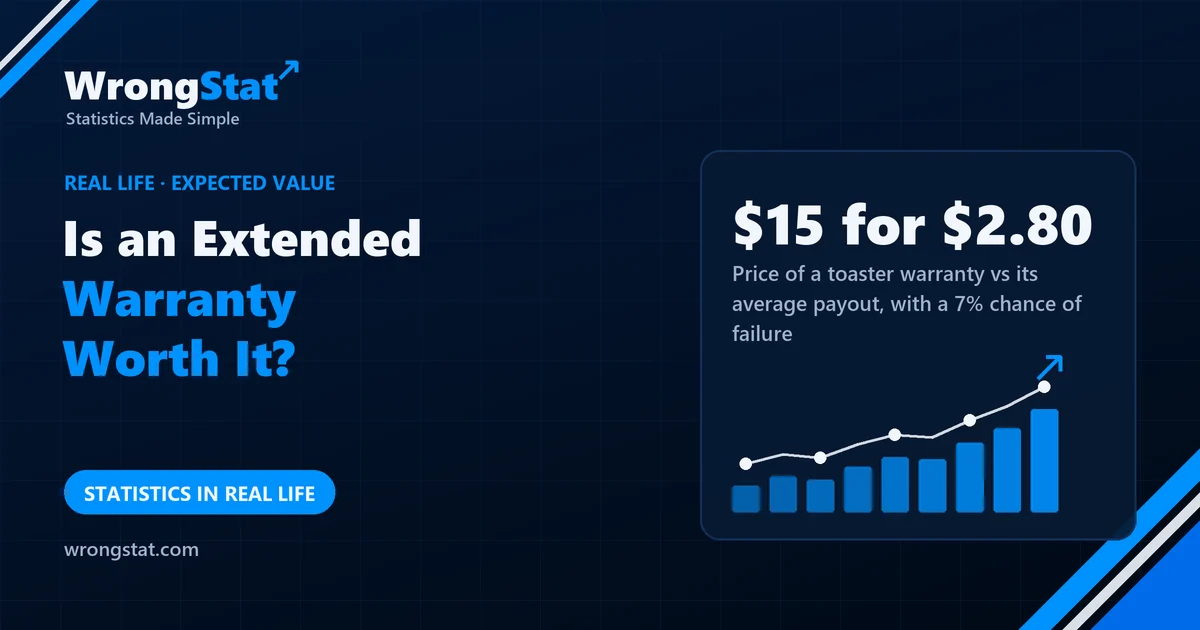
The short version: an extended warranty is worth its price only if the chance of failure times the cost of fixing it is higher than the price. For a $40 toaster with a 7% chance of failing in the extra two years, the expected payout is about $2.80, against a $15 price. That gap is the shop's profit. Insurance makes sense when a loss would really hurt you, like a house or your health. For things you could replace without trouble, you're usually better off being your own insurer.
Brenda, Aunt Linda's sister, bought a toaster for $40. At the till, a young man called Darren, whose badge said "Customer Protection Specialist", asked whether she would like the three-year Peace of Mind Plan for $15.
Brenda asked what it covered. Darren said it covered everything. Brenda asked whether it covered the toaster breaking. Darren checked and said it covered the toaster breaking unless the breaking was caused by toast, crumbs, electricity, use, or the toaster. Brenda asked what was left. Darren said: "Peace of mind."
What the warranty is worth
The first year is already covered by the manufacturer's guarantee, so the plan really covers years two and three. Let's say the chance that a toaster like this fails in those two years is 7%, and that a failure costs a new $40 toaster.
- Expected payout: 7% × $40 = $2.80.
- Price of the plan: $15.
- On average, every plan sold transfers about $12 from the customer to the shop.
That's the expected value of the warranty: the average payout across everyone who buys one. Most people pay $15 and get nothing, a few get a $40 toaster, and the shop keeps the difference. It's why the person at the till is called a Customer Protection Specialist and not a Toaster Repair Specialist.
Toaster warranty: price vs average payout
Why it feels like a good deal
At the till, the failure feels vivid: you imagine the toaster dying on a Monday morning. The chance, 7%, feels small but somehow present, and $15 feels small next to a $40 purchase. What you don't picture is the other 93 people who paid $15 and whose toasters toasted on. The base rate of failure is the whole question, and it's the one number the shop doesn't mention.
When insurance makes sense
Insurance always costs more on average than it pays out; that's how insurers stay in business. It's still worth buying when the loss would be hard to survive: a house burning down, a serious illness, a car crash that hurts someone. You pay a little more than the average to avoid a disaster you couldn't absorb.
A toaster is not that. Neither, for most people, is a phone, a kettle or a vacuum cleaner. If you could replace the thing without real hardship, you're better off putting the $15 aside. Do that for every gadget you own, and you've built your own warranty fund, one that keeps the profit.
How to check any warranty in a minute
1. Estimate the chance of failure. Look up reliability figures or reviews; for most small appliances in their second and third years, it's low.
2. Multiply by the cost of the fix. Chance × repair or replacement cost = what the warranty is worth on average.
3. Compare with the price, then ask whether you could survive the loss. If the price is much higher and the loss is affordable, say no thank you. Read what's excluded, especially anything caused by toast.
Where it costs you money
Investment products sold with "protection" or "guarantees" often have the same shape: a fee that's higher on average than what the guarantee pays out. Sometimes the protection is worth it, because a loss would be a disaster for you; often it's peace of mind at a high price. Ask what the guarantee is worth on average, and whether you could absorb the loss without it.
The moral
Brenda declined the plan. Darren looked hurt and asked whether she'd like the Peace of Mind Plan for the receipt. She declined that too. The toaster is now in its fourth year and works perfectly, except on Sundays, when it burns one side of every slice. Brenda has looked at the warranty terms on the shop's website. "Uneven browning" is excluded, along with toast, crumbs, electricity, use and Sundays.
The 7% failure chance and the prices are illustrative; check real reliability data for any product. Educational content, not financial advice.