How Long Will It Last? Kevin's Food Truck and the Copernican Principle
The short version: if you see something at a random moment in its life, you're probably somewhere in the middle. So its future is likely to be similar in length to its past: with 50% confidence, between a third and three times as long; with 95%, between 1/39 and 39 times. The physicist J. Richard Gott used this on the Berlin Wall in 1969 and on Broadway shows in 1993. It's a crude rule with real critics, and it fails for things with known lifespans, but it says something useful: what has lasted long tends to keep lasting.
Cousin Kevin has opened a food truck called Kevin's Kebabs. It has been trading for six months. Kevin has signed a five-year lease on a parking space, ordered a second truck and had the logo tattooed on his forearm.
Mia asked how long Kevin expected the business to last. "Forever," said Kevin. "Like the Red Lion." The Red Lion has been serving beer on the same corner for 120 years. Mia said she could give him a slightly more precise answer than forever. Kevin asked her not to.
The man who timed the Berlin Wall
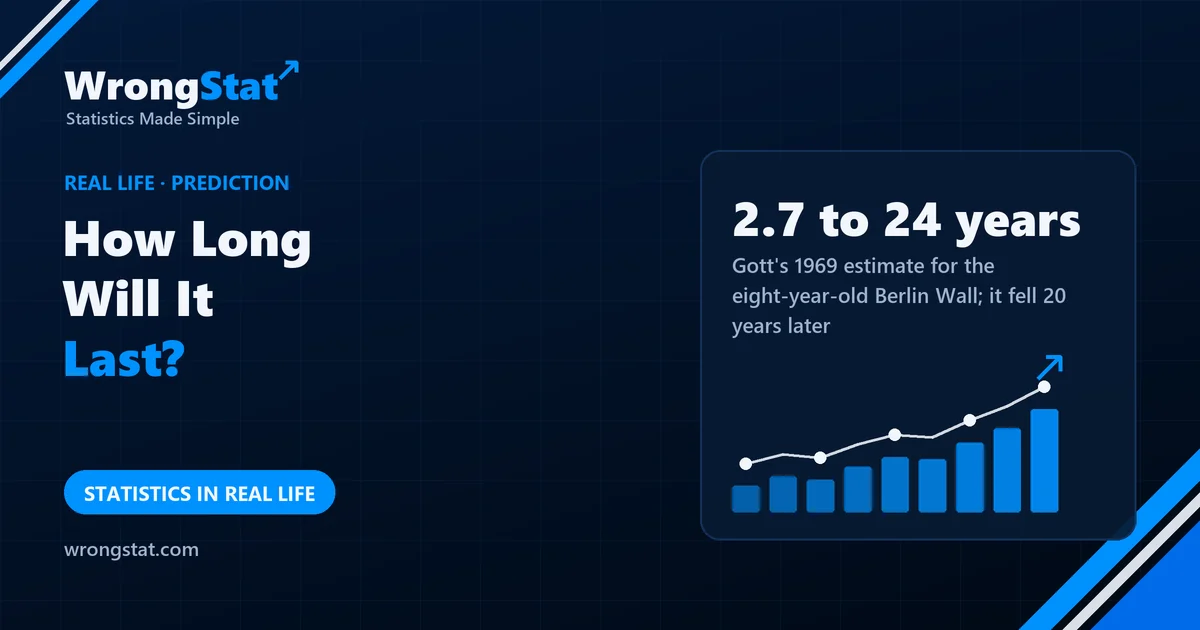
In 1969 a young American physicist, J. Richard Gott, visited the Berlin Wall. It was eight years old. Gott reasoned like this: there's nothing special about the moment of my visit, so I'm probably seeing the Wall somewhere in the middle of its life, not right at the start or right at the end.
If you're in the middle half of something's lifetime, its future is between a third and three times its past. So with 50% confidence, the Wall would last between about 2.7 and 24 more years. It came down in 1989: 20 years later. In 1993 Gott published the idea in the journal Nature, and checked it against the 44 shows running on and off Broadway that week. Most closed within the ranges his rule gave.
The Berlin Wall: Gott's 1969 prediction of its remaining life, in years
Kevin and the Red Lion
The rule only needs one number: how long the thing has existed so far.
- Kevin's Kebabs, 6 months old. 50% range: another 2 to 18 months. 95% range: about 5 days to 19.5 years.
- The Red Lion, 120 years old. 50% range: another 40 to 360 years. 95% range: about 3 to 4,680 years.
The ranges are enormous, which is honest: one number can't tell you much. But they're very different from each other. The pub that has survived world wars, recessions and smoking bans is far more likely to see out the decade than a truck that has survived one winter. Things that have lasted a long time have shown they can last. That's sometimes called the Lindy effect, after a New York deli where comedians used to gather and judge each other's staying power.
When the rule breaks
It only works if there's nothing special about when you're looking. It fails for things with known lifespans: a 90-year-old person won't live another 90 years, and a carton of milk two days from its date doesn't have weeks left. It fails if you arrived because something was newsworthy, which often happens at the beginning or the end. And critics, including the physicist Carlton Caves, have argued that it's far less universal than Gott claimed. Treat it as a rough confidence interval for when you know nothing else, not as a law.
How to use the rule
1. Find the age. How long has this business, show, tradition or trend existed?
2. Multiply and divide by 3. For a rough 50% range for its future. By 39 for 95%. Expect to be surprised a fair amount of the time.
3. Check that nothing is special. Known lifespans, sell-by dates or arriving at a dramatic moment break the rule.
Where it costs you money
A trading strategy that has worked for six months has shown very little; one that has worked across decades and different markets has shown more. A company founded last year is more fragile than one that has survived several recessions, other things being equal. Don't treat a short track record as a long one, and don't sign the five-year lease on six months of evidence.
The moral
Mia gave Kevin the 95% range anyway: somewhere between five days and nineteen and a half years. Kevin said that was fine, because nineteen and a half years would see him to retirement. The food truck is now eleven months old, which Mia notes has widened its expected future to between about 4 and 33 more months. Kevin has started saying "the business is maturing". The tattoo, Mia points out, is expected to last much longer.
Ranges use Gott's delta-t argument (50%: one third to three times the past; 95%: 1/39 to 39 times). It is a rough rule with well-known critics. Kevin's Kebabs is fictional. Educational content, not financial advice.