Were the Good Old Days Really Better? Grandpa Remembers Everything Except the Data
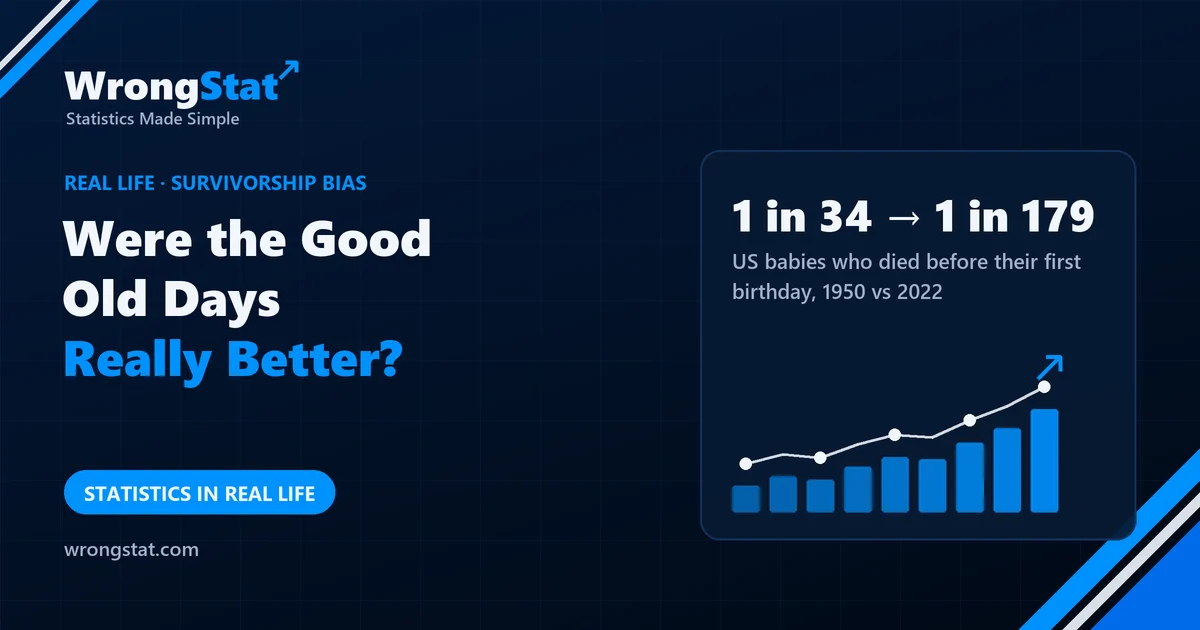
The short version: the past looks better because we see a filtered version of it. The old houses still standing are the ones that were built well; the bad ones were demolished decades ago. The old songs still on the radio are the hits; the flops are forgotten. And memory keeps the years around our late teens most vividly. Where we have records, the comparison often flips: in 1950, 29.2 of every 1,000 US babies died before their first birthday (about 1 in 34); in 2022 it was 5.6 (about 1 in 179).
Sunday lunch. Grandpa Frank, 81, puts down his fork and delivers the speech. "In my day, houses were built to last. Music was real music. Children were healthy, played outside all day and came home when the streetlights went on."
Mia, 15, is doing statistics homework at the end of the table. She writes it all down. Grandpa takes this as a sign of respect. It is a sign of a project.
"Houses were built to last"
Look at a street of houses from the 1950s and they do look solid. But you aren't looking at the houses built in the 1950s. You're looking at the houses from the 1950s that are still standing. The badly built ones cracked, leaked and were pulled down long ago. They aren't on the street to argue.
A made-up example shows how much this matters. Say a town built 1,000 houses in 1955, of every quality. Over seventy years, the worst 400 were demolished. The 600 that remain are, by definition, the better ones, so the average 1955 house you can visit today is better than the average 1955 house ever was. Compare it with today's new houses, which include every bad one, and the past wins without being better.
This is survivorship bias: judging a group by the members that made it through a filter, and forgetting the filter.
"Music was real music"
The songs from Grandpa's youth that you still hear have been filtered by sixty years of radio, film and nostalgia. What survives is the best of thousands. Today's music arrives unfiltered: the hits, the misses and the song about a truck that was number one for a week. It's a fair fight between a greatest-hits album and the whole of this week's releases.
There's also memory. Psychologists call it the reminiscence bump: people remember far more from roughly ages 10 to 30 than from other periods, and the music from their late teens tends to stay the most emotional for life. A 2013 study in Psychological Science found that young people had strong memories of, and liked, the music of their parents' youth too, probably because it filled the house when they were small. Grandpa isn't remembering 1960. He's remembering being 17.
"Children were healthier"
Here we have records, and they disagree with Grandpa. In 1950, the US infant mortality rate was 29.2 per 1,000 live births: about 1 baby in 34 died before their first birthday. In 2022, it was 5.6 per 1,000, about 1 in 179.
Grandpa's memory of healthy children is a memory of the children who grew up to play outside with him. The ones who didn't aren't in the memories, or at the reunion. It's the same filter as the houses, and the saddest version of it.
US infant deaths per 1,000 live births
So was nothing better?
Some things probably were, and some weren't. The point isn't that the past was bad. It's that "then" and "now" are usually compared unfairly: the survivors of then against everything of now, and memories of then against the news of now. A fair comparison uses the same kind of evidence on both sides.
How to compare then and now fairly
1. Survivors against survivors. Compare all the houses or songs of 1960 with all of today's, or the best of each with the best of each. Not the best of then with the whole of now.
2. Records over memories. Memory keeps the vivid and drops the ordinary. Where numbers were collected at the time, use them.
3. Same age, same view. Compare being 17 then with being 17 now, not being 17 then with being 81 now.
Where it costs you money
Markets have their own good old days. Today's stock index is made of companies that survived; the famous names that went bust dropped out and are easy to forget. A backtest run only on today's index members quietly buys the survivors in advance, and its past returns look golden for the same reason Grandpa's street does. Every test on this site includes the companies that later disappeared.
The moral
Mia read out the infant mortality numbers. Grandpa considered them, nodded, and said that in his day statistics were better too. "In your day," said Mia, "the statistic was 1 in 34." "Exactly," said Grandpa. "Round numbers. You knew where you stood." He then asked her to put on some real music, and she played him a song from 1962 that he'd never heard of, because it had sunk without trace. He hated it. Mia wrote that down too.
Infant mortality figures are US rates per 1,000 live births from national vital statistics (29.2 in 1950; 5.6 in 2022, per the CDC). The housing example is illustrative. Educational content, not financial advice.