The Friendship Paradox: Why The Friendship Paradox: Why "Everyone Else Is Allowed"
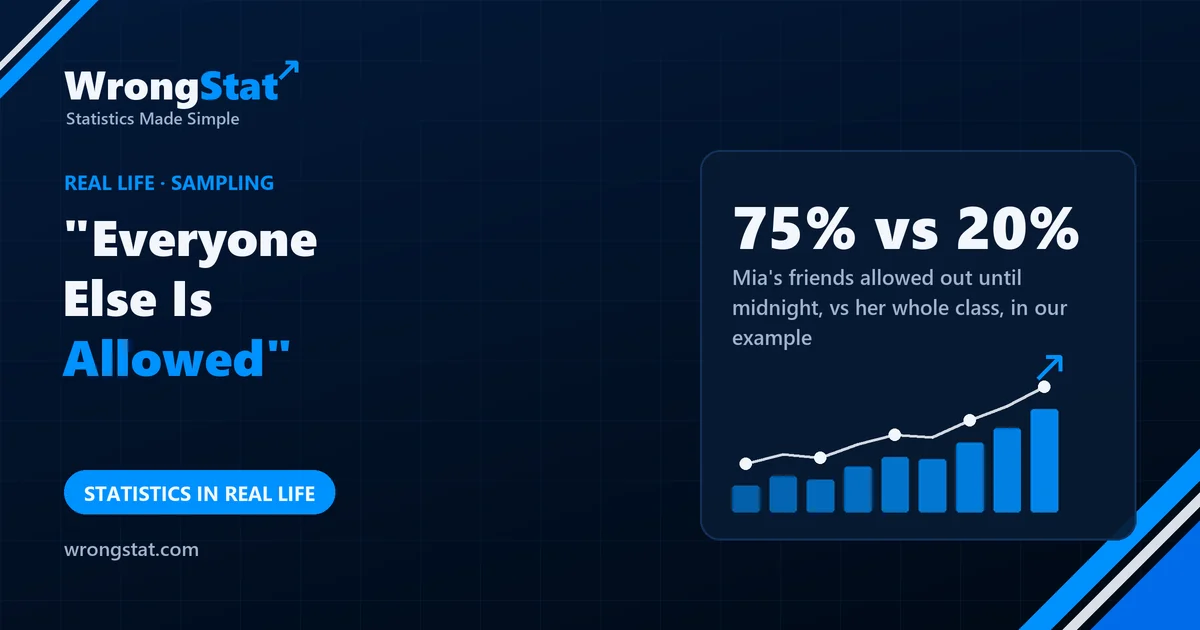
The short version: the most social people show up in the most friend lists, so your friends are, on average, more social than you are. In our example class, only 20% of kids are allowed out until midnight, but for a typical kid like Mia, 75% of her friends are. 'Everyone else is allowed' is a true description of a biased sample. It's called the friendship paradox.
Cousin Kevin's daughter Mia is fifteen and has been negotiating since she was four. Her opening position this time: "Everyone else is allowed out until midnight."
Kevin's counter-offer was ten o'clock and the phrase "If everyone else jumped off a bridge". Mia pointed out that if everyone else jumped off a bridge, it would be on her phone by 10:05, because everyone else posts everything.
Kevin assumed she was exaggerating. She wasn't. Mia's statement was accurate about every friend she has. It just wasn't accurate about the class. Both of those can be true at once, and the reason is one of the strangest facts in statistics.
The class, counted
Take a class of 30. Six of them are allowed out until midnight, and, as it happens, those six are also the most social: they each have 20 friends in the class. The other 24 kids, including Mia, have 5 friends each.
- Share of the class allowed out until midnight: 6 of 30, 20%.
- The six social kids have 20 friendships each: 5 with each other and 15 with the rest of the class. That's 90 friendships reaching into the other 24.
- The other 24 kids have 5 friends each, 120 friendships in total. 90 of those lead to one of the six midnight kids.
- So for a typical kid like Mia, 75% of her friends are allowed out until midnight.
20% of the class. 75% of Mia's friends. Nobody is lying, nobody is wrong about what they see, and the picture each kid sees is wildly off. Mia isn't surveying the class. She's surveying her friend list, and her friend list is packed with exactly the kids who have the most friends and the latest curfews.
Allowed out until midnight
The friendship paradox
This works in almost every group of people, not just our made-up class: on average, your friends have more friends than you do. It sounds like an insult. It's arithmetic. Someone with 20 friends appears in 20 friend lists. Someone with 5 appears in 5. So when you look at your friends, the very social people are over-represented, because they're in everyone's list.
Add social media and it gets stronger. The kids who are out until midnight are the ones posting at midnight. The kids at home at ten are at home, being invisible. "Everyone" means "everyone I can see", and the people you can see were selected for being visible.
Kevin does it too
Kevin decided to check, and asked the other parents. Specifically, he asked the four parents he chats to at the school gate. All four have relaxed rules, because the parents who chat at the gate are the relaxed ones. The strict parents were at home, enforcing things. Kevin came back and reported that "everyone else's parents allow it". He had run Mia's survey on himself, with the same result.
How to check "everyone"
1. Ask who you're counting. "Everyone" almost always means "the people I'm in contact with". Those people were not picked at random. They were picked for being in contact with lots of people.
2. Count the quiet ones. The people who don't post, don't chat at the gate and don't answer surveys are part of "everyone" too. They're just missing from your sample.
3. Find a list nobody chose. The whole class list, not the friend list. The whole register of parents, not the ones at the gate.
Where it costs you money
"Everyone is making money in this stock" is the investing version. The people telling you are the ones who made money, and they're the ones talking. The ones who lost are quiet, like the kids at home at ten. The feed you see is a friend list, not the class register. It's sampling bias with a profit and loss account.
The moral
Kevin and Mia agreed on 11 o'clock. Each reported to their own friends that they had won. Mia's friends believed her. Kevin's friends believed him. Both are, technically, a representative sample of themselves.
Mia has since told Kevin that everyone else's dad lets them have a phone in their bedroom. Kevin has started asking for the class list.
The class and its numbers are an illustration chosen to make the arithmetic easy to follow. The friendship paradox itself is a well-established mathematical result about networks. Educational content, not financial advice.