'More Than 80% of Dentists Recommend': How Every Brand Can Be the Favourite
The short version: if a survey lets each person pick several options, the percentages can add up to far more than 100%, and every option can be 'recommended by most'. In 2007 the UK Advertising Standards Authority ruled that Colgate's 'More than 80% of dentists recommend Colgate' poster was misleading, because the survey had allowed dentists to recommend several brands, so the claim implied a preference that hadn't been asked about. Always ask what the question was, and whether people could choose more than one answer.
Brenda, Aunt Linda's sister, needed toothpaste. The supermarket offered four brands. One was "recommended by more than 80% of dentists". Another was "the No. 1 brand recommended by dentists". A third was "trusted by 9 out of 10 dental professionals". The fourth had a picture of a dentist looking pleased.
Brenda did the arithmetic. 80% plus 90% plus whatever "No. 1" means came to more dentists than exist. She asked a shop assistant which toothpaste dentists actually recommend. He said: "All of them, apparently." She bought the one on offer.
How 80% of dentists can recommend everything
Imagine a survey asks 100 dentists: "Which of these toothpastes would you recommend? Tick all that apply." Most dentists think most fluoride toothpastes are fine, so they tick several.
- Brand A: ticked by 82 dentists.
- Brand B: ticked by 79. Brand C: ticked by 76. Brand D: ticked by 70.
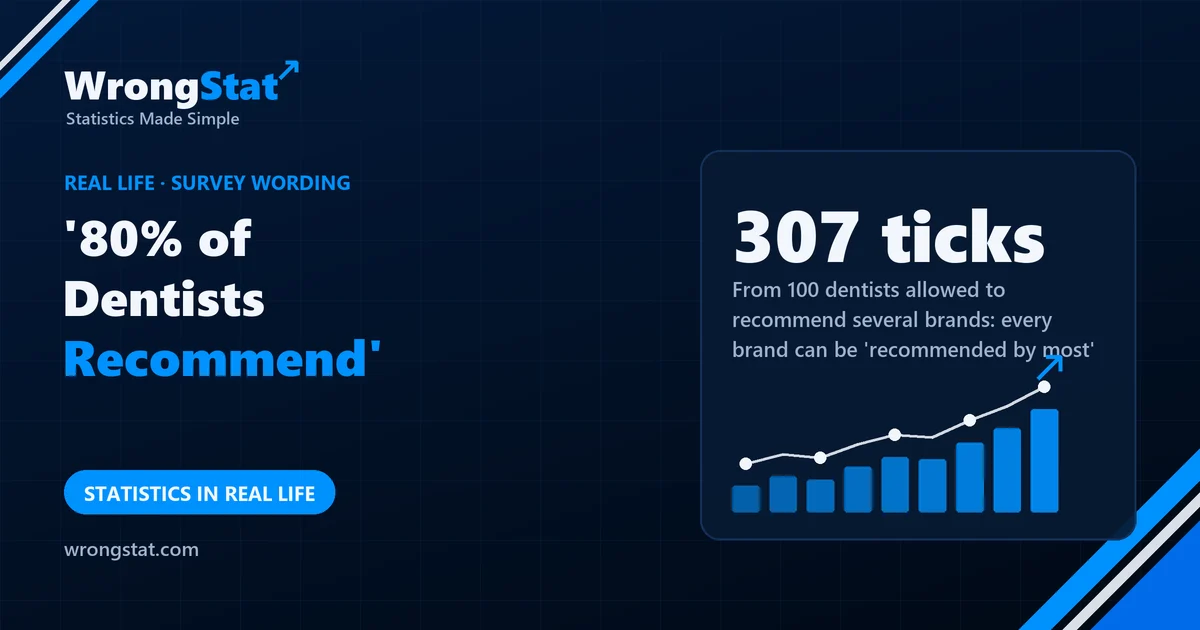
- Total ticks: 307 from 100 dentists. Every brand is "recommended by most dentists".
Each claim is true. None of them means what it sounds like: that dentists prefer this brand over the others. Nobody was asked to choose.
100 dentists, 'tick all that apply': share ticking each brand
The real ruling
This isn't hypothetical. In January 2007, the UK's Advertising Standards Authority ruled against a Colgate poster headlined "More than 80% of dentists recommend Colgate". The survey behind it had allowed dentists to recommend several brands, and didn't ask them to state a preference. Readers would understand the claim to mean that dentists preferred Colgate to other toothpastes, which the survey hadn't shown. Colgate was told not to use the claim in that form again.
The question shapes the answer
Survey results are only as meaningful as the question behind them. "Tick all that apply" produces big, overlapping percentages. "Pick one" produces smaller ones that add up to 100%. "Would you recommend X?" invites yes; "Which would you recommend most?" forces a choice. The same dentists, asked differently, can make any brand look like the favourite or an also-ran. It's the same arithmetic as couples who each do "70% of the housework": the percentages are real, but they aren't shares of a single whole.
What to ask about any "X% recommend"
1. What exactly was the question? Recommend, prefer, use, trust? Each means something different.
2. Could people choose more than one answer? If so, the percentages can add up to more than 100%, and "most" means much less.
3. Who was asked, and who paid? A sample chosen by the company, on a question the company wrote, should be read with that in mind.
Where it costs you money
"Rated buy by most analysts" may mean most analysts rate most stocks a buy. "Top-rated fund" may mean top-rated by one of several rating systems, in one category, over one period. Before a recommendation affects your money, find out what was asked, of whom, how many other things got the same recommendation, and whether anyone was asked to choose.
The moral
Brenda wrote to all four toothpaste makers asking which toothpaste their dentists recommended most. Three sent coupons. One sent a free sample of a fifth brand, "recommended by 85% of dentists". Brenda's own dentist, when she asked him, said that any fluoride toothpaste is fine, that the important thing is to brush for two minutes twice a day, and that he has no idea who these 80% are, because nobody has ever asked him.
The supermarket and the 100-dentist example are illustrative. The 2007 ruling is summarised from reports of the Advertising Standards Authority's decision. Educational content, not financial advice.