Myth #11 · Rebalancing
Does Rebalancing Boost Returns? We Tested 118,000 Pairs of Stocks.
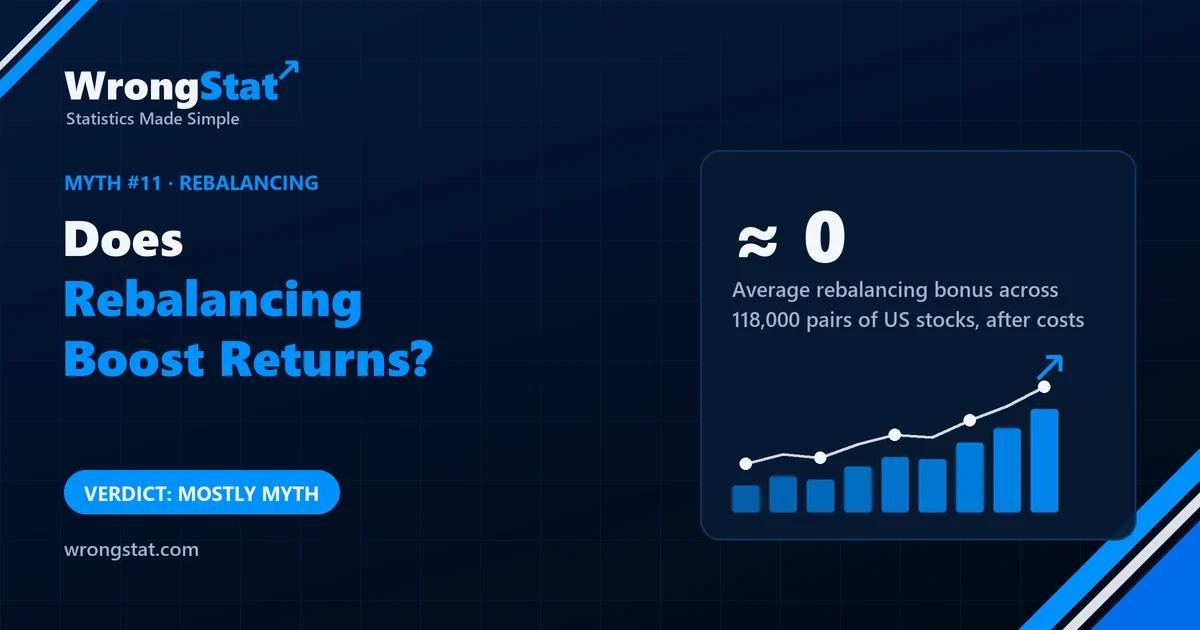
Verdict: mostly myth. A rebalancing bonus exists, but across about 118,000 pairs of US stocks it averaged zero after costs. The 1,000 pairs a formula picked as best earned 1.6 to 2.3 points a year more than holding them in 2021 to 2026, and 0.6 points or less in 2013 to 2020, when they also trailed simply owning every stock equally by about 5 points a year. We found no reliable edge; that's not proof that rebalancing can never help.
Aunt Linda owns exactly two stocks, half and half. On the first of every month she sells a bit of whichever went up and buys a bit of whichever went down, to get back to 50/50. She read that this "harvests volatility" and earns a "rebalancing bonus".
Uncle Gary says she's selling her winners to buy her losers, which is what he does too, only by accident. Linda would like to know which of them is right. So we counted.
The idea behind the bonus
If two stocks bounce around a lot and don't move together, rebalancing sells a little high and buys a little low, over and over. In theory that adds a small amount of growth compared with just holding both. The theory even says how much to expect: roughly an eighth of how much the two stocks' moves differ from each other, measured as variance. The more volatile and the less related the pair, the bigger the promised bonus.
That's a nice thing to test, because the formula makes a prediction before you look at the results.
What we tested
- The pairs: 486 US stocks make about 118,000 possible pairs. Every pair held 50/50.
- Rebalancing: back to 50/50 every day, every week, every month or every quarter (1, 5, 21 or 63 trading days), after trading costs on everything bought and sold.
- The comparison: the same two stocks bought once and simply held. That's the fairest test of rebalancing itself. We also compared with owning all 486 stocks equally and with the S&P 500.
- Two periods: the formula picked the 1,000 most promising pairs using 2013 to 2020, and we checked them on 2021 to 2026. Then we did it the other way round. A rule should work in data it hasn't seen.
Result one: across all pairs, nothing
Over all 118,000 pairs, rebalancing earned between 0.06 points a year less and exactly the same as holding the pair. No free lunch.
There's a twist. The typical (median) pair did gain about 0.5 to 0.6 points a year from rebalancing. The average was dragged back to zero by the pairs where one stock went to the moon: rebalancing kept selling it, and missed most of the ride. Rebalancing trims your winners. Usually that's harmless; occasionally it's expensive.
Result two: the best-looking pairs, in two different periods
| Top 1,000 pairs, tested on | Bonus over holding the pair | Rebalanced pairs, per year | All stocks equally, per year |
|---|---|---|---|
| 2021-2026 (picked on 2013-2020) | +1.6 to +2.3 points | 20.3% | 14.5% (S&P 500: 14.0%) |
| 2013-2020 (picked on 2021-2026) | +0.6 to -0.06 points | 12.9% | 18.1% |
In the later period the bonus looked real and the rebalanced pairs beat everything. But that period happened to reward very volatile stocks: just holding the same pairs, with no rebalancing at all, made 18.1% a year, well above the S&P 500. Most of the win came from owning volatile stocks in a good time for them, not from rebalancing.
In the earlier period the bonus shrank to 0.6 points with daily or weekly rebalancing, 0.15 with monthly and slightly below zero with quarterly. And the rebalanced pairs made 12.9% a year while simply owning every stock equally made 18.1%: about 5 points a year worse than doing nothing clever.
The formula's predictions also barely matched what happened: the link between the bonus it promised and the bonus that arrived was weak (a rank correlation of 0.05 to 0.18).
Top 1,000 rebalanced pairs vs simple alternatives, per year
Why the "1,000 pairs" are fewer than they look
The formula loves volatile stocks, so the same few kept turning up. The top 1,000 pairs shared only 330 of the 486 stocks, and a handful of very jumpy ones dominated. A thousand pairs built from a few dozen stocks behave like a few dozen bets, not a thousand. That's why a statistical test that treats them as independent made the result look much more certain than it is.
Statistics for noobs: a formula is a prediction, so test the prediction
When a theory tells you in advance which cases should work best, you get a free check: rank the cases by the theory, then see whether the ranking holds in new data. Here the ranking held weakly in one period and hardly at all in the other. A theory that is true in principle can still be too small to matter after costs.
And always ask what the winners have in common. If they all share one trait, such as high volatility, the test may be measuring that trait, not the strategy.
The moral
Linda is right that rebalancing does something. Gary is right that it means selling the winner. Both were looking for a bonus, and the bonus turned out to be roughly the size of the argument about it. Linda has decided to keep rebalancing for a different reason: it stops her checking the prices every day. That benefit we didn't measure, and it may be the biggest one.
Every test on this site is judged against simple alternatives. This one met two: holding the same pair, which rebalancing barely beat, and owning everything equally, which it lost to in one of the two periods.
What this test can't tell you
- Pairs only. We tested two stocks at 50/50. Rebalancing a broad portfolio of ten or more holdings, or of stocks against bonds, wasn't tested here.
- Returns only. Rebalancing is often used to keep risk steady. We measured growth, not risk.
- US stocks listed today, which brings survivorship bias: companies that disappeared are missing, which flatters buy and hold.
- Two periods. The result flipped between them; a third might look different again.
- Absence of evidence. "No reliable edge in our test" isn't proof that rebalancing never helps.
Simulations on historical data, not real trades. Daily prices of 486 US stocks listed today, 2013 to 2026, with trading costs on every rebalance. Historical results do not guarantee future returns. This is educational content, not financial advice.