Corporate life · Murphy's laws
The 90-90 Rule: Why '90% Done' Means Two-Thirds of the Way There
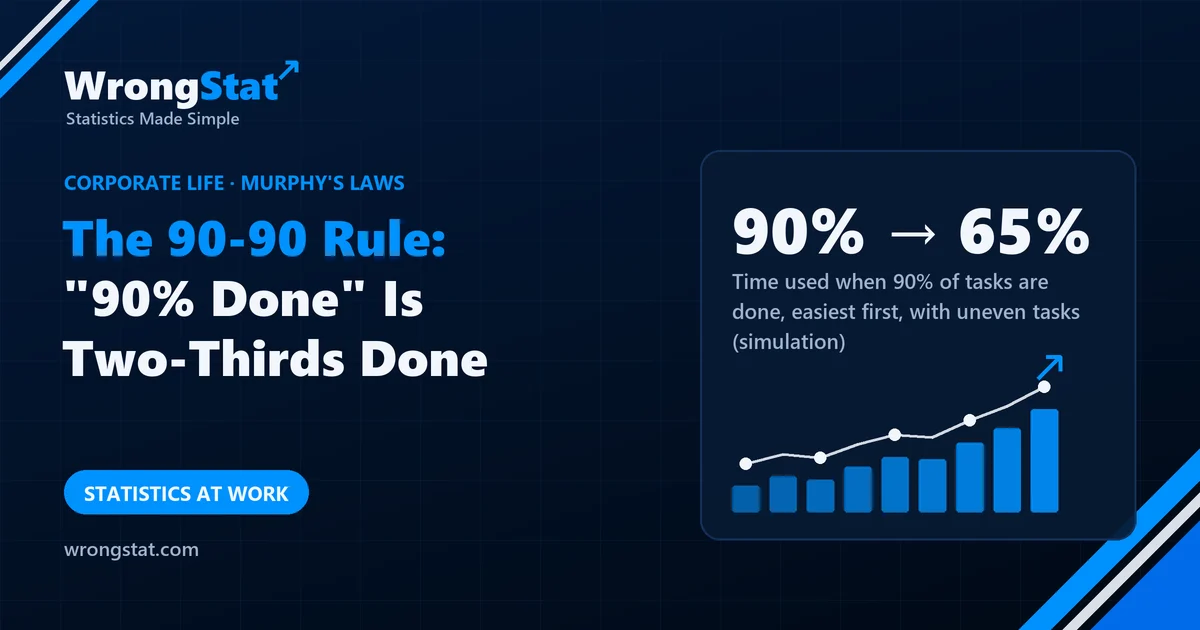
The short version: '90% done' usually counts tasks, and tasks aren't equal. When task lengths are lopsided and people do the easy ones first, the last few tasks hold most of the remaining work. In our simulation of 20 tasks with skewed lengths, done shortest-first, half the tasks were finished after 17% of the time and 90% of tasks after 65%; the final two tasks took 35% of the total and the last one alone 22%. Progress measured by count overstates progress measured by effort. Ask what's left, not how much is done.
Week 6 of the migration project. Status: 90% done. Week 8: 90% done. Week 11: "basically done, just the last bit". The last bit is the payments integration, which nobody wanted to start, which is why it was left until last.
Kevin's boss has asked why a project that was 90% done two months ago is still not finished. The project manager has asked the same question, in a different tone.
The rule
The 90-90 rule is credited to Tom Cargill, an engineer at Bell Labs, and was made famous by a 1985 column on programming: the first 90% of the code accounts for the first 90% of the development time; the remaining 10% of the code accounts for the other 90% of the development time. That adds up to 180%, which is the joke, and also the experience of most people who have reported "90% done".
Where the 90% comes from
Two things combine. Task lengths are lopsided: most are short, a few are long. That's a skewness in the distribution. And people pick the short, easy tasks first, because they're quick, satisfying and look good in the status report. We simulated 20 tasks with skewed lengths, done in order from shortest to longest:
| Tasks done | Share of the total time used |
|---|---|
| 5 of 20 (25%) | 5% |
| 10 of 20 (50%) | 17% |
| 15 of 20 (75%) | 40% |
| 18 of 20 (90%) | 65% |
| 19 of 20 (95%) | 78% |
At "90% done", a third of the work is still ahead, and the very last task alone takes about 22% of the whole project. If the tasks were done in random order instead, 90% of tasks would mean about 90% of the time. The count is honest; it's measuring the wrong thing.
Share of total time used, by share of tasks done (easiest first)
A better status report
- Report what's left, in effort. "Two tasks left, estimated at 5 weeks" says far more than "90% done".
- Do a hard task early. Starting the scariest piece first reveals the real size of the project while there's time to react.
- Weight by size. If you must give a percentage, weight tasks by their estimated effort, not by count.
Statistics for noobs: counting isn't measuring
A share of items is only a share of the total if the items are similar. With skewed sizes, a few big items dominate: 90% of the tasks can be 65% of the work, just as 80% of customers can be 20% of revenue. Before trusting a percentage, ask: percent of what?
Where it costs you money
"I've sold 90% of my losing positions" can mean you've sold the small ones and kept the big one. A portfolio review that counts holdings rather than weighting by size can hide where the risk really is.
The moral
The migration finished in week 15. The project manager presented a "lessons learned" slide recommending that next time the payments integration be started first. The slide was approved. The next project's plan, circulated last week, has the payments integration as the final task, marked "simple, half a day".
What this model can't tell you
- Our task lengths are a model. We used a common skewed (log-normal) shape; real projects can be more or less lopsided.
- Teams don't always pick the shortest task first. The effect is smaller if they don't, and absent if tasks are similar.
- The rule is a joke. It adds up to 180% on purpose; the serious point is about how progress is measured.
The migration and the project manager are an illustration. The 90-90 rule is attributed to Tom Cargill and was popularised in Jon Bentley's programming column in Communications of the ACM (1985). The figures come from our own simulation of 200,000 projects of 20 tasks with log-normal lengths, done shortest-first. Educational content, not business or financial advice.