Is the Peter Principle True? What 53,035 Salespeople Showed
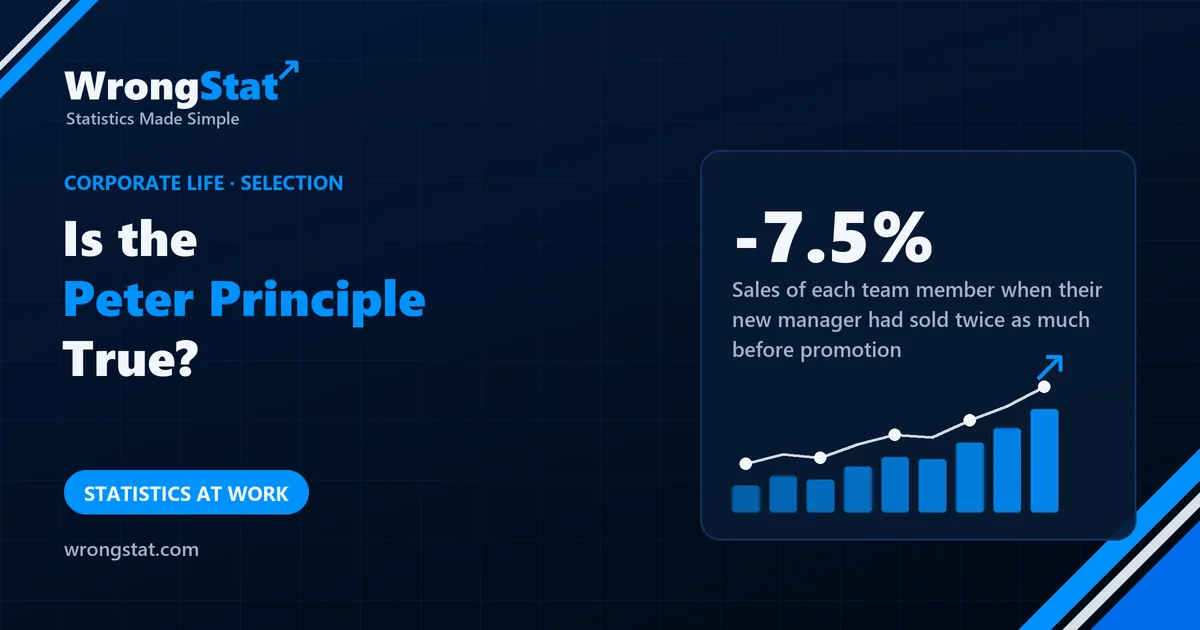
The short version: in a study of 53,035 sales workers at 214 US firms, the best sellers were the most likely to be promoted to manager, and the best sellers then made worse managers. Doubling a worker's sales raised their chance of promotion by 14% but, among those promoted, went with 7.5% lower sales for each person on their new team. Experience of working with colleagues predicted good managers better, and was barely rewarded. The firms aren't necessarily stupid: promotion is also a prize. But as a way of finding managers, it measures the wrong thing.
Report from sales. For three years running, Dave sold more than anyone on the floor. Management did the obvious thing and made him sales manager. Dave is now responsible for eight people and sells nothing himself.
Six months later, his team's sales are down. Dave works longer hours than ever. Mostly he redoes his team's deals himself, which is what he is good at, and which is no longer his job.
Cousin Kevin, who sits next to the team, says this has a name. He is right. It has had a name since 1969.
What the Peter principle says
The idea comes from a satirical book published in 1969: people are promoted for doing their current job well, so they keep rising until they reach a job they do badly. There they stop, because nobody gets promoted for doing a job badly. Given enough time, every post is filled by someone who isn't good at it.
For decades this was a joke that everyone recognised and nobody had measured. Measuring it is hard, because you need two numbers for the same person: how good they were before promotion, and how good they were after it, in a job that asks for different skills.
The test: salespeople
Sales is one of the few jobs where both numbers exist. Economists obtained data from software that companies use to calculate sales commissions: 214 US firms, 53,035 sales workers and 1,531 of them promoted to manager, between 2005 and 2011. A worker's performance is their sales compared with colleagues in the same company and month. A manager's performance is how much the sales of the people on their team change when they start working for that manager.
| What the data showed | Result |
|---|---|
| A worker doubles their sales: chance of promotion | up 14.3% (relative to the usual chance) |
| A new manager had sold twice as much before promotion: sales of each person on their team | down 7.5% |
| Experience of sharing deals with colleagues | predicted better managers, not consistently rewarded |
| Promoting purely on predicted management skill | managers about 30% better (model estimate) |
Doubling your sales sounds dramatic but isn't rare: in this data it's the difference between the middle of the company (50th percentile) and the 67th percentile. So the pattern applies to ordinary good salespeople, not only to legends like Dave.
Why it happens: one measurement, two jobs
The company wants to know who would be a good manager. That number doesn't exist yet. What it does have is a very precise number for who is a good salesperson, so it uses that. The statistical mistake is choosing on a measurement that predicts the old job very well and the new job poorly, or, in this data, slightly in reverse.
An obvious objection is luck. The year's best seller is partly the year's luckiest seller, and luck doesn't come with them to the new job, which is regression to the mean. The researchers checked this, and also whether the best sellers simply turned promotions down. Neither explained the result.
Statistics for noobs: selecting on the wrong variable
Whenever you choose people or things by a score, ask what the score actually predicts. A typing speed test picks fast typists, not good writers. Last year's sales pick last year's best seller, not next year's best manager. The more precisely you measure the wrong thing, the more confidently you choose the wrong person.
The fix is to measure something closer to the new job: in this study, experience of working with colleagues on shared deals.
Where it costs you money
The investment version: a star analyst who picked great stocks gets a fund to run, which also needs risk management, position sizing and the nerve to sit through losses. A strategy that worked brilliantly in one kind of market gets more money just as the market changes. Past success at one task is weak evidence of success at a different one.
The moral
The researchers point out that companies may know all this and do it anyway: promotion is the prize that keeps every salesperson trying, and losing some management quality may be the price. Kevin's company found a different solution. Dave has been moved to a new role, Head of Sales Excellence, with no team. His sales are the best they have been in a year. His old team is now managed by their second-best seller, who was promoted last week, for reasons nobody needed to explain.
What this study can't tell you
- One kind of job. Sales, mostly business-to-business, in the US. Other jobs may reward different skills in managers.
- Not an experiment. Promotions weren't random. The researchers used statistical methods to correct for who gets promoted, but these rely on assumptions.
- Manager quality is one number. It measures the team's sales, not training, morale or keeping good people (the researchers found no sign that top sellers did better on keeping staff).
- Not every top performer. It's an average pattern; some top sellers become excellent managers.
Dave, Kevin and the sales floor are an illustration. The figures come from the study's working paper (National Bureau of Economic Research, 2018), published in the Quarterly Journal of Economics in 2019; the published version may report slightly different sample sizes. Educational content, not career, legal or financial advice.