Do 90% of Startups Fail? It Depends What You Count
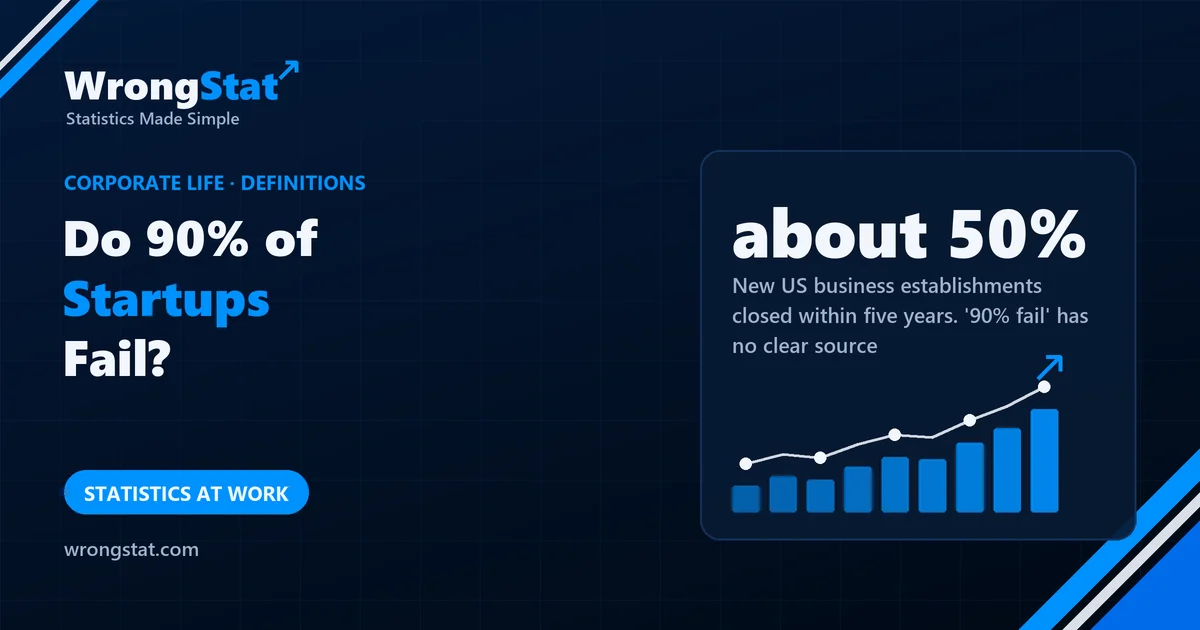
The short version: there's no reliable source for 90%. US government data on new business establishments show about 20% closing within their first year, about half within five years and about two-thirds within ten. Among startups funded by venture capital, a Harvard study estimated that about three in four never return their investors' money. Closing isn't always failing either: some owners sell or move on. 'How many fail' needs three definitions before it means anything: which businesses, what counts as failure, and over how many years.
Kevin's friend is leaving the company to start a business. At his leaving drinks, Kevin's boss raised a glass: "Good luck! Of course, 90% of startups fail." Everyone laughed. The friend didn't.
Later, Kevin looked for the source of the 90%. He found it quoted thousands of times, always confidently, never with a study.
Three questions behind one number
- Which businesses? Every new café and plumber, or only tech companies backed by investors hoping for a huge exit?
- What counts as failure? Closing down? Losing money? Not making the investors rich? A business that closes because the owner retires or sells it hasn't necessarily failed.
- Over how long? One year? Five? Ten? Almost every business closes eventually, so "how many fail" without a time limit tends towards 100%.
What the official data say
The US Bureau of Labor Statistics tracks every new business establishment with employees and records how many are still open years later. The pattern has been fairly stable for decades:
| Years after opening | Share closed (roughly) |
|---|---|
| 1 | about 20% |
| 5 | about 50% |
| 10 | about 65% |
That's a survival rate curve: the share still alive at each age. It falls fastest at the start and slower later, because the businesses that make it through the first years are, on average, sturdier.
Where something like 90% might come from
For venture-backed startups, the bar is higher: investors need a big return, not survival. A Harvard researcher who studied such companies estimated that about three in four never returned investors' money. Count "didn't become a big success" as failure, and the share rises further. So a figure like 90% can be true for one definition, in one corner of the economy, and wrong as a statement about "startups" in general.
Statistics for noobs: define before you count
Many famous percentages hide a definition. "Half of marriages end in divorce", "90% of startups fail", "most diets don't work": each depends on who's counted, what counts as the outcome and over what period. When you meet a round, confident number, ask for those three things. If nobody can give them, the number is decoration.
Where it costs you money
Fund performance has the same trap. "Most funds fail to beat the market" depends on the period, the benchmark and whether closed funds are counted, and closed funds are usually the worst ones. Ask whether the figure includes the ones that disappeared.
The moral
Kevin emailed his friend the official figures: about a 50% chance of still being open in five years, better if he survived the first two. The friend printed the table and stuck it above his desk. His business is now three years old. Kevin's boss's department was closed in a reorganisation last spring, after two years.
What this can't tell you
- Rounded figures. The shares vary a little by year and industry; the ones here are the typical pattern.
- Establishments, not companies. The official data count business locations with employees; a firm with several sites, or a one-person business, is counted differently.
- Closing isn't the only failure. A business can survive for years while barely paying its owner. Survival rates don't measure that.
Kevin, his friend and the leaving drinks are an illustration. The survival figures come from the US Bureau of Labor Statistics' Business Employment Dynamics data, rounded; the venture capital estimate comes from a Harvard Business School researcher, as reported in 2012. Educational content, not business or financial advice.