Corporate life · Murphy's laws
Brooks's Law: Why Adding People to a Late Project Makes It Later
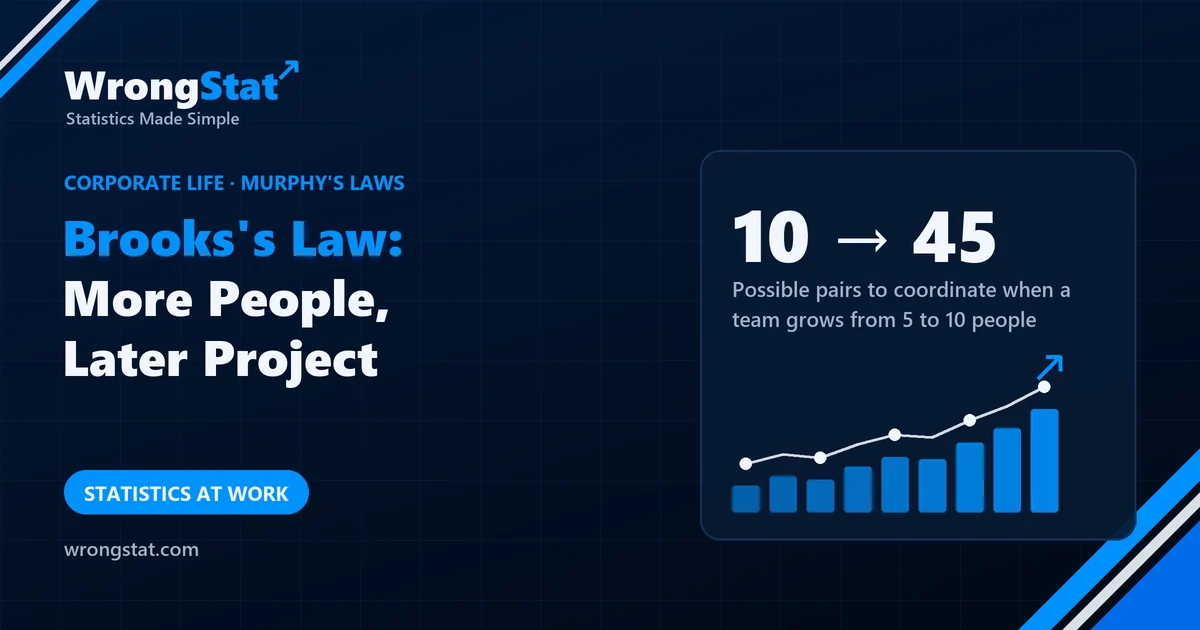
The short version: the number of pairs of people who may need to coordinate grows much faster than the number of people. A team of n has n × (n - 1) ÷ 2 possible pairs: 5 people have 10, 10 people have 45, 20 people have 190. Fred Brooks, writing in 1975 about IBM's huge OS/360 software project, observed that adding people to a late software project makes it later: newcomers need training, the work can't always be split, and coordination grows with the pairs. His famous line: bearing a child takes nine months, no matter how many women are assigned.
The new system is three months late. Five developers are working on it. The boss has done the maths: twice the people, half the time. Five more developers start on Monday.
By Friday, the original five have spent the week explaining the system to the new five. The project is now three months and one week late. The boss has requested five more.
Brooks's law
Fred Brooks managed the development of OS/360, one of the largest software projects of the 1960s at IBM. In 1975 he wrote a book about what he'd learned, The Mythical Man-Month, and in it the line that became his law: adding manpower to a late software project makes it later. His explanation: bearing a child takes nine months, no matter how many women are assigned. Some work can be split between people; some can't.
The counting part
Every pair of people on a team is a possible line of communication: someone who might need to check, ask, agree or wait. The number of pairs from n people is n × (n - 1) ÷ 2, which is a count of combinations:
| People on the team | Possible pairs to coordinate |
|---|---|
| 3 | 3 |
| 5 | 10 |
| 10 | 45 |
| 20 | 190 |
| 50 | 1,225 |
Doubling the team from 5 to 10 doubles the hands but more than quadruples the pairs. Not every pair talks, but meetings, emails and "quick syncs" tend to grow with the pairs, not with the people.
Possible pairs who may need to coordinate, by team size
The other two parts
- Ramp-up. New people aren't productive on day one, and the people training them aren't productive while they do it. Early on, a bigger team can deliver less.
- Indivisible work. Some tasks are sequential: design before build, build before test. More people don't make a chain shorter.
Brooks's law is a rule of thumb, not a theorem. Adding people early, to work that splits cleanly, can help. Adding them late, to tangled work, usually doesn't.
Statistics for noobs: pairs grow faster than people
Whenever something depends on pairs (handshakes, connections, possible conflicts, matches to compare), it grows roughly with the square of the number of items. Ten people have 45 pairs; a hundred have 4,950. That's why big groups need structure: smaller teams with clear interfaces keep the number of connections manageable.
Where it costs you money
Holding 40 stocks means 780 pairs whose relationships matter for risk. Adding more holdings doesn't add diversification in proportion; past a point it mostly adds complexity. Fewer, clearly understood positions, or a simple index fund, often do the same job with far fewer connections to watch.
The moral
The team reached 15. The project delivered four months late instead of three. The boss presented this as a success, because without the extra people "it would have been even later", which nobody could check. Kevin has calculated that the team now has 105 pairs and 11 recurring meetings, including one to decide which meetings to cancel.
What this can't tell you
- Pairs are potential, not actual. Well-organised teams don't need every pair to talk; structure can keep real coordination far below the maximum.
- Brooks wrote about software. Other kinds of work split more or less easily.
- Not a measured constant. The law is an experienced manager's observation, supported by much later experience, not an exact formula for delay.
The project, the boss and the meetings are an illustration. Brooks's law and the nine-months line come from Fred Brooks's book The Mythical Man-Month (1975). The pair counts are simple arithmetic. Educational content, not business or financial advice.