Corporate life · Vivid examples
Are Successful Founders Young? What 2.7 Million Founders Showed
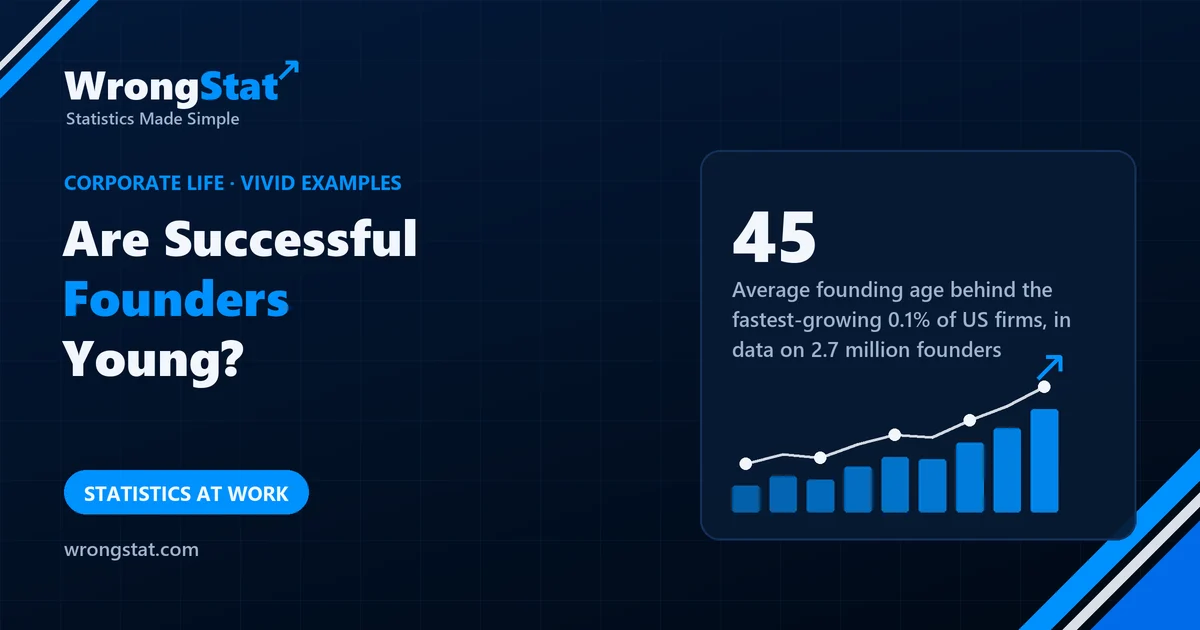
The short version: no. Data on about 2.7 million people who founded US companies between 2007 and 2014 show an average founding age of 41.9, and 45.0 among founders of the fastest-growing 0.1% of firms. A 50-year-old founder was about 1.8 times as likely as a 30-year-old to start one of those. The young-founder image comes from a handful of famous names, which are memorable precisely because they're unusual. Judging by the examples that come to mind easily is the availability heuristic.
Kevin's company has launched an internal startup programme. The brochure shows a hoodie, a laptop and the line: "The next big thing won't come from someone who's been doing this for 20 years." Applications are open to employees under 30.
Kevin's colleague Darren is 52 and has had three ideas this year that the company later bought from other people. He has been asked to mentor the applicants.
Where the image comes from
Think of a famous founder and you probably picture someone who started in a dorm room or a garage, in their late teens or twenties. Those stories are told again and again, in films, magazine covers and lists of young people to watch. They're true, and they're exceptions, and that's why they're memorable.
Judging how common something is by how easily examples come to mind is called the availability heuristic. Famous examples are a terrible sample: they were picked for being remarkable, not for being typical.
The full list
In 2020 a team of economists, working with the US Census Bureau, looked at every founder they could identify: about 2.7 million people who started companies with employees between 2007 and 2014, linked to tax and employment records. They could see how fast each firm grew, so they didn't have to rely on who became famous.
| Group | Average age at founding |
|---|---|
| All founders | 41.9 |
| Founders of the fastest-growing 0.1% of firms | 45.0 |
The chances of building a top firm rose with age well into middle age. A 50-year-old founder was about 1.8 times as likely to reach the top 0.1% of growth as a 30-year-old. The researchers found the same pattern in technology and in other industries, and they also found that prior work experience in the same industry made success much more likely.
Why the famous cases mislead
There are far more middle-aged founders than famous young ones, and most of them run successful companies nobody writes films about. A few young founders became globally famous, which makes them easy to recall, which makes them feel typical. The story is built from the most visible tip of a very large group.
Statistics for noobs: count, don't recall
When you catch yourself saying "they're always..." or "you never see...", check whether you're counting or remembering. Memory keeps the dramatic cases and drops the ordinary ones. The fix is boring and reliable: find the full list, or at least a list that wasn't chosen for being interesting, and look at the base rate.
Where it costs you money
Investors remember the stock that went up a hundredfold and the friend who called it. The thousands of similar stocks that went nowhere don't come to mind. Strategies built on memorable winners ignore all of those, which is why every test on this site counts every trade, not the famous ones.
The moral
The startup programme produced four ideas, all apps for ordering lunch. Darren, mentoring, pointed out that the company already has a canteen. His own proposal, which needed his 30 years of contacts in the industry, was ineligible. He has since left to start it, at 52, which according to the data is a reasonable age to try.
What this study can't tell you
- US firms with employees. One-person businesses and other countries aren't covered.
- Growth isn't everything. The study measured growth in employment and sales; other kinds of success may look different.
- Averages, not individuals. Young founders do sometimes build huge companies; they're just not the typical case.
The startup programme and Darren are an illustration. The figures come from a study of US founders using Census Bureau data (American Economic Review: Insights, 2020). Educational content, not business, career or financial advice.